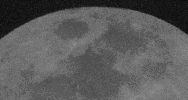
ZZ-ZZ-ZZ-FM-TLP-Lunar_Impact.gifLunar Impact?263 visiteUno splendido TLP ripreso "in diretta" e poi montato su questo interessantissimo GIF-Movie: un "flash", un lampo improvviso si accende sulla Superficie Lunare nelle immediate prossimità del Cratere "Gauss".
Gli Scienziati sono unanimi: è l'evidenza oggettiva di un Meteor Strike. Un impatto, insomma, tra un bolide di dimensioni irrisorie (quanto un pallone da calcio, più o meno) e la Superficie della Luna.
Certo, viaggiando a quasi 50000 Km orari, anche un "pallone da calcio", all'atto di urtare contro una superficie solida e massiccia, arriva a possedere un quantum di energia cinetica tale da consentire l'espressione di un lampo luminoso ma...Siamo davvero CERTI (al 100% intendiamo) che i "lampi lunari" sìano SOLO e SEMPRE le evidenze di impatti?
Pensiamoci sopra...MareKromiumSet 05, 2009
|
|
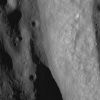
LRO-0007-375109main_lroc_20090730_burgcrater_full.jpgInside Bürg Crater67 visiteBürg is a 40-Km (about 25 miles) diameter, Copernican-aged, complex crater located within Lacus Mortis (the Lake of Death), on the Near-Side of the Moon.
Complex craters, like this one, have terraced walls and a Central Peak (not shown here). The Rim of the crater is along the right side and the walls slope down towards the left of the image.
The terrace is about 3,5 Km (about 2,2 miles) wide and is pockmarked with smaller craters. Terraces form as sections of the Crater wall slump downward after the impact (image width: about 7,9 Km across, roughly 4,9 miles).
Note that there are very few impact craters on the wall of the Crater. Usually fewer craters indicate a surface is younger, however in this case it's simply that material slides down the crater wall's steep slopes, erasing craters.
Note also that LROC, LRO's camera, is powerful enough to see a shadow cast by a boulder about 8 mt wide (about 26 feet) at the contact between the wall and the terrace near the top of the figure.MareKromiumAgo 13, 2009
|
|
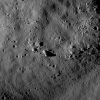
LRO-0008-376470main_tsiol438_lr_area.jpgTsiolkovskiy Crater73 visiteThe Far-Side Crater Tsiolkovskiy is one of the most spectacular and unique geologic features on the Moon.
Identified in the first image of the Far-Side, and named after visionary space pioneer Konstantin Tsiolkovskiy, Tsiolkovskiy Crater (185 Km diameter) has a an irregular (meaning: non-circular) shape, a Central Peak, and is completely filled with mare basalt.
Many geological and geomorphological features can be seen within and around the Crater, making this a particularly interesting place on the Moon to work and study.MareKromiumAgo 13, 2009
|
|

Q-APOLLO_17_AS_17-M-1518.jpgAPOLLO 17 AS 17-M-R29-1518 - Ina104 visiteThe so-called "Conventional Wisdom! says the Moon is dead, BUT "Conventional Wisdom" may also - and often - be wrong.
In the journal "Nature" (Nov. 9th, 2006), a team of scientists led by Prof. Peter Schultz of Brown University announced evidence for fresh geologic activity on the Moon. Although lunar volcanism was supposed to have ceased billions of years ago, there's at least one place on the Moon where "outgassing" may have happened within the past 10 million years - and may still be happening today (Schultz, Staid and Pieters, Nature, 444, 184).
The site is a strange-looking geological feature named "Ina" in Lacus Felicitatis, a lake of ancient, hardened lava located at lunar coordinates of about 19° North Lat. and 5° East Long.
"Ina was first noticed by Apollo Astronauts" says Schultz. Pictured right, "it's shaped like a letter D about two kilometers wide".
Three things about Ina point to recent activity:
1) Ina has mysteriously sharp edges. "Something that razor sharp shouldn't stay around long. It ought to be destroyed within 50 million years" says Schultz. The destroyer of sharp edges on the Moon is a constant rain of small meteoroids that wear down mountains and craters to a nub, given time. Ina's sharp features suggest great youth.
2) Ina is sparsely cratered. While small meteoroids sandblast the terrain into smoothness, larger meteoroids and asteroids make craters. The older the surface, the more heavily cratered it becomes. "Ina is almost devoid of craters" notes Schultz. "We found only two clear impact craters larger than 30 meters on the 8 square kilometers of the structure’s floor". Again, Ina appears young.
3) Ina is bright and has odd colors. Rocks and dirt on the surface of the Moon grow darker as time passes. The darkening agent is space weather: a nonstop rain of cosmic rays, solar radiation and meteoroids hit the Moon and darken the ground. (The mechanisms - a.k.a.: "Space Weathering" - are too detailed to discuss here, but the effect is mostly uncontroversial)
Ina, however, is bright, as if fresh dirt has been overturned and newly exposed. Furthermore, the colors of Ina, measured by a spectrometer on the Clementine Spacecraft, are similar to the colors of the Moon's youngest craters. Yet Ina is not an impact crater.
It all adds up to outgassing: "We believe there has been a rapid release of gasses, blowing off surface deposits and exposing less weathered materials" explains Schultz. This is not necessarily a sign of active volcanism. "The appearance of the surface at Ina does not indicate an explosive release of magma, which would create visible rays of ejecta surrounding a central crater".
Instead, the gasses may have been trapped below ground for millions or billions of years and released by, say, a recent moonquake. This interpretation is appealing because Ina is located at the intersection of two linear valleys or rilles - like many geologically active areas on Earth.
"Over the years" he adds, "amateur astronomers have reported puffs or flashes of light coming from the Moon's surface". While many professional astronomers insisted the moon was inactive, the amateur sightings kept open a window of doubt. Schultz thinks it's time to start looking in earnest: "A coordinated observation campaign, including both professional and amateur astronomers, would be one way to build additional evidence for activity. A gas release itself would not be visible for more than a second or so, but the dust it kicked up might stay suspended for 30". With modern alert networks, that's long enough to move a professional telescope into position to see what's happening."
There may be plenty of targets to monitor. The researchers have identified at least four features similar to Ina associated with the same system of rilles, as well as others in neighboring rille systems.
Could these gases actually prove useful to future lunar explorers? Schultz thinks so. "CO2 and even H2O could be coming out of these vents. But first" he cautions, "we have to find out if the outgassing is real - and what the gases are". This makes Ina an intriguing site for future exploration by robots and people.
Says Schultz, "the Moon may not be so dead after all".MareKromiumAgo 04, 2009
|
|

Panoramic-AS14-66-9285-9292.jpgFrom AS 14-66-9285 until 9292 (EVA-1; Up-Sun with the Blue Flare)66 visitenessun commentoMareKromiumAgo 02, 2009
|
|

Panoramic-AS14-64-9078-9084.jpgFrom AS 14-64-9078 until 9084 (EVA-2; Station B1 - Up-Sun)57 visitenessun commentoMareKromiumAgo 02, 2009
|
|

Panoramic-AS14-64-9099-9108.jpgFrom AS 14-64-9099 until 9108 (EVA-2; Station C1, Saddle Rock and the Rim of Cone Crater)59 visitenessun commentoMareKromiumAgo 02, 2009
|
|

ZZ-ZZ-ZZ-ZZ-APOLLO_11-LANDING_SITE-000.jpgThe Eagle has Landed: Apollo 11 Landing Site (from orbit - edited)97 visitenessun commentoMareKromiumLug 24, 2009
|
|





