| |

| Ultimi arrivi - MOON |

APOLLO_14_AS_14_70-9835-6-7_H.jpgAS 14-70-9835 - 9836 - 9837 - Just an Image-Artifact? (Image-Mosaic; credits: Dr M. Faccin)140 visitenessun commentoMareKromiumFeb 02, 2010
|
|

APOLLO_15_-_AS_15-86-11571_HR-3D1-MF-LXTT.jpgAS 15-86-11571 - Extremely Anomalous "Mercury-like" Material discovered on a medium-sized Boulder (credits: Dr M. Faccin - Lunexit Team)101 visiteMareKromiumGen 19, 2010
|
|

APOLLO_15_-_AS_15-86-11571_HR-3D2-MF-LXTT.jpgAS 15-86-11571 - Extremely Anomalous "Mercury-like" Material discovered on a medium-sized Boulder (credits: Dr M. Faccin - Lunexit Team)141 visiteMareKromiumGen 19, 2010
|
|
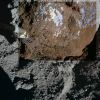
APOLLO_15_-_AS_15-86-11571_HR-MF-LXTT.jpgAS 15-86-11571 - Extremely Anomalous "Mercury-like" Material discovered on a medium-sized Boulder (credits: Dr M. Faccin - Lunexit Team)125 visiteMareKromiumGen 19, 2010
|
|

APOLLO_14_-_AS_14-70-9835-9837-MF.gifReflections? (GIF-Movie; credits: Dr M. Faccin)128 visiteDa guardare, e da "metabolizzare". Non ci sono risposte, però: solo domande.MareKromiumGen 17, 2010
|
|

LRO-1015-Lunar-Plume.jpgAfter the Impact: the "Plume"106 visiteDa "NASA - Picture of the Day" del giorno 18 Novembre 2009:"In October 2009, the LCROSS Mission crashed a large impactor into a permanently shadowed crater near the Lunar South Pole and a "Plume" (---> pennacchio) of dust rose enough to be visible by the LRO, although hard to discern from Earth.
The Plume in question is now shown in this frame - taken in Visible Light.
The results of a preliminary chemical analysis gave a clear indication that such a Dust Plume contained water, and water is of high importance not only for understanding the history of the Moon, but also as a possible reservoir for future astronauts trying to live on the Moon for long periods.
The source of the Lunar Water is still a topic of debate (water could have been carried by many small meteorites, or a comet, or - maybe - it was an inborn component of the Primordial Moon Soil").MareKromiumNov 18, 2009
|
|

LRO-2000-eAGLE-WestCrater-00.jpgThe Lunar Module "Eagle", from LRO (CTX Frame - credits: NASA)87 visite...Due immagini (questa e l'EDM che segue) ASSOLUTAMENTE FANTASTICHE e da guardare, a nostro parere, non solo con Deferenza e grande Rispetto, ma anche dedicando, nel contempo, un pensiero ed una preghiara a coloro che, per realizzare questo Sogno, sono morti e poi sono anche stati - in larga misura - dimenticati (e NON ci riferiamo solamente agli Astronauti Americani, ma a TUTTI i Cosmonauti USA ed URSS i quali, negli Anni d'Oro della "Moon Quest" e poi in seguito, arrivando ai nostri giorni, hanno inseguito un Sogno ed hanno obbedito agli ordini, sino a compiere l'Estremo Sacrificio).MareKromiumNov 11, 2009
|
|

LRO-2000-eAGLE-WestCrater-01.jpgThe Lunar Module "Eagle", from LRO (EDM - credits: NASA)109 visiteIl dettaglio magnificato del Descent Stage del Modulo Lunare "Eagle", il quale portò sulla Luna gli Astronauti Armstrong ed Aldrin, nel Luglio del 1969.
I "Complottisti", a questo punto, dovrebbero essere stati "serviti", non credete?
Ma è già totalmente ovvio quello che gli irriducibili detrattori della più GRANDE Avventura Umana e Scientifica mai compiuta nella Storia dell'Umanità ci diranno adesso...
Che cosa? Semplice: che ANCHE questi frames sono "tarocchi"...MareKromiumNov 11, 2009
|
|

Kaguya-034-Haruyama2009Fig2_edm.jpgWindow onto an abyss: Cave Skylight on the Moon! (EDM)112 visitenessun commentoMareKromiumOtt 23, 2009
|
|

Kaguya-033-Haruyama2009Fig1_context.jpgWindow onto an abyss: Cave Skylight on the Moon! (CTX Frame)86 visiteSu segnalazione della nostra sempre attentissima Amica e Partner, Elisabetta Bonora (alias "2di7"), la recente possibile scoperta di un Collapse Pit situato sulla nostra Luna, nella Regione dell'Oceano delle Tempeste (Oceanus Procellarum) ed in prossimità del complesso collinare noto come "Marius Hills".
Eccovi l'interessante articolo scritto al riguardo da Emily Lakdawalla (Planetary Society):"This just in: researchers on JAXA's Kaguya Lunar Orbiter have discovered an open pit on the Moon that is likely a window onto a sublunar world -- a skylight into a subsurface cavern.
Junichi Haruyama, Kazuyuki Hioki, Motomaro Shirao, Tomokatsu Morota, Harald Hiesinger, Carolyn van der Bogert, Hideaki Miyamoto, Akira Iwasaki, Yasuhiro Yokots, Makiko Ohtake, Tsuneo Matsunaga, Seiichi Hara, Shunsuke Nakanotani, and Carlé Pieters describe the feature in a paper now in press in Geophysical Research Letters: "Possible lunar lava tube skylight observed by SELENE cameras.
"First, some context. The Moon will be a difficult, but not impossible, place to set up a permanent human outpost. Lacking a protective atmosphere, its surface is bathed in punishing solar radiation, not to mention a continuous rain of micrometeorites; and over the course of a lunar day (that is, about a month) its temperature ranges over more than 200 degrees Celsius (more than 450 degrees Fahrenheit). Many workers imagining future human habitation of the Moon have advanced the idea of setting up the colony inside a shelter that would provide some protection from the hazards of space radiation and the challenge of insulating against such extremes of temperature.
Digging such a shelter would be a major engineering project; we could get a head start on things if we could find a natural cave. The Moon doesn't have Earth-type limestone rocks bathed in acidic subsurface water, but there is another type of environment that might produce underground caverns: hollow lava tubes. The Moon once had active volcanic geology that has left its surface carved by numerous "sinuous rilles", some of which may once have been underground lava tubes like the ones that form on the flanks of Kilauea today. But while there are lots of rilles to be seen on the Moon, no one has ever confirmed the presence of an enclosed tube, with an intact roof, that could be used as a shelter. One study did find several possible locations where there were likely intact tubes present next to collapsed tube sections (link takes you to a 1.4 MB PDF of a paper by Cassandra Coombs and Ray Hawke), but could not confirm the presence of intact tubes. There are probably lots of intact tubes, but how to find where they're hidden?
The answer is to look for skylights, black holes in the lunar surface that are openings onto sublunar caverns. Skylights are common on Earth, and they've even been seen on the flanks of Martian volcanoes. But despite decades of searching, no one has ever discovered a lunar skylight.
Until now. Haruyama and his coauthors examined Kaguya Terrain Camera photos of an area on the Moon that is populated by numerous rilles, the volcanic complex of the Marius Hills on the lunar nearside. And their search was rewarded with the discovery of exactly one black hole too deep to be an impact crater. The hole is located at 303.3°E and 14.2°N and is, suggetively, in the middle of a small rille. It is nearly circular, 65 meters in diameter, and is equidistant from the rille walls, 250 meters on either side. Previous missions did not image it at high enough resolution to allow scientists to distinguish it from a small impact crater.
Kaguya imaged it nine times, five with the Terrain Camera and four with the lower-resolution Multi-band Imager, at a wide variety of solar incidence angles and camera look angles. A little trigonometry allowed Haruyama et al. to determine that the hole is 80 to 88 meters deep, with very steep walls. The fact that it's deeper than it is wide means it's definitely not an impact crater. But is it a cave skylight? Its location in the dead center of a rille is suggestive, but volcanic environments have a couple of other ways to make pits, such as volcanic vents. But Haruyama et al. determined that a skylight into an underground lava tube is the most likely explanation for this feature; moreover, they figured out that the cavern should be at least 370 meters wide. That's quite a lot of space to work with!
The team searched for more skylights in the region, but only found this one, and as far as they know, it's the only one anybody has ever spotted on the Moon. They concluded: "This is a potentially important discovery for both studies of lunar volcanology and future human outposts....the Marius Hills region has long been considered an important and accessible exploration target, both scientifically and technically. Indeed, the discovery of the Marius Hills Hole further supports the importance of the Marius Hills region as a future exploration target."
This hole is probably not the place we'd establish a permanent base. I imagine that a place that requires a vertical descent and ascent wouldn't be optimal. You'd probably really want one that you could drive into -- an intact tube next to a collapsed part, like the possible ones identified by Coombs and Hawke, and probably ideally with a North or South-facing opening so it wouldn't get blasted by Sunlight at either end of the Lunar Day. I'm smiling now, because I'm thinking about how far humans have come as a species: we're beginning to expand into space, but we're still doing what our forebears did hundreds of thousands (or more) years ago, looking for a nice cave to establish our hearth in.
I want to thank Carolyn van der Bogert for providing the Kaguya images from this paper. Carolyn is also on the Lunar Reconnaissance Orbiter Camera (LROC) team, and told me that LROC has this site on its list of things yet to photograph on the Moon. She said they'll try to photograph it, as Kaguya did, at a variety of solar incidence angles, to get good looks at both the walls of the pit and the floor it opens onto.
LROC should improve on the resolution of the Kaguya imaging by a factor of more than ten, so I'm looking forward to those photos!MareKromiumOtt 23, 2009
|
|
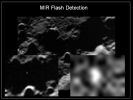
LRO-1010-392933main_LCROSS_5_full.jpgLCROSS impacting the Moon: the "Flash" in MIR Light91 visiteThis Mid-InfraRed (MIR) image was taken in the last minutes of the LCROSS flight mission to the Moon.
The small white spot (enlarged in the insets) seen within the dark shadow of lunar crater walls is the initial flash created by the impact of a spent Centaur upper stage rocket. Traveling at 1,5 mps (miles-per-second), the Centaur rocket hit the Lunar Surface yesterday at 04:31 UT, followed a few minutes later by the shepherding LCROSS Spacecraft.
Earthbound observatories have reported capturing both impacts. But before crashing into the Lunar Surface itself, the LCROSS Spacecraft's instrumentation successfully recorded close-up the details of the rocket stage impact, the resulting crater and debris cloud.
In the coming weeks, data from the challenging mission will be used to search for signs of water in the Lunar Material blasted from the Surface.MareKromiumOtt 10, 2009
|
|

LRO-1011-392970main_LCROSS_9_full.jpgLCROSS impacting the Moon: the "Flash"119 visitenessun commentoMareKromiumOtt 10, 2009
|
|
| 2195 immagini su 183 pagina(e) |
|
|
|
|
|
11 | |
|
|
|
|
|
|





