| Ultimi arrivi - MOON |
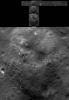
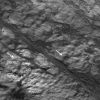
LRO-2500-Epigenes_A_Crater-2.jpgEpigenes A63 visiteAnother example of dark Impact Melt flows channeling through the preexisting material on the Crater Wall.
The white arrow points to the Crater Floor.
(this image is approx. 540 meters wide)MareKromiumFeb 25, 2010
|
|

LRO-2500-Epigenes_A_Crater-3.jpgEpigenes A59 visiteImpact Melt (the dark material) flowed around and over Rocky Outcrops on the upper portion of the Crater Wall.
The white arrow points to the Crater Floor.
The initial outward surge of material during the excavation of the crater threw Impact Melt near the Rim and then gravity pulled the Melt downward during the modification stage of the impact.
(this image is approx. 540 meters wide)MareKromiumFeb 25, 2010
|
|

LRO-2500-Epigenes_A_Crater-1.jpgEpigenes A68 visiteA plethora of Boulders surrounds braided flows of impact melt along the Inner Wall of the Crater Epigenes A. As the melt moves toward the Crater Floor (direction indicated by white arrow), the flow buries and moves boulders.
Epigenes A is an about 18-Km-diameter Impact Crater located at 66,9° North and 0,3° West, on the Rim of crater W. Bond.
(this NAC image is 540 meters wide)MareKromiumFeb 25, 2010
|
|

LRO-2500-Marius_Crater.jpgLandslides or unusual Surface-decoloration in Marius Crater?57 visiteImpact Events, Volcanism, and Tectonism form the majority of features found on the Moon. However, Landslides are an important modifier of the landscape at small scales.
Ultimately, the source of Landslides are Seismic Events triggered by Impacts or movements deep inside the Moon. These shaking events cause poorly consolidated material on steep slopes to slide downhill.
In this case the slide spreads out in a complex of narrow finger-like streamers. What controls this distinctive pattern? The process is controlled by the energy of the shaking, the size of particles in the slide, the steepness of the slope, and volume of the source deposit.
Mars also has many Landslide Deposits, so scientists are using the new LROC data to compare with these martian counterparts.
Marius Crater (approx. 41 Km diameter) is located in Oceanus Procellarum (11,9° North and 50,8° West) and is notable for its mare filled floor (unequivocal evidence that it formed before before the surrounding mare basalts flooded the Region).MareKromiumFeb 25, 2010
|
|

LRO-2500-Saha_E_Crater.jpgThe Floor of Crater "Saha E"54 visiteThe lava-like melt produced by impacts on the Moon can have a variety of morphologies.
The polygonal texture you see here is located on the Floor of Crater Saha E, an approx. 28-Km-diameter Impact Crater located East of Mare Smythii.
This texture could be the result of impact melt coating boulders and other deposits on the Floor of the Crater. From the perspective of exploration planning, impact melt deposits are scientifically interesting because they can be used to age-date impacts. Impact melts can also contain geochemical traces of the original impact, and often contain small fragments of the original pre-impact target rocks. LROC will be providing high-resolution images of many other fresh, relatively undegraded craters to document the complex aftermath of impact events as well as to define targets for future human lunar exploration.MareKromiumFeb 25, 2010
|
|

LRO-2501-Oceanus_Procellarum~0.jpgLunar Landslide in an Unnamed Crater of Oceanus Procellarum (Natural Colors; credits: Dr Paolo C. Fienga - Lunexit Team)63 visitenessun commentoMareKromiumFeb 25, 2010
|
|
LRO-2500-Peary_Crater.jpgPeary Crater and the North Pole of the Moon70 visiteOne day in the not-too-distant future, lunar explorers may spend their winter holidays at the Lunar North Pole.
Peary, an irregularly-shaped Impact Crater centered at 88,5° North Lat. and approx. 30° East Long., could be the place to do just that.
Adjacent to the Lunar North Pole, Peary has areas along its Crater Floor cast in permanent shadow, but it also has areas along its rim that may be permanently illuminated by the Sun. The proximity to the North Pole, possible areas of permanent shadow and light, plus the potential for in-situ resources make Peary crater a challenging and enticing location for future human and robotic exploration.
Peary Crater is one of 50 specific sites being explored by lunar geologists using LROC images for NASA's Constellation Program.MareKromiumFeb 21, 2010
|
|

LRO-2501-Oceanus_Procellarum.jpgLunar Landslide in an Unnamed Crater of Oceanus Procellarum59 visiteA key part of the LROC science investigation is the imaging and analysis of fresh, Copernican-aged Craters (such as Craters younger than 1,1 Billion Years), like this small (6-Km diameter) example at the edge of Oceanus Procellarum, West of Balboa Crater.
The LROC team has seen a variety of landforms related to these important lunar features. For example, a Landslide on the Crater wall partially covers the solidified impact melts on the floor. The Landslide clearly happened after the Crater initially formed; the materials were likely dislodged by seismic shaking from nearby smaller impacts.
These young, fresh craters preserve an vital record of the impact process.
Where does ejecta come from? How much impact melt is produced? How thick is ejecta? What is the importance of self-secondary impacts?
These are only some of the important scientific questions that lunar scientists can address by studying these craters.
As geologic time progresses, the pristine features in fresh craters are worn down by impacts of all sizes. Understanding young craters help geologists piece together the history of ancient degraded craters, an understanding particularly useful for planning future human missions to the Moon. The best way to explore fresh craters like this one, of course, would be with Astronauts.
However, until humans return to the Moon, lunar geologists will analyze images like this for clues, as well as comparing the landforms like the one visible here with other craters on the Moon, Mars, and impact structures on Earth.MareKromiumFeb 21, 2010
|
|

LRO-2502-Mare_Imbrium.jpgMare Imbrium63 visitenessun commentoMareKromiumFeb 21, 2010
|
|

LRO-2503-Mare_Moscoviense.jpgMare - Highlands Boundary in Mare Moscoviense68 visiteMare Moscoviense: a "Window" to the Lunar Far-Side Volcanism
It's clear from looking at pictures of the Moon that the Near-Side and the Far-Side are very different from a geologic standpoint.
The darker, basaltic mare deposits dominate the Near-Side, whereas the Far-Side is dominated by bright deposits of anorthosite thought to be remnants of the Moon's original crust. Mare Moscoviense is one of the few (and also the largest) deposits of mare basalts on the Lunar Far-Side.
Why are there so many mare basalts on the Near-Side, but so few on the Far-Side? Lunar scientists simply don't know the answer to that question. One idea is that the Far-Side crust is simply thicker than the near side crust, and rising basaltic magma simply solidified before it was able to push through the thicker Far-Side crust. That's where Moscoviense comes in. We know enough about the Moscoviense Region from previous missions that we have a well-defined set of questions that potential future missions might be able to answer. For example, the Lunar Prospector mission showed that there are high concentrations of thorium in the Moscoviense Basin. Thorium acts as a tracer for the Lunar KREEP (Potassium - K -, Rare Earth Elements and Phosphorus) geochemical component found in abundance on the Near-Side but not on the Far-Side.
Understanding the extent and distribution of thorium in the basin may tell us about the global distribution of the Lunar KREEP component and thus the evolution of the Lunar Mantle. We also know from the Clementine mission that the Moscoviense basalts are rich in both Iron and Titanium. Since basalts form by partial melting of the Lunar Mantle, sampling Moscoviense basalts provides lunar scientists with vital insights into how the Lunar Mantle on the Far-Side differs from the Near-Side one, which in turn would help us to learn why mare basalts are so much rarer on the Far-Side and provide key insights about the formation of all of the terrestrial planets, including Mars and Earth.
For these reasons, a Constellation Program region of interest is located within Mare Moscoviense. The region is at the edge of Moscoviense, allowing explorers to collect samples from both the mare basalts and the surrounding highlands terrain during their traverses.
The materials at the edge of the basin provide important insights into the formation of the Moscoviense Basin itself. By exploring and sampling the Moscoviense Region, we would date the basalt flows and definitively determine their composition. This sampling would let us determine how Moscoviense basalts differ from the near side basalts sampled during Apollo. Age-dating Moscoviense basalts also provides important insights into the history of lunar volcanism by determining whether the Moscoviense basalts are older or younger than Near-Side basalts.
While the scientific goals of exploring the Moscoviense Region are certainly important, no less important is access to key lunar resources. The lunar regolith (the broken-up rocks and impact products that make up the first 10 meters or so of the Lunar Surface) in this region is derived in part from the local titanium-rich Moscoviense basalts. This regolith material could be used for a variety of vital purposes, including the construction of human habitats, radiation shielding, or as feedstock for local resource utilization.
Taking a longer view, Titanium is an important industrial material on Earth, and it will be very important for indigenous lunar industrial development.MareKromiumFeb 21, 2010
|
|

LRO-2504-Mare_Moscoviense.jpgMare - Highlands Boundary in Mare Moscoviense66 visitenessun commentoMareKromiumFeb 21, 2010
|
|

APOLLO_14_-_AS_14-70-9837-MF.jpgAS 14-70-9837 - Illuminated? (Negative Enhanced View; credits: Dr M. Faccin - Lunexit Team)145 visiteIl titolo che abbiamo deciso di dare a questo frame è, ovviamente, ironico, ma non del tutto improbabile. Perchè? Perchè fra le tantissime Teorie - più o meno stravaganti o credibili - che hanno cercato di spiegare quello che si vede in questo frame (e negli altri due dell'ormai famosissimo "Trittico della Serie AS 14-70") a noi ne è venuta in mente una nuova.
Osservate bene il frame: riuscite a vedere i raggi (del Sole) che generano effetti prismatici in alto e sui lati dell'immagine?
A nostro parere l'Oggetto Sconosciuto potrebbe non essere affatto il riflesso di un particolare interno alla capsula USA, nè un image-artifact, nè un effetto prismatico sui-generis, bensì un Oggetto Reale il quale si è evidenziato solamente in virtù di una favorevole situazione di illuminazione (rectius: in accordo ad un peculiare, se non unico, Angolo di Fase - ivi: Sole-presunto OVNI-Apollo - venutosi a deteminare fra i diversi oggetti coinvolti nell'osservazione).
Il che significa ed implica, sebbene tutto questo Vi potrà sembrare assurdo, che l'Oggetto NON SAREBBE DOVUTO ESSERE (normalmente) VISIBILE, ma lo è diventato (ed è stato quindi fotografato) SOLO grazie alla presenza ed all'effetto dei raggi del Sole su di esso ed alla particolare geometria esistente fra il Sole, esso stesso e la Navicella Apollo.
Dite che è assurdo ed impossibile? Probabilmente avrete anche ragione, ma la "Luminescenza Bianca" - a nostro parere - NON E' un riflesso, nè un artefatto fotografico. E dunque, escluso l'impossibile (riflesso) e l'improbabile (artefatto) che cosa resta, se non la (sempre più incredibile ed elusiva) Verità?
I Vostri commenti saranno apprezzati.MareKromiumFeb 03, 2010
|
|
| 2195 immagini su 183 pagina(e) |
 |
 |
 |
 |
 |
10 |  |
 |
 |
 |
|