| Ultimi arrivi - THE LUNAR EXPLORER ARCHIVES |

Valles_Marineris-MGS.jpgPortion of the Valles Marineris Canyon System (Natural Colors; credits: NASA/MGS/MSSS)107 visitenessun commentoOtt 07, 2004
|
|

Souhern_Emisphere.jpgThe Southern Hemisphere of Mars (Natural Colors; credits: NASA/MGS/MSSS)118 visiteCaption NASA:"The wide angle camera view of Mars shown here was obtained by the Mars Global Surveyor Mars Orbiter Camera in late July 1999, about 1 week before the start of southern Spring. The frosty, retreating south polar cap (white) is seen in the lower quarter of the image and wisps of dust storm clouds (grayish-orange in this view) occur just above the cap at the lower left. The southernmost of the large Tharsis volcanoes, Arsia Mons, is seen at the upper left. Arsia Mons is about 350 Km across".
Ott 07, 2004
|
|

Volcanoes-Olympus_Mons_and_Tharsis_Region.jpgTharsis Region (Natural Colors; credits: NASA/MGS/MSSS)143 visite"Mars Global Surveyor's camera, MOC, provided this hemispheric view of the northern Tharsis region on June 1, 1998. This picture shows the giant volcano, Olympus Mons, and one of the Tharsis Montes volcanoes, Ascraeus Mons. Another volcano, Alba Patera, is lurking under the haze and clouds at the top of the image. Olympus Mons is about 550 Km wide. The terminator - such as the line that divides night and day - was located west of Olympus Mons (left part of the image). It is Winter in the northern hemisphere of Mars and the high latitudes (i.e.: north of Olympus Mons in this picture) exhibit clouds and haze. These clouds most likely contain water ice".
Non possiamo non notare l'enfasi che viene spesso posta, in sede di commento originale alle immagini, sul fatto che le nuvole Marziane "MOLTO PROBABILMENTE" (ossìa "QUASI CERTAMENTE") contengono ACQUA. E allora noi rivolgiamo alla NASA - ancora - la stessa domanda: ma siamo certi che su Marte non piove da qualche milione di anni?
Risposta? Silenzio totale.Ott 07, 2004
|
|

Phobos_from_Mgs-011.jpgMartian Limb and Phobos (Natural Colors; credits: NASA/MGS/MSSS)142 visiteUna spettacolare veduta del bordo ("limb") di Marte e della sua luna "misteriosa", Phobos, la quale costituisce anche uno degli oggetti più "bui" dell'intero Sistema Solare. Ecco il commento originale a questa immagine:
"Phobos is one of the darkest objects in the Solar System. Thus, 4 wide angle images were obtained to make the picture of Phobos over the martian limb: a pair of red and blue wide angle images was acquired for the limb and a pair of separate images were required to see Phobos. The wide angle images illustrate the fact that Phobos is mostly colorless (dark gray); the faint orange/red hue in the wide angle picture is a combination of slight differences in the focal lengths of the blue and red cameras and the orange/red illumination provided by reflection of sunlight off Mars. To a person standing on Phobos, the Red Planet would fill most of the sky". Ott 07, 2004
|
|

Craters-Gusev_Crater-R1300473_474.jpgGusev Crater Landscape from MGS (Extremely Enhanced Natural Colors; credits:NASA/JPL-MSSS)149 visiteSi tratta di un'immagine a colori ad HD semplicemente fantastica, ottenuta dalla Sonda Mars Global Surveyor e relativa (in parte) all'area di lavoro di Spirit. Abbiamo scelto di mostrarVi questo frame per almeno 3 buoni motivi: 1) perchè si tratta di un frame bellissimo; 2) perchè ci fa vedere bene i "colori di Marte" (che, dall'alto, sembrano diversi da quanto ci mostrano le Sonde che stazionano sulla superficie e 3) perchè ci aiuta a cogliere, usando i nostri occhi, la sensazione che proveremmo se ci trovassimo fisicamente su una nave spaziale, in orbita intorno a Marte.Ott 07, 2004
|
|

Red_Giant.jpgRising Red Giant...454 visite"...Ti invito al viaggio - in quel paese che ti somiglia tanto
I soli languidi dei suoi cieli annebbiati -
hanno per il mio spirito, l'incanto - dei tuoi occhi
quando brillano, offuscati..."
(M. Sgalambro - F. Battiato)Set 29, 2004
|
|
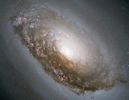
M 64.jpgM 64 (NGC 4826) - Great Spiral Galaxy111 visiteThe "Sleeping Beauty Galaxy" may appear peaceful at first sight but it is actually tossing and turning. In an unexpected twist, recent observations have shown that the gas in the outer regions of this spiral is rotating in the opposite direction from all of the stars! Collisions between gas in the inner and outer regions are creating many hot blue stars and pink emission nebulae. The above image was taken by the Hubble Space Telescope in 2001. The fascinating internal motions of M 64 (also known as NGC 4826), are thought to be the result of a collision between a small galaxy and a large galaxy where the resultant mix has not yet settled down. Set 27, 2004
|
|
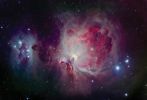
M 42~0.jpgM 42 in real colors172 visiteUna visione ad HD della Grande Nebulosa di Orione: visibile nei nostri cieli invernali anche ad occhio nudo, ma in forma di gran lunga meno spettacolare rispetto a quanto ci è dato vedere in questa ed in altre immagini similari. Ma cos'è che permette alla splendida Grande Nebulosa di Orione di manifestarsi così come noi la vediamo? La "fonte" dello splendore della Nebulosa è dato dal "Trapezio": un gruppo di 4 stelle, le più luminose presenti nella nebulosa. Le strutture a "filamento" che rendono la Nebulosa ancora più suggestiva alla vista sono il prodotto di "onde d'urto" (ovvero di "collisioni" vere e proprie fra elementi pesanti - e che si muovono velocemente nello spazio - con gas stazionari o anch'essi in movimento, ma più lentamente rispetto ai primi). La Grande Nebulosa di Orione si estende nello spazio interstellare per oltre 40 AL e si trova ad una distanza da noi pari a circa 1500 AL, comunque all'interno del medesimo braccio della Via Lattea in cui si trova il nostro Sole (e noi con esso).Set 27, 2004
|
|

South_Polar_Regions-Polygons-PIA05951.jpgThe "Martian Polygons" (Original NASA-MGS-MSSS b/w frame)163 visiteThis Mars Global Surveyor (MGS) Mars Orbiter Camera (MOC) image shows "polygons" patterned ground in the South Polar region near 82.0°S, 90.8°W. Polygons are fairly common at high latitudes in both Martian hemispheres, but they do not occur everywhere. On Earth, features such as these would be good indicators of the presence and freeze-thaw cycles of ground ice. On Mars, the same might (emphasis on "might") also be true. This image covers an area approximately 3 Km across and is illuminated by sunlight from the upper left. Seasonal frost enhances the contrast in the scene; the darkest areas have advanced the farthest in the springtime defrosting process. Set 22, 2004
|
|

Phobos_from_MGS-000.jpgPhobos from Mars Global Surveyor (1)186 visitePhobos, a quanto pensano gli Scienziati, potrebbe non essere una "luna originale" di Marte. Potrebbe (peraltro verosimilmente) trattarsi di un asteroide 'catturato' da Marte, in epoche remote, mentre transitava nei suoi paraggi. La velocità di rotazione di Phobos è estremamente elevata: questa luna, infatti, completa un'intera orbita intorno a Marte in circa 8 ore. Per quanto attiene, poi, il lato "esteriore" di Phobos, possiamo facilmente notare il grandissimo numero di crateri sulla sue superficie e l'enorme depressione (lo "Stickney Crater") che lo caratterizza in maniera davvero unica.Set 20, 2004
|
|

M 17.jpgM 17 - The "Omega Nebula" detail mgnf127 visiteIn the depths of the dark clouds of dust and molecular gas known as M 17, stars continue to form. Also known as the Omega Nebula and Horseshoe Nebula, the darkness of M17's molecular clouds results from background starlight being absorbed by thick filaments of carbon-based smoke-sized dust. As bright massive stars form, they produce intense and energetic light that slowly boils away the dark shroud. Colors in the above image were picked to highlight specific elements that emit nebular light: red indicates emission from sulfur, green from hydrogen, and blue from oxygen. The Swan Nebula is visible with binoculars towards the constellation of Sagittarius, lies 5000 LY away, and spans 20 LY across. Set 20, 2004
|
|

M 42.jpgM 42 in different colors182 visiteUna suggestiva combinazione di immagini ottenute con 3 filtri distinti, ciascuno capace di registrare una diversa linea di emissione: Zolfo (S), Ossigeno (O2) e Idrogeno (H). A bassa densità (ovvero nelle condizioni esistenti all'interno della Grande Nebulosa di Orione), S ed H emettono luce rossa mentre l'O2 emette luce verde. Per distinguerli bene nell'immagine, tuttavia, allo Zolfo è stato - in sede di sviluppo finale - assegnato il rosso, all'Idrogeno il verde ed all'Ossigeno il blu.
Il risultato, sebbene la colorazione finale NON sia "realistica", appare comunque non solo utile a fini della ricerca e dell'esatta mappatura dei gas presenti nella Nebulosa, ma anche molto suggestivo.
Set 19, 2004
|
|
| 3220 immagini su 269 pagina(e) |
 |
|
|
|
|
|
|
|
267 | |
|





