| Ultimi arrivi - THE LUNAR EXPLORER ARCHIVES |

Earth_and_Moon_from_Mars-01.jpg"Us", from Mars (EDM)103 visitevedi il commento al frame precedenteNov 10, 2004
|
|

Earth_and_Moon_from_Mars-00.jpgEarth and Moon from Mars104 visiteCaption originale:"This is the first image of Earth ever taken from another planet that actually shows our home as a planetary disk. Because Earth and the Moon are closer to the Sun than Mars, they exhibit phases, just as the Moon, Venus, and Mercury do when viewed from Earth. As seen from Mars by MGS on 8 May 2003, Earth and the Moon appeared in the evening sky. The MOC Earth/Moon image has been specially processed to allow both Earth (with an apparent magnitude of -2.5) and the much darker Moon (with an apparent magnitude of +0.9) to be visible together. The bright area at the top of the image of Earth is cloud cover over central and eastern North America. Below that, a darker area includes Central America and the Gulf of Mexico. The bright feature near the center-right of the crescent Earth consists of clouds over northern South America. The image also shows the Earth-facing hemisphere of the Moon, since the Moon was on the far side of Earth as viewed from Mars.The slightly lighter tone of the lower portion of the image of the Moon results from the large and conspicuous ray system associated with the crater Tycho.Nov 10, 2004
|
|

Martian_Limb-MGS-E23-00100_limb-01.jpgMartian Limb, Clouds, Haze and Outer Space (Original NASA/MGS/MSSS b/w Frame)134 visiteCaption originale:"Mars Global Surveyor orbits the Red Planet 12 times each day. Half of each orbit is spent on the day side of Mars, which is where most Mars Orbiter Camera images are obtained because sunlight is required to illuminate the Surfaces being observed. However, on the night side of Mars, the wide angle cameras can see clouds and hazes above the sunward Martian Limb. This blue wide angle camera image, obtained on the night side of Mars on May 15, 2003, shows Clouds picking up the first sunlight before dawn near 55° North Latitude. The scene is illuminated by sunlight from the right. The Sun is actually on the other side of the Planet and has not yet risen over this Region. The dark area on the left side of the picture is the Martian Surface at night. The dark band on the right side is Outer Space. The bright features just right of center are the Clouds hanging above the Martian Limb over Mars' Northern Plains. North is up and the Spacecraft was moving Southward when the image was acquired".Nov 10, 2004
|
|

Martian_Limb-MGS-E23-00100_limb-00.jpgMartian Limb and Outer Space (Original NASA/MGS/MSSS b/w Frame)174 visitecaption originale: "The Mars Global Surveyor (MGS) Mars Orbiter Camera (MOC) red and blue wide angle cameras provide daily coverage of the Red Planet "from Limb to Limb." The "Limbs" are the edges of the Planet as seen to the West and East of the spacecraft. Depending on weather conditions, Clouds or Haze can sometimes be seen above the Limb. This picture was taken by the blue camera in December 2002. It is an oblique view looking Westward across heavily Cratered Terrain at High Southern Latitudes. A thin line of Haze, high in the Martian Atmosphere, can be seen above the Planet's Surface. The view of Craters in the foreground is enhanced by the presence of bright, winter-time CO2 Frost. The darkness above the Limb is outer space".Nov 10, 2004
|
|

Martian_Mountains-MGS-02.jpgCharitum Montes (Natural Colors; credits: NASA/MGS/MSSS)159 visitenessun commentoNov 10, 2004
|
|

Martian_Mountains-MGS-01.jpgCharitum Montes (Natural Colors; credits: NASA/MGS/MSSS)142 visiteCaption originale: "This is a perspective view of the Charitum Montes, the Mountain Range that bounds Southern Argyre Planitia, created by combining red and blue Mars Global Surveyor (MGS) Mars Orbiter Camera (MOC) wide angle images with topography from the MGS Mars Orbiter Laser Altimeter (MOLA). Carbon dioxide frost coats some of the hills, craters, and mountainsides in this southern springtime image. The picture is located near 57° South Lat. and 43°West Long. North is toward the top, South toward the bottom. Sunlight illuminates the scene from the upper left. The area shown is about 355 Km. A smaller portion of this image was previously released in July 2003 as "Frosty Mountains." Nov 10, 2004
|
|

Craters-Newton_Crater-03.jpgNewton Crater's Gullies (Original NASA/MGS/MSSS b/w Frame)203 visiteDa "NASA - Picture of the Day" del 26.6.2000:"...Inside a small crater that lies inside large Newton Crater on Mars, numerous narrow channels run from the top down to the crater floor. The above picture covers a region spanning about 3000 meters across. These and other gullies have been found on Mars in recent HR pictures taken by the orbiting Mars Global Surveyor robot spacecraft. Similar channels on Earth are formed by flowing water, but on Mars the temperature is normally too cold and the atmosphere too thin to sustain liquid water. Nevertheless, many scientists now hypothesize that liquid water did burst out here from underground Mars, eroded the gullies and pooled at the bottom as it froze and evaporated. If so, life-sustaining ice and water might exist even today below the Martian surface (...)". L'idea che ci sia acqua allo stato liquido sotto la superficie di Marte non è nuova, anzi: la NASA stessa lo ipotizzava 4 anni fa. Oggi, dopo mesi di esplorazione "in loco", tutto tace. Forse un ripensamento?Ott 30, 2004
|
|

Craters-Galle_Crater-Happy_Face_Crater-MGS-2.jpgGalle Crater (Saturated Natural Colors; credits: NASA/MGS/MSSS)115 visiteIl nome che è stato dato al cratere qui ripreso dal Mars Global Surveyor spiega già tutto: da questa angolazione, infatti, si potrebbe dire che un dotato burlone sia andato a disegnare un bel "viso sorridente" sulla superficie di Marte. Ovviamente si tratta di un semplice effetto ottico determinato dalla particolare prospettiva in cui si trovava la Sonda rispetto al cratere nel momento della ripresa.
Eppure - credeteci! - c'è stato qualcuno che ha pensato che questa "Faccia Felice" fosse un altro degli enigmatici "Monumenti di Marte", dopo la Sfinge e le Piramidi di Cydonia Mensae.Ott 18, 2004
|
|

SN-1987A-Starfield_-_HST_(dtl).jpgSupernova 1987A - HST213 visiteDa NASA - Picture of the Day del 9-02-1999: "Bright stars don't last forever. A bright star similar to others in this field exploded in a spectacular supernova that was witnessed on Earth in 1987. The result is visible even today as unusual rings and glowing gas. The above picture is a composite of recent images taken over several years. The explosion originated from a bright massive star that ran out of nuclear fuel. SN1987A occurred in the Large Magellanic Cloud (LMC), a satellite galaxy only 150.000 LY from our Milky Way Galaxy. The rings of SN1987A are currently excited by light from the initial explosion. Astronomers expect the inner ring to brighten in the next few years as expanding supernova debris overtakes it".Ott 18, 2004
|
|
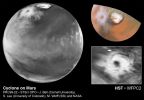
Mars-9a.jpgCyclone!161 visiteNASA - Picture of the Day del 20 Maggio 1999:"Late last month (April 1999) a team of Mars-watching astronomers sighted an immense cyclonic storm system raging near the (...) North Pole. Their discovery picture, made with the HST on April 27, is seen at left while the projected insets (right) show closeups of the storm and surrounding areas. Shrunken to its martian midsummer state, Mars' north polar cap appears at the top of the picture and (...) it is clearly smaller than the storm just below it and farther left. Similar to the "spiral storms" detected on Mars over 20 years ago by the Viking spacecraft, this storm was marked by a system of swirling bright water-ice clouds instead of the billowing dust of a more typical martian wind storm. Measuring roughly 1.600 Km across (...) it was comparable in size to cyclones seen in planet Earth's polar regions. The storm (...) may have had a lifetime of only a few days". Commento: ma come si fa a dire che su Marte non piove da qualche milione di anni?!?!?!Ott 18, 2004
|
|

M 84.jpgM 84 - Galactic nucleus and... a Black Hole?72 visiteIs this "almost artistic graph" the signature of a supermassive Black Hole in the center of distant galaxy M 84 (based on data recorded by Hubble's new Space Telescope Imaging Spectrograph (STIS)?. The presence of a Black Hole can also be revealed by watching matter fall into it.
In fact, material spiraling into a Black Hole would find its speed increasing at a drastic rate. These extreme velocity increases provide what we call a 'signature' of the Black Hole's presence. The STIS data show that radiation from approaching gas, shifted to blue wavelengths left of the centerline, is suddenly redshifted to the right of center indicating a rapidly rotating disk of material near the galactic nucleus. The resulting sharp S-shape is effectively the signature of a Black Hole estimated to contain at least 300 million solar masses. Now the question is: do all galaxies have central Black Holes? And, if "Yes", then "Why"?Ott 14, 2004
|
|

ORIGINAL NASA APOLLO 17 - AS17-148-22727.jpgAPOLLO 17 AS 17-148-22727 - The Earth from Space (Extra High Definition)2444 visiteUn'immagine bellissima del nostro Pianeta, ripresa durante il viaggio di ritorno a casa dell'Apollo 17.
Ed una curiosità, segnalataci dall'Amico Enzo Caparrelli di Pordenone (ancora un "bravo" per il colpo d'occhio dimostrato!): l'immagine della Terra che state guadando ritrae il nostro Pianeta mentre "si specchia"!
Che cosa intendiamo dire? Che il dettaglio maggiore del Globo che possiamo vedere in questo frame (il "Corno d'Africa") appare 'rovesciato'!
La fotografia, insomma, è stata stampata nella sua versione 'speculare'. Errore umano o tentativo di attrarre la nostra attenzione su qualcosa di particolare? Noi optiamo per il semplice 'errore umano', come disse il supercomputer HAL-9000 (da "2001 - A Space Odyssey") quando gli venne riferita una discordanza di risultati (interpretazioni?) fra quanto diceva lui, a proposito di un problema con l'elemento AE-35 (l'antenna dell'astronave Discovery), e quanto invece asseriva il suo 'Gemello Terrestre".
Però HAL-9000 si stava sbagliando...Ott 11, 2004
|
|
| 3220 immagini su 269 pagina(e) |
 |
|
|
|
|
263 | |
|
|
|
|





