| Ultimi arrivi - THE LUNAR EXPLORER ARCHIVES |

Craters-Lomonosov_Crater.jpgLomonosov Crater in Wintertime105 visiteCaption NASA originale:"On April 20, 2000 (Wintertime on Mars), the Mars Orbiter Camera (MOC) onboard Mars Global Surveyor (MGS) captured this view of a chilly Lomonosov Crater. The rims of the crater appear white because they are covered with wintertime frost. A dark patch just right of center on the crater floor is a sand dune field. Both low-lying ground fogs (fuzzy, patchy areas around the lower perimeter of the crater) and higher cloud layers (fuzzy white arcs seen within the crater and towards the upper right) obscure much of the surface. The Sun, only 12° above the horizon, bathes the scene in a reddish-brown hue. Lomonosov Crater is about 150 Km (93 mi) across and located on the martian northern plains at 64.8° N, 8.8° W. The crater is named for the 18th Century Russian chemist, Mikhail V. Lomonosov (1711-1765)".Gen 07, 2005
|
|

Craters-Newton_Crater-00-39S_166W_30.jpgGullies inside Newton Crater - Terra Sirenum (Natural Colors; credits: NASA/MGS/MSSS)110 visiteCaption NASA originale:"Both pictures show gullies (gully--->plur.: gullies: "gole" o "crepacci scoscesi") on the walls of two different meteor impact craters that occur in Newton Basin in Sirenum Terra, Mars. This picture, showing gullies in a crater at 42.4°S, 158.2°W, exhibits patches (patch-->geol.: "placche" o "macchie") of wintertime frost on the crater wall and dark-toned sand dunes on the floor. Its resolution is 1,5 meters (5 feet) per pixel - objects the size of school buses can be resolved in the full size image. The gullies in these craters originate at a specific layer and may have formed by release of groundwater to the martian surface in geologically recent times".Gen 07, 2005
|
|

Craters-Newton_Crater-01-42S_158W_30.jpgGullies inside Newton Crater - Terra Sirenum (Natural Colors; credits: NASA/MGS/MSSS)117 visiteCaption NASA originale:"This picture shows gullies in a crater at 39.0°S, 166.1°W and it is one of the highest-resolution images ever obtained from Mars. Also in this case the resolution is 1,5 meters (5 feet) per pixel".Gen 07, 2005
|
|

Craters-Unnamed_Crater_in_Noachis_Terra-PIA07202_modest.jpgUnnamed Crater in Noachis Terra (Original NASA/MGS/MSSS b/w Frame)89 visiteCaption NASA originale: "This Mars Global Surveyor (MGS) Mars Orbiter Camera (MOC) image shows an impact crater, a little over 2 Km (> 1,2 mi) in diameter, located in Noachis Terra near 50.4°S, 14.3°W. The crater's bouldery ejecta blanket has protected underlying material from being eroded away by wind, leaving the ejecta up on a low pedestal. This picture covers an area about 3 km (1.9 mi) across, and is illuminated by sunlight from the upper left".Gen 07, 2005
|
|

Dunes-PIA07152-00.jpgDark Dunes and Yardangs inside Herschel Crater (Original NASA/MGS/MSSS b/w Frame)98 visiteImmagine ripresa dal Mars Global Surveyor (MGS) Mars Orbiter Camera (MOC) che ci mostra Dune di colore scuro, scolpite dal vento, che giacciono sul fondo del Cratere Herschel. La superficie di queste Dune sembra caratterizzarsi per il fatto che ci appaiono - anche da una notevole distanza... - consistenti fessure scavate al loro interno. Questo sta a significare che la sabbia che le forma NON è semplicemente "accatastata" (ma, granuloscopicamente parlando, "libera"), così come accade per la maggior parte delle Dune Terrestri! Questo fenomeno ci dice che la sabbia di queste Dune Marziane è "cementata e compatta", simile a roccia (fragile, ma pur sempre roccia), e l'azione costante dei venti, nel tempo, ha creato, su queste sabbie "indurite", delle particolari "aree erose" che sono conosciute come Yardangs. L'immagine copre un'area di circa 3 Km (1,9 miglia) la quale si trova vicino ai 15,6° di Latitudine Sud ed ai 229,0° di Longitudine Ovest. Il Sole illumina la scena dalla Sn, in alto.Gen 05, 2005
|
|

North_Polar_Features-Chasma_Boreale-PIA07195-00-PCF-LXTT.jpgFeatures of Chasma Boreale (Original NASA/MGS/MSSS b/w Frame) 104 visiteCaption NASA originale:"This Mars Global Surveyor (MGS) Mars Orbiter Camera (MOC) image shows dark Sand Dunes in the North Polar Region of Mars. They are streaming away (toward the left) from a low escarpment at the edge of an outlier of Polar Water Ice (the bright area on the right). The picture covers an area about 3 Km (1.9 mi) wide and is located near 80,7° North Lat. and 80,2° West Long.. Sunlight illuminates the scene from the lower left". Gen 05, 2005
|
|
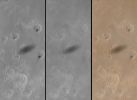
Martian_Eclipse-moc2_msss_3shadow100-01.jpgMOC Views of Martian Solar Eclipses (Original NASA/MGS/MSSS - Natural Color Frame)147 visiteThis picture shows wide angle red (left), blue (middle) and color composite (right) views of the shadow of Phobos (elliptical feature at center of each frame) as it was cast upon western Xanthe Terra on August 26, 1999, at about 2 p.m. local time on Mars. The image covers an area about 250 Km (155 miles) across and is illuminated from the left. The meandering Nanedi Valles is visible in the lower right corner of the scene. Note the dark spots on three crater floors - these appear dark in the red camera image (left) but are barely distingished in the blue image (middle), while the shadow is dark in both images. The spots on the crater floors are probably small fields of dark sand dunes.Gen 01, 2005
|
|

Martian_Eclipse-moc2_msss_3shadow100-00.jpgMOC Views of Martian Solar Eclipses (Original NASA/MGS/MSSS b/w Frame)116 visiteThe shadow of the martian moon, Phobos, has been captured in many recent wide angle camera views of the red planet obtained by the Mars Global Surveyor (MGS) Mars Orbiter Camera (MOC). Designed to monitor changes in weather and surface conditions, the wide angle cameras are also proving to be a good way to spot the frequent solar eclipses caused by the passage of Phobos between Mars and the Sun.This picture shows three samples of MOC's global image swaths, each in this case with a shadow of Phobos visible (arrow). The first scene (left) was taken on September 1, 1999 and shows the shadow of Phobos cast upon southern Elysium Planitia. The large crater with dark markings on its floor at the lower right corner is Herschel Basin. The second scene shows the shadow of Phobos cast upon northern Lunae Planum on September 8, 1999. Kasei Valles dominates the upper right and the deep chasms of Valles Marineris dominate the lower third of the September 8 image. The picture on the right shows the shadow of Phobos near the giant volcano, Olympus Mons (upper left), on September 25, 1999. Three other major volcanoes are visible from lower-center (Arsia Mons) and right-center (Pavonis Mons) to upper-middle-right (Ascraeus Mons).Gen 01, 2005
|
|

Craters-Crater_Cluster-Meridiani_Planum-PIA07151_modest-00.jpgCrater Cluster in Meridiani Planum (Original NASA/MGS/MSSS b/w Frame)130 visiteUna piccola porzione di Meridiani Planum, caratterizzata da un grande ed antico cratere (in alto) e da una moltitudine di crateri più piccoli che tanto ci ricordano il Cratere Endurance. certo, sarebbe bello andare a dare un'occhiata a questo strano paesaggio dal basso ma...Opportunity è troppo lontana e, in questa zona, quasi certamente, non ci arriverà mai.
Ma poi, in fondo, chissà...Dic 29, 2004
|
|

Imagination-PIA07096_modest.jpgAnother Sun, another Time, another Place...155 visite"...Principio invento, facile est augere reliquum..."
(Aristotele)
"...Trovato l'inizio (di una qualsiasi opera), è facile completare tutto il resto..."Dic 11, 2004
|
|

Phobos-Phobos_Monolith-00.jpgThe "Phobos' Monolith" (CTX Frame)306 visitenessun commentoNov 15, 2004
|
|
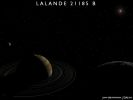
Lalande Solar System.jpgLalande 21185 and a possible extra-solar system165 visiteThe closest extrasolar planetary system could be made by the planets of the dim red dwarf star known as Lalande 21185: only 8 LY distant! This star is too faint to be seen by the naked eye and its planets have never been imaged directly but their presence is inferred by a long series of telescopic observations, tracking the star as it wiggles and wobbles in mutual gravitational response to the masses of its orbiting planets. University of Pitsburgh astronomer George Gatewood recently announced that much of Lalande 21185's wobble is most likely due to an unseen planet with approximately 90% of the mass of Jupiter and an orbital period of 5.8 years. His work also indicates that a second and possibly third planet of similar mass could well be present in the system. Nov 14, 2004
|
|
| 3220 immagini su 269 pagina(e) |
 |
|
|
|
|
262 | |
|
|
|
|





