| Ultimi arrivi - THE LUNAR EXPLORER ARCHIVES |

Aeolian_Features-DD_and_Dust_Storms-2003_06_02-00.jpgDust Storms and Dust Devils between Syria Planum and Claritas Fossae (Enhanced Natural Colors; credits: NASA/MGS/MSSS)100 visiteCaption NASA originale:"This color-enhanced composite of Mars Global Surveyor (MGS) Mars Orbiter Camera (MOC) wide angle images shows dust-raising events (small dust "storms" and a few very large dust devils) in the Syria/Claritas Region around 2 p.m. MLT on May 21, 2003. The Region is southwest of the Labyrinthus Noctis, near 14°S, 108°W. Sunlight illuminates the scene from the left; winds were blowing from the west/southwest when the picture was taken. This composite was constructed from a full-resolution (240 meters per pixel) red wide angle image and a much lower resolution (7,5 Km per pixel) blue wide angle image acquired at the same time".Feb 21, 2005
|
|

Craters-Galle_Crater-Happy_Face_Crater-2003_05_15_M2300366.jpgGalle Crater (Natural Colors; credits: NASA/MGS/MSSS)93 visiteCaption NASA originale:"The 2 pictures shown here are taken from the same daily global image mosaic (the only difference is that each was processed slightly differently). The pictures show Galle Crater, informally known as "Happy Face," as it appeared in early Southern Winter. The white-ish gray surfaces are coated with wintertime carbon dioxide frost. The pattern of frost distribution gives the appearance that "Happy Face" has opened its mouth. Galle Crater is located on the east rim of Argyre Planitia at 51°S, 31°W. Sunlight illuminates the scene from the upper left. Galle Crater is about 230 Km (143 mi) across".Feb 21, 2005
|
|

North_Polar_Features-Polygons-PIA07354-0.jpgNorth Polar "Polygons" (Original NASA/MGS/MSSS b/w Frame)77 visiteCaption NASA originale:"This Mars Global Surveyor (MGS) Mars Orbiter Camera (MOC) image shows Polygons formed in ice-rich material in the North Polar Regions of Mars. The bright surfaces in this image are covered by a thin Water Ice Frost".Feb 15, 2005
|
|

Craters-Unnamed_Craters_with_Sedimentary_Rock_Outcrops-PIA07127-00.jpgSedimentary Rocks (Original NASA/MGS/MSSS b/w Frame)91 visiteCaption NASA originale:"Burial and Exhumation of Impact Craters, and their destruction by erosion, are common and repeated themes all over the Surface of Mars. Many Craters in Western Arabia Terra exhibit light-toned, Layered Outcrops of ancient Sedimentary Rock. Like the Sedimentary Rocks explored further to the South in Meridiani Planum by the Opportunity Mars Exploration Rover (MER-B), these "Intracrater Sedimentary Rocks" may have been deposited in water. This MGS-MOC image shows an example of light-toned Sedimentary Rocks outcropping in an Unnamed Crater that is much farther North than most of the similar examples in Western Arabia Terra. This one is located near 36,6° North Lat. and 1,4° West Long. and shows several old Impact Craters in various states of erosion and exhumation from beneath and within the Sedimentary Rock Materials. The image covers an area of approx. 3 Km".Feb 12, 2005
|
|

Channels-Unnamed_Channel_in_Stygis_Catena-PIA07133-00.jpgAncient Riverbed in Stygis Catena (Original NASA/MGS/MSSS b/w Frame)77 visiteCaption NASA originale:"This MGS-MOC image shows a Trough (trough---> canale) in the Stygis Catena Region, East of the Martian Volcano Elysium Mons. The Trough probably formed by collapse (collapse--->geol. "cedimento" del terreno). Large, dark Boulders can be seen on the Trough Floor in this Volcanic Region. The image is located near 24,4° North Lat. and 210,4° West Long. The image covers an area about 3 km (approx. 1,9 mi) wide and sunlight illuminates the scene from the lower left".Feb 12, 2005
|
|
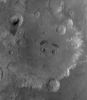
Craters-Tikhonravov_Crater-PIA07196.jpgThe "Eyes" and "Eyebrows" of Tikhonravov Crater (Original NASA/MGS/MSSS b/w Frame)85 visiteCaption NASA originale:"This red wide angle MGS-MOC image shows Tikhonravov Crater in Central Arabia Terra. The Crater is about 386 Km (approx. 240 miles) in diameter and presents two Unnamed Impact Craters at its center that have dark patches of Sand in them, giving the impression of pupils in two eyes. Each of these two Unnamed Craters lies a dark-toned patch of Surface Material, providing the impression of eyebrows.
M. K. Tikhonravov was a leading Russian rocket engineer in the 20th Century. The crater named for him, despite its large size, is still partly buried, on its West Side, beneath the heavily Cratered Terrain of Arabia Terra. The center of Tikhonravov is near 13,5° North Lat. and 324,2° West Long. Sunlight illuminates the scene from the upper left".Feb 12, 2005
|
|

Dunes-Dark_Dunes-Noachis_Terra-PIA07351-00.jpgDark Dunes in Noachis Terra (Original NASA/JPL/MSSS b/w Frame)102 visiteCaption NASA originale:"This MGS-MOC image shows low albedo Sand Dunes on the floor of a crater in Southern Noachis Terra".
Location near: 52.5° South Lat. and 336.9° West Long.
Image width: ~~3.0 Km (~1.9 mi)
Illumination from: upper left
Season: Southern AutumnFeb 12, 2005
|
|

Dunes-Dark_Dunes-Chasma_Boreale-PIA07350-00.jpgDark Dunes in Chasma Boreale (Original NASA/JPL/MSSS b/w Frame)110 visiteCaption NASA originale:" This MGS-MOC image shows Dark Sand Dunes overlying an eroded, layered substrate in Chasma Boreale, amid the materials of the Martian North Polar Cap.
Location near: 84,5° North Lat. and 358,3° West Long.
Image width: ~3,0 Km (~1,9 mi)
Illumination from: lower left
Season: Northern Summer".Feb 12, 2005
|
|

Craters-Unnamed_Crater-MGS-PIA06877.jpgUnnamed Crater in Lycus Sulci (Original NASA/MGS/MSSS b/w Frame)96 visiteUn Cratere da impatto Senza Nome giace nell'area immediatamente ad Ovest di Lycus Sulci ed a Nord-Ovest del Monte Olympus. Spettacolare il livello di dettaglio raggiunto nella ripresa delle pareti del Cratere che, nella sua interezza, copre un'area di circa 3 Km quadrati.Feb 08, 2005
|
|

Slope_Streaks-MGS-PIA06846.jpgAs Time Goes By... (Original NASA/MGS/MSSS b/w Frame)101 visiteUn'interessantissimo frame che ci mostra "come passa il tempo" (e come cambiano le cose...) su Marte. La stessa zona (Memnonia region - 5,9° South Lat. and 162,2° West Long.) a distanza di quasi 5 anni. Noi vediamo delle differenze palesi del paesaggio ed altre, per così dire, un pò "più sottili", che richiedono una certa attenzione per essere individuate (ma che sono individuabili!). Provateci anche Voi a trovarle!... Feb 08, 2005
|
|

Volcanic_Features-Pits-Ascraeus_Mons-PIA07313-03.jpgAscraeus Mons' Pit Chain (Original HD NASA/MGS/MSSS b/w Frame)127 visitenessun commentoFeb 01, 2005
|
|

Volcanic_Features-Pits-Ascraeus_Mons-PIA07313-01.jpgAscraeus Mons' Pit Chain (EDM/HD - Absolute Natural Colors; credits for the additional process. and color.: Dr Paolo C. Fienga - Lunexit Team)128 visiteCaption NASA originale:"This Mars Global Surveyor (MGS) Mars Orbiter Camera (MOC) image shows Collapse Pits on the Northern Flank of the giant Tharsis Shield-Volcano, Ascraeus Mons. Details in Rock and Dust are seen when this image is examined at its full, 1,5 meters (5 ft) per pixel resolution. Large, dark Boulders occur on the Floors of some of the Pits, for example. This scene is located near 13,1° North Lat. and 103,1° West Long. The picture covers an area of about 3 Km (such as approx. 1,9 mi) wide". Feb 01, 2005
|
|
| 3220 immagini su 269 pagina(e) |
 |
|
|
|
|
260 | |
|
|
|
|





