| Ultimi arrivi - THE LUNAR EXPLORER ARCHIVES |

North_Polar_Features-North_Polar_Scarp-MGS-01.jpgNorth Polar Panorama (Absolute Natural Colors; credits for the additional process. and color.: Dr Paolo C. Fienga - Lunexit Team)176 visiteCaption NASA originale:"This MGS-MOC image shows a steep slope in the North Polar Region of Mars. The stripes indicate an exposure of layered material; the variations in brightness among the stripes are the result of varying amounts and textures on seasonal Carbon Dioxide (CO2) frost. At the time the image was acquired - such as in June 2006 -, the Carbon Dioxide frost was beginning to sublime way, leaving a variety of different patterns in frost distribution".
Location near: 85,2° North Lat. and 122,7° West Long.
Image width: ~3 Km (~1,9 mi)
Illumination from: lower left
Season: Northern Spring MareKromiumOtt 26, 2011
|
|

Craters-Unnamed_Buried_Craters-MGS-PIA06855-01.jpgUnnamed Buried Craters in Utopia Planitia (Enhanced Absolute Natural Colors; credits for the additional process. and color.: Dr Paolo C. Fienga - Lunexit Team)152 visiteCaption NASA:"This Mars Global Surveyor (MGS) Mars Orbiter Camera (MOC) image shows a cracked Plain in Western Utopia Planitia. The three circular crack patterns indicate the location of three buried Unnamed Impact Craters. These landforms are located near 41,9° North Lat. and 275,9° West Long. The image covers an area approximately 3 km (about 1,9 mi) across. Sunlight illuminates this scene from the lower left".MareKromiumOtt 25, 2011
|
|

Aeolian_Features-Windstreaks-Becquerel_Crater-M0702802-01.jpgWindstreaks inside Becquerel Crater (Natural Colors; credits for the additional process. and color.: Dr Paolo C. Fienga - Lunexit Team)198 visitenessun commentoMareKromiumOtt 25, 2011
|
|

South_Polar_Regions-M0903484-01.jpgFeatures of the South Polar Regions (CTX Frame - Absolute Natural Colors; credits for the additional process. and color.: Dr Paolo C. Fienga - Lunexit Team) 196 visitenessun commentoMareKromiumOtt 22, 2011
|
|

South_Polar_Regions-M0903484-03.jpgFeatures of the South Polar Regions (EDM - Absolute Natural Colors; credits for the additional process. and color.: Dr Paolo C. Fienga - Lunexit Team) 191 visitenessun commentoMareKromiumOtt 22, 2011
|
|

Noachis_Terra-M0705535-01.jpgBizarre-looking Surface Features of Southern Noachis Terra (Absolute Natural Colors; credits for the additional process. and color.: Dr Paolo C. Fienga - Lunexit Team)190 visitenessun commentoMareKromiumOtt 20, 2011
|
|

Dunes-PIA07152-01.jpgDark Dunes and Yardangs inside Herschel Crater (Absolute Natural Colors; credits for the additional process. and color.: Dr Paolo C. Fienga - Lunexit Team)148 visitenessun commentoMareKromiumOtt 20, 2011
|
|

North_Polar_Features-The_Erg-PIA07375.jpgDark Dunes and Frost in the North Polar Erg (Absolute Natural Colors; credits for the additional process. and color.: Dr Paolo C. Fienga - Lunexit Team)159 visiteCaption NASA originale:"This MGS-MOC image shows sand dunes in the North Polar Region of Mars, as they appeared during Northern Summer in December 2004".
Location near: 78.1° North Lat. and 227,2° West Long.
Image width: ~3 Km (~1,9 mi)
Illumination from: upper left
Season: Northern Summer
MareKromiumOtt 20, 2011
|
|

Volcanoes-Olympus-Viking-MGS.gifAs Time Goes By... (a GIF-Movie by Dr Paolo C. Fienga - Lunexit Team)233 visitenessun commentoMareKromiumOtt 17, 2011
|
|

Craters-Unnamed_Crater_in_Terra_Sabaea-02.jpgUnnamed Crater in Terra Sabaea (Absolute Natural Colors; credits for the additional process. and color.: Dr Paolo C. Fienga - Lunexit Team)223 visiteCaption originale:"This MGS-MOC image shows a 1,5 mt (~5 feet) per pixel view of an Impact Crater that is approximately 3 Km (about 9840 ft) in diameter. It is located in South-Western Terra Sabaea".
Location near: 21,9° South Lat. and 338,6° West Long.
Image width: ~3 km (~1,9 mi)
Illumination from: upper left
Season: Southern Summer MareKromiumOtt 16, 2011
|
|
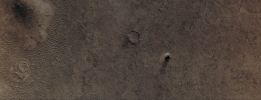
Aeolian_Features-Dust_Devil-MGS-02.jpgRunning Winds... (Absolute Natural Colors; credits for the additional process. and color.: Dr Paolo C. Fienga - Lunexit Team)207 visitenessun commentoMareKromiumOtt 16, 2011
|
|

Dunes-S2200554sub-01.jpgMigrating Dunes (Absolute Natural Colors; credits for the additional process. and color.: Dr Paolo C. Fienga - Lunexit Team))176 visiteCaption NASA originale:"This MGS-MOC image shows a suite of dunes in one of the several North Polar Dune Fields. The bright surfaces adjacent to some of the dunes are patches of frost. These dunes spend much of the Autumn, Winter, and Spring seasons covered with CO2 frost. Only in late Spring and in Summer are the dark windblown sands fully exposed.
Over the course of the 9+ years of the MGS mission, the MOC team has sought evidence that sand dunes may be migrating downwind over time. However, no clear examples of the movement of a whole dune have been identified. On Earth, such movement is typically detectable in air photos of the smallest active dunes over periods of a few years. Owing to the fact that the North Polar Dunes spend much of each Martian Year under a cover of frost, perhaps these move much more slowly than their frost-free, terrestrial counterparts. The sand may also be somewhat cemented by ice or minerals, likewise preventing vigorous dune migration in the present environment.
This view covers an area approximately 3 km (1.9 mi) wide and is illuminated by sunlight from the lower left. The dunes are located near 79.8°N, 127.1°W, and the picture was acquired on 11 September 2006.MareKromiumOtt 15, 2011
|
|
| 3220 immagini su 269 pagina(e) |
 |
|
|
|
|
19 | |
|
|
|
|





