| Ultimi arrivi - THE LUNAR EXPLORER ARCHIVES |
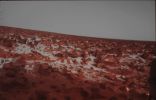
vl2_p21841-3.jpgMorning "frost" over Utopia Planitia - Frame Viking Lander 2 n. p21873 (Enhanced Absolute Natural Colors; credits for the additional process. and color.: Dr Paolo C. Fienga - Lunexit Team)252 visitenessun commentoMareKromiumNov 07, 2011
|
|
![vo1_mg01n104[1]-PCF-LXTT-01.jpg](albums/userpics/10060/small_vo1_mg01n104%5B1%5D-PCF-LXTT-01.jpg "Nome del file=vo1_mg01n104[1]-PCF-LXTT-01.jpg
Dimensione del file=299KiB
Dimensioni=1408x2128
Aggiunta il=Nov 07, 2011")
vo1_mg01n104[1]-PCF-LXTT-01.jpgThe "Tharsis' Montes" (Absolute Natural Colors; credits for the additional process. and color.: Dr Paolo C. Fienga - Lunexit Team)161 visiteThe alignment of the 3 Shield Volcanoes that make up the Tharsis Montes is clearly evident in this view. The 3 Volcanoes are named Ascraeus Mons, Pavonis Mons and Arsia Mons, going from North to South. The 3 Volcanoes are each somewhat smaller than Olympus Mons, varying from about 350 to 450 Km (approx. 210 to 270 mi) in horizontal extent and each rising about 15 Km (approx. 9 miles) above the surrounding Plains.
The Tharsis Montes are located on the crest of a broad uplift of the Martian Crust so that their Summits are at about the same elevation as the Summit of Olympus Mons.
The "Fractures" to the South/East of Pavonis Mons, are known as "Noctis Labyrinthus"; this Region merges with the enormous Valles Marineris Canyon System to the East. The white patches around the lower Flanks of the Volcanoes are thin Clouds that commonly occur near them.MareKromiumNov 07, 2011
|
|

Volcanoes-Olympus_Mons.jpgImage n. 641A52 - Olympus (Enhanced Absolute Natural Colors; credits for the additional process. and color.: Dr Paolo C. Fienga - Lunexit Team) 218 visiteThis image shows the Volcano Olympus Mons. With a diameter of more than 600 Km (approx. the size of Arizona) and a height of nearly 25 Km above the surrounding Plains, Olympus it is the tallest volcano known to exist in the Solar System. When clouds are present, it is sometimes even visible above the clouds.
The relative ages of the Surface in various parts of Mars can be estimated from the number of Impact Craters present in a given area, with young regions having fewer craters than old regions. Only two Craters are visible here, indicating that Olympus Mons is young, probably the youngest Volcanic Feature on Mars. By some estimates, the most recent large volcanic eruption at Olympus Mons occurred only 25 million years ago. The oldest activity at Olympus Mons could be much older than this and would have been buried by younger Lava Flows.
The Caldera of Olympus Mons is the depression near the top center of the image. The Caldera is about 65 × 80 Km across (approx. the size of Rhode Island) and occurs near the maximum elevation of the Volcano. It formed when the Magma within the Volcano either erupted out of Vents located on the side, or temporarily drained deeper into the Planet. In either case, the removal of this Magma allowed part of the overlying Surface to collapse, producing a topographic depression that is termed as "Caldera". The overlapping series of structures in the Olympus Mons Caldera demonstrates that this Magma withdrawal occurred a number of different times.
Similar Calderas are seen on other Volcanos, both on Mars and on Earth.MareKromiumNov 07, 2011
|
|

vo1_00437-01.jpgMosaic P-18114 - Noctis Labyrinthus at Dawn (Absolute Natural Colors; credits for the additional process. and color.: Dr Paolo C. Fienga - Lunexit Team)212 visiteThis image shows Early Morning Fog in the Noctis Labyrinthus Region of Mars, at the Westernmost End of the Valles Marineris Canyon System. This Fog, which is probably composed of Water Ice, is confined primarily to the low-lying Troughs, but occasionally extends over the adjacent Plateau. The Region shown here is about 300 Km across.MareKromiumNov 07, 2011
|
|

South_Polar_Region-PIA08649-1.jpgFeatures of the South Polar Regions (Absolute Natural Colors; credits for the additional process. and color.: Dr Paolo C. Fienga - Lunexit Team)239 visitenessun commentoMareKromiumNov 04, 2011
|
|

Elysium_Planitia-M1103342.jpgFeatures of Elysium Planitia (Absolute Natural Colors; credits for the additional process. and color.: Dr Paolo C. Fienga - Lunexit Team)218 visitenessun commentoMareKromiumNov 04, 2011
|
|

L-Original_Lunar_Orbiter_Frames-LO1-1098-04_med.jpgTAMPERING: Caught in the ACT! (an Image-Mosaic by Dr Paolo C. Fienga - Lunexit Team)326 visiteUn piccolissimo esempio - ma davvero INDISCUTIBILE - di come la NASA (o chi per essa) "tarocchi" i frames e li modifichi a proprio (o altrui, ma non sapremmo dirVi "chi") uso e consumo.
Questo frame LO-1 è una chicca davvero straordinaria e dimostra come la capacità di manipolazione ed alterazione delle immagini maturata dagli Amici di Pasadena abbia raggiunto dei livelli straordinari. Una "Volcanic Vent", infatti, viene - come vedete, alquanto semplicemente... - fatta sparire e di essa non rimane nulla.
Nulla.
Perchè?
Cos'ha di "meritevole di cover-up" una Volcanic Vent?
Nessuno lo sa.
O meglio: qualcuno lo sa, ma non parla.
Nessuno parla.
In compenso, chi si azzarda a definire la NASA, in qualche caso (tipo questo!), come "poco corretta", viene messo in croce.
Ok, va bene. Ma quelli che crocifiggono, evidentemente, non hanno mai visto questo "lavoretto".
Oppure l'hanno visto e l'hanno ignorato.
Dunque, delle tre, l'una:
1) o sono bolsi, oppure
2) sono assolutamente incompetenti, oppure
3) sono in palese malafede.
Secndo noi, sono probabilmente tutte e tre le cose (più bestie ignoranti che altro, comunque)...MareKromiumNov 01, 2011
|
|

SOL858-2P202552105EFFAS00P2669L4M1-01.jpgSunset over Gusev Crater - Sol 858 (by Dr Paolo C. Fienga - Lunar Explorer Italia)246 visitenessun commentoMareKromiumOtt 27, 2011
|
|
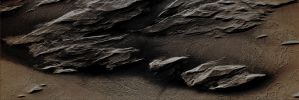
Volcanic_Regions-Rocky_Outcrops-MGS-01.jpgStreamlined Rocky Outcrops near Olympus Mons (Enhanced Absolute Natural Colors; credits for the additional process. and color.: Dr Paolo C. Fienga - Lunar Explorer Italia) 249 visiteCaption NASA originale:"This MGS-MOC image shows wind-eroded "Streamlined" Rocky Outcrops overlying Lava Flow Surfaces located to the West of Olympus Mons. Outcrops with this appearance are also called Yardangs. Yardangs typically form in Sedimentary Rock or Volcanic Ash that contains some amount of Sand. The weathering of the Rock due to the Aeolian action cause the release of sand-sized particles from the Outcrops and, in time, such a form of erosion slowly shape the rock into the classic, inverted boat hull-like shapes of Yardangs".
Location near: 13,2° North Lat. and 160,1° West Long.
Image width: ~3 Km (~1,9 mi)
Illumination from: lower left
Season: Northern SpringMareKromiumOtt 26, 2011
|
|

Channels-Unnamed_Channel_in_Stygis_Catena-PIA07133-01.jpgAncient Riverbed in Stygis Catena (Absolute Natural Colors; credits for the additional process. and color.: Dr Paolo C. Fienga - Lunexit Team)170 visiteCaption NASA originale:"This MGS-MOC image shows a Trough (Trough ---> canale) in the Stygis Catena Region, East of the Martian Volcano Elysium Mons. The Trough probably formed by collapse (Collapse ---> geol. "cedimento" del terreno). Large, dark Boulders can be seen on the Trough Floor in this Volcanic Region. The image is located near 24,4° North Lat. and 210,4° West Long. The image covers an area about 3 km (approx. 1,9 mi) wide and sunlight illuminates the scene from the lower left".MareKromiumOtt 26, 2011
|
|

Channels-Unnamed_Channel_near_Cydonia_Region-PIA07272-01.jpgArabia Terra, near Cydonia Region: the "Sphynx" River (Absolute Natural Colors; credits for the additional process. and color.: Dr Paolo C. Fienga - Lunexit Team) 167 visitenessun commentoMareKromiumOtt 26, 2011
|
|

Channels-Bahram_Vallis-Landslide-M1000913-01.jpgLandslide in Bahram Vallis (Natural Colors; credits for the additional process. and color.: Dr Paolo C. Fienga - Lunexit Team)166 visiteMareKromiumOtt 26, 2011
|
|
| 3220 immagini su 269 pagina(e) |
 |
|
|
|
|
18 | |
|
|
|
|





