| |
| Ultimi arrivi |

SOL0054-PIA14762-NASA-JPL-Caltech-MSSS.jpg"Bathurst Inlet" Rock - Sol 54 (Natural Colors; credts: NASA/JPL-Caltech, Malin Space Science Systems)85 visiteNASA's Mars Rover Curiosity held its Mars Hand Lens Imager (MAHLI) camera about 10,5" (---> inches, such as about 27 centimeters) away from the top of a Rock called "Bathurst Inlet" for a set of 8 images combined into this merged-focus view of the Rock. This context image covers an area that is roughly 6,5 by 5" (such as 16 by 12 centimeters). Resolution is about 105 microns per pixel.
MAHLI took the component images for this merged-focus view, plus closer-up images of Bathurst Inlet, during Curiosity's 54th Martian Day, or Sol (such as September 30, 2012). The instrument's principal investigator had invited Curiosity's science team to "MAHLI it up!" in the selection of Sol 54 targets for inspection with MAHLI and with the other instrument at the end of Curiosity's Arm: the Alpha Particle X-Ray Spectrometer.
The "Bathurst Inlet" Rock is dark gray and appears to be so fine-grained that MAHLI cannot resolve Grains or Crystals in it. This means that the Grains or Crystals, if there are any at all, are smaller than about 80 microns in size. Some windblown sand-sized Grains or Dust Aggregates have accumulated on the Surface of the Rock, but this Surface is clean (if compared, for example, to the pebbly substrate below the rock - upper left and lower right in this context image).
MAHLI can do focus merging onboard the MER and, in fact, the full-frame versions of the 8 separate images that were combined into this view were not even returned to Earth -- just the thumbnail versions. In other words, merging the images onboard reduces the volume of data that is supposed to be downlinked to Earth.MareKromiumOtt 04, 2012
|
|

SOL0054-PIA14762-PCF-LXTT-IPF.jpg"Bathurst Inlet" Rock - Sol 54 (Absolute Natural Colors; credts for the additional process. and color.: Dr Paolo C. Fienga/Lunar Explorer Italia/Italian Planetary Foundation)105 visite...Solo per evidenziare agli Amici di Lunar Explorer Italia la differenza che esiste tra il color processing adottato dalla NASA/JPL-Caltech (in collaborazione con il Malin Space Science Systems) e quello adottato da noi. E attenzione: qui non si discute di "estetica", ma di "verosimiglianza"! Il color processing NASA (quello del frame che precede, tanto per intenderci), presuppone l'esistenza di una nebbia gialla FITTA E COSTANTE! Una nebbia che, laddove esistesse davvero, impedirebbe di vedere oltre i 5/8 metri! Ora, che su Marte esista una discreta Opacità Atmosferica nessuno ne dubita. E nessuno dubita che Marte abbia una Dominante Cromatica giallo/arancio.
Ma quello che le foto colorizzate "ufficiali" fanno vedere e vorrebbero rappresentare, secondo noi, è un Marte che - semplicemente - non esiste, se non a Pasadena e nella testa dei Signori del MSSS. Poi, giustamente, ognuno la può vedere come vuole. Ergo...Giudicate Voi!MareKromiumOtt 04, 2012
|
|

Phobos-Phobos_Monolith-10.jpgThe Phobos' Monoliths in context (an Image-Mosaic in Absolute Natural Colors; credits for the additional process. and color.: Marco Faccin and Paolo C. Fienga/Lunar Explorer Italia/Italian Planetary Foundation)146 visiteTanto per ricordare agli Amici "Anomaly Hunters" che di Monoliti (o, come suggeriamo noi, di "Parallelepipedal-shaped Ejecta Boulders"), su Phobos, ce ne sono ALMENO due. E comunque, se proprio vogliamo parlare di Anomalìe, potremmo discutere non solo (e non tanto!) della forma dei due rilievi controversi ed indicati da una freccia, quanto della loro (straordinaria ed inspiegabile, oltre che totalmente fuori contesto, a nostro parere) Albedo...MareKromiumOtt 03, 2012
|
|
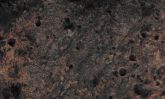
ESP_028367_2085-PCF-LXTT-IPF.jpgClay-rich Bedrock (Absolute Natural Colors; credits for the additional process. and color.: Dr Paolo C. Fienga/Lunar Explorer Italia/Italian Planetary Foundation)89 visiteThis image covers an exposure of Clay-rich Bedrock on the "shore" of the Northern Plains, North of Mawrth Vallis. The relatively bright areas reveal a Complex Terrain with a wide range of textures and colors.MareKromiumOtt 03, 2012
|
|

SOL0020-0020MR0057011000C0_DXXX.jpgWhite Edge - Sol 20 (RAW b/w Original NASA Frame; credits: NASA/JPL-Caltech - Research: Dr Gianluigi Barca/Lunar Explorer Italia/Italian Planetary Foundation)91 visitenessun commentoMareKromiumOtt 03, 2012
|
|

SOL0039-PIA16156.jpg"Hard" Mars... - Sol 39 (Credits: NASA/JPL-Caltech/MSSS)113 visite...Bisogna pure sorridere, in qualche modo ed in qualche misura...
Caption NASA:"NASA's Curiosity Rover found evidence for an ancient, flowing Stream on Mars at a few sites, including the Rock Outcrop pictured here, which the science team has named "Hottah" after Hottah Lake in Canada's Northwest Territories. It may look like a broken sidewalk, but this geological feature on Mars is actually exposed Bedrock made up of smaller fragments cemented together, or what geologists call a "Sedimentary Conglomerate". Scientists theorize that the Bedrock was disrupted in the past, giving it the titled angle, most likely via impacts from Meteorites.
The key evidence for the ancient Stream comes from the size and rounded shape of the Gravel in and around the Bedrock. Hottah has pieces of gravel embedded in it, called clasts, up to a couple inches (few centimeters) in size and located within a matrix of sand-sized material. Some of the clasts are round in shape, leading the Science Team to conclude they were transported by a vigorous flow of Water. The Grains are too large to have been moved by Wind. A close-up view of Hottah reveals more details of the Outcrop. Broken surfaces of the Outcrop have rounded, Gravel Clasts, such as the one circled in white, which is about 1,2" (3 centimeters) across. Erosion of the Outcrop results in Gravel Clasts that protrude from the Outcrop and ultimately fall onto the Ground, creating the Gravel Pile at left".MareKromiumSet 30, 2012
|
|

Io-Loki_Patera-PIA00320-PCF-LXTT-IPF.jpgVolcanic Plains and Paterae on Io: Loki Patera (Absolute Natural Colors; credits for the additional process. and color.: Dr Paolo C. Fienga/Lunar Explorer Italia/Italian Planetary Foundation)99 visiteA huge area of Io's Volcanic Plains is well shown in this mosaic of pictures taken by the NASA - Voyager 1 Space Probe. Numerous Volcanic Calderas and Lava Flows are visible here, including the Loki Patera (an active Lava Lake), which is the large shield-shaped and dark red Surface Feature visible in the lower right portion of the mosaic. As a matter of fact, the (sometime) intense light emitted from the Lava that boils inside Loki Patera can even be seen through telescopes, all the way from Earth, and these observations tell us that Loki has been active continuously (or at least every time an astronomer took a good look at it...) since the Voyager 1 Fly-By, which occurred in the month of March of the AD 1979.
The composition of Io's Volcanic Plains and Lava Flows has not been completely determined yet but, in the light of the information that we already possess (and, in particular, once we duly consider the orange-yellow color that can be seen over most of the Surface of Io), it is reasonable to say that they could dominantly consist of Sulphur, with Surface Frosts made of Sulphur Dioxide, Silicates (such as Basalts) encrusted with Sulphur and Sulphur Dioxide Condensates. The bright whitish patches, on the other hand, could probably consist of freshly deposited Sulphur Dioxide Frost. The dark red (and, sometime, almost black) spots, including Loki, are hot Sulphur Lava Lakes, which may remain molten even for a long time, thanks to the intrusions of molten Silicate Magma that (probably in an almost continuous way) comes up from deep inside Io. However, the very ultimate source of heat that keeps Io active, must be the Tidal (Frictional) Heating, due to the perpetual flexure of Io that is caused by the powerful Gravitational Influence of both Jupiter and Europa.
This picture (which is an Original NASA - Voyager 1 Space Proble color image mosaic published on the NASA - Planetary Photojournal with the n. PIA 00320) has been additionally processed and then re-colorized in Absolute Natural Colors (such as the colors that a human eye would actually perceive if someone were onboard the NASA - Voyager 1 Space Probe and then looked outside, towards the limb of the Jovian moon Io), by using an original technique created - and, in time, dramatically improved - by the Lunar Explorer Italia Team. Different colors, as well as different shades of the same color, mean, among others, the existence of different Elements present on the Surface of Io, each having a different Albedo (---> Reflectivity) and Chemical Composition.MareKromiumSet 30, 2012
|
|
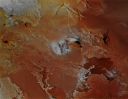
Io-Galai_Patera-PIA00324-PCF-LXTT-IPF.jpgVolcanic Plains and Paterae on Io: Galai Patera (Absolute Natural Colors; credits for the additional process. and color.: Dr Paolo C. Fienga/Lunar Explorer Italia/Italian Planetary Foundation)111 visiteIo's Volcanic Plains and at least 9 (nine) Paterae are shown, once again, in this really beautiful and highly suggestive NASA - Voyager 1 Space Probe image, which spans an area of about 1030 Km (such as approx. 640 miles) from left to right. North is at about the 01:30 o'clock position on the frame. A number of active Volcanic Calderae and huge Lava Flows are visible here: the most important (both for size and activity) is the dark red "teardrop-shaped" Surface Feature visible near the center of the frame, slightly to the right, which is Galai Patera, an approx. 100-Km-long (such as about 62 miles) Lava-flooded Caldera (---> Collapsed Vent). As we have already mentioned in yesterday's APOD, the exact composition of Io's Volcanic Plains and Lava Flows has not been determined yet; however, the prevalent yellow, brown, and orange materials may consist, dominantly, of Sulphur, with Surface Frosts made of Sulphur Dioxide and Silicates (such as Basalt), encrusted with Sulphur and Sulphur Dioxide Condensates. The dark red (and, sometime, almost black) spots visible all around the frame, of course including Galai Patera, are hot Sulphur Lava Lakes, which may remain molten for a long time, thanks to the intrusions of molten Silicate Magma that (probably in an almost continuous way) comes up from deep inside Io. Finally, the whitish patches visible at the upper left corner, in the center and on the lower left side of the picture are, most likely, Fresh Deposits of Sulphur Dioxide Frost.
This picture (which is an Original NASA - Voyager 1 Space Proble color image mosaic published on the NASA - Planetary Photojournal with the n. PIA 00324) has been additionally processed and then re-colorized in Absolute Natural Colors (such as the colors that a human eye would actually perceive if someone were onboard the NASA - Voyager 1 Space Probe and then looked outside, towards the limb of the Jovian moon Io), by using an original technique created - and, in time, dramatically improved - by the Lunar Explorer Italia Team. Different colors, as well as different shades of the same color, mean, among others, the existence of different Elements present on the Surface of Io, each having a different Albedo (---> Reflectivity) and Chemical Composition.MareKromiumSet 30, 2012
|
|
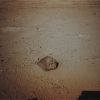
SOL0043-PIA16155.jpg'Jake Matijevic' - Sol 43 (Absolute Natural Colors; credits for the additional process. and color.: Dr Paolo C. Fienga/Lunar Explorer Italia/Italian Planetary Foundation)155 visiteCaption NASA:"The drive by NASA's Mars Exploration Rover Curiosity during the Mission's 43rd Martian Day, or Sol, (such as September 19, 2012) ended with this Rock that lies at about 8 feet (such as 2,5 meters) from the Rover. The Rock is about 10" (inches, such as approx. 25 centimeters) tall and 16" (approx. 40 centimeters) wide. The Rover Team has assessed it as a suitable target for the first use of Curiosity's Contact Instruments on a Rock. The image was taken by the left Navigation Camera (or NavCam) at the end of the drive.
The rock has been named "Jake Matijevic", and this choice was made with the aim of commemorating Jacob Matijevic (1947-2012), who was the Surface Operations Systems Chief Engineer for the Mars Science Laboratory Project and the Project's Curiosity Rover. He was also a Leading Engineer for all of the previous NASA Mars Rovers, such as Sojourner, Spirit and Opportunity.
Curiosity's Contact Instruments are on a turret at the end of the Rover's Robotic Arm; they are the Alpha Particle X-Ray Spectrometer (for reading the target's elemental composition) and the Mars Hand Lens Imager (for close-up imaging).MareKromiumSet 25, 2012
|
|

OPP-SOL3064-Spherules-PCF-LXTT-IPF.jpgCompacted Spherules at "Kirkwood" - Sol 3046 (Absolute Natural Colors; credits for the additional process. and color.: Dr Paolo C. Fienga/Lunar Explorer Italia/Italian Planetary Foundation)87 visiteCaption NASA:"Small Spherical Objects fill the field in this mosaic combining 4 (four) images from the Microscopic Imager onboard the NASA - Mars Exploration Rover (MER) Opportunity. The view covers an area about 2,4" (inches, such as about 6 centimeters) across, at a Rocky Outcrop known as "Kirkwood" and located in the Cape York Segment of the Western Rim of Endeavour Crater. The individual Spherules are up to about one-eighth of one inch (such as approx. 3 millimeters) in diameter. The Microscopic Imager took the component images during the 3064th Martian Day, or Sol, of Opportunity's work on Mars (such as September 6, 2012).
It has to be remembered that the MER Opportunity already discovered Martian Spherules at its Landing Site, more than eight-and-a-half years ago and those Spherules were nicknamed "Blueberries". They provided important evidence about long gone "Wet Environmental Conditions" on Mars because researchers using Opportunity's science instruments identified them as "Rocky Concretions" rich in the Mineral Hematite deposited by Water saturating the Bedrock.
However, the Spherules at Kirkwood do not have the Iron-rich composition of the Blueberries and they also differ in concentration, distribution and structure. Some of the Spherules in this image have been partially eroded away, revealing a "Concentric Internal Structure". Opportunity's Science Team plans to use Opportunity for further investigation of these Spherules in order to determine what evidence they can provide about the (VERY) ancient Martian Environmental Conditions.MareKromiumSet 25, 2012
|
|

OPP-SOL036-P2274_L257-B067R1-PCF-LXTT~0.jpgMeridiani Planum - Sol 36 (Absolute Natural Colors; credits for the additional process. and color.: Dr Paolo C. Fienga - Lunexit Team)171 visitenessun commentoMareKromiumSet 24, 2012
|
|

OPP-SOL036-PCF-LXTT-IPF.jpgOpportunity's Backshell and Parachute - Sol 36 (Absolute Natural Colors; credits for the additional process. and color. Dr Paolo C. Fienga/Lunar Explorer Italia/Italian Planetary Foundation)116 visitenessun commentoMareKromiumSet 24, 2012
|
|
| 25353 immagini su 2113 pagina(e) |
 |
|
|
|
|
99 | |
|
|
|
|
|
|





