| |
| Ultimi arrivi |

Titan-PIA09846-PCF-LXTT-IPF.jpgTitanian Clouds and Surface Features (Absolute Natural Colors; credits for the additional process. and color.: Dr Paolo C. Fienga/Lunar Explorer Italia/Italian Planetary Foundation)71 visiteA bright streak of whitish Clouds graces the Northern Skies of the Saturnian moon Titan and this was the second time that the NASA - Cassini Spacecraft's imaging cameras spotted clouds at apporx. 60° of North Latitude (the previous occasion occurred during the observations that were carried out in the month of February of the AD 2007: observations which also led the cameras of the Spacecraft to spot the Dark Lakes - likely filled by Liquid Hydrocarbons - that cover much of the Northern Regions of this fascinating moon). The almost circular, and approx. 400-Kilometer wide Impact Crater Menrva can be seen near center, a little to the left of the Terminator. North on Titan (which, we remind you, is approx. 5150 Km - such about 3200 miles across) is up and rotated 26° to the right.
The image was taken with the NASA - Cassini Spacecraft Narrow-Angle Camera on January 20, 2008, using a combination of Spectral Filters sensitive to Wavelengths of Polarized InfraRed Light centered at 938 and 746 nanometers. The view was acquired at a distance of approximately 1,3 MKM (---> Million KiloMeters), such as about 800.000 miles from Titan and at a Sun-Titan-Spacecraft, or Phase, Angle of 58°. Image scale is roughly 8 Km (a little more than 5 miles) per pixel. However, it has to be noted that, due to the scattering of light that is caused by the Titanian Hazy Atmosphere, the size of the Surface Features that can be seen and resolved, is a few times larger than the actual (and aforementioned) pixel scale.
This frame (which is an Original NASA - Cassini Spacecraft image published on the NASA - Planetary Photojournal with the ID n. PIA 09846) has been additionally processed and then colorized in Absolute Natural Colors (such as the colors that a human eye would actually perceive if someone were onboard the NASA - Cassini Spacecraft and then looked outside, towards the Saturnian moon Titan), by using an original technique created - and, in time, dramatically improved - by the Lunar Explorer Italia Team. Different colors, as well as different shades of the same color, mean, among others, the existence of different Elements present in the Atmosphere and Surface - where visible - of Titan, each having a different Albedo (---> Reflectivity) and Chemical Composition.
MareKromiumOtt 14, 2012
|
|
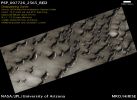
PSP_007726_2565_RED_abrowse-PCF-LXTT-IPF.jpgNorthern Dunes (Absolute Natural Colors; credits for the additional process. and color.: Dr Paolo C. Fienga/Lunar Explorer Italia/Italian Planetary Foundation)110 visiteThis NASA - Mars Reconnaissance Orbiter "HiRISE" image shows a portion of a Dunefield where many large "Barchan" (meaning "Crescent-shaped"), a few "Barchanoid" (meaning a "Non uniformly Crescent-shaped") and some smaller Dome-shaped Sand Dunes can be seen. The Dunefield that contains all these types of Sand Dunes is located in the Northern Regions of Mars and in a specific place where the first significant changes occurring to Sand Dunes was reported on the Red Planet (in the AD 2008). That study made by Dr Bourke (et al.) used a time series of NASA - Mars Global Surveyor (MGS), Mars Orbiter Camera (MOC) images taken over a period of 3 Martian Years (which are equivalent to 6 Earth Years) and showed that 2 (two) approx. 20 meter-wide Dome Dunes disappeared while a third one shrank by an estimated 15%.
Now, the HiRISE image here confirms that the first two Sand Dune studied by Dr Bourke no longer exist but, interestingly, it also suggests that the Sediment removal is still ongoing, since the third Dune has dramatically reduced its volume. On the other hand, it must be noticed and underlined that this "Dune-Changing Process" does not occur in a uniform and generalized way (at least in this specific location), since many of the other large Dunes present in the Dunefield do not show any (apparent/obvious) change; however, more time and some more precise measurements (fit to display evidence of the occurrence of an actual change of the larger Dunes, either in their shape, or their position) are needed in order to achieve a more substantiated conclusion.
In addition to that, we should also consider that it is even possible that the stability of all the other larger Dunes present in the Dunefield might be caused by the circumstance that the Sediment existing inside them is now (let us say "at present time"...) unavailable for removal, due to Induration (meaning that said Sediment became too hard to be blown away by just a simple, even though quite strong sometime, Aeolian Action, but in a future - maybe as a consequence of a dramatic variation in the Surface Temperature of this Region of Mars - its physical conditions could change again, and therefore make it fit to be remodeled, removed or, maybe, totally dispersed).
In the end, the change observed in the small Dome-shaped Dunes indicates, once and for all, that certainly not all Dunes on Mars are effectively and permanently stabilized and immobile, as it was erroneously believed for a long time.
Mars Local Time: 14:10 (Early Afternoon)
Coord. (centered): 76,182° North Lat. and 95,300° East Long.
Spacecraft altitude: 318,0 Km (such as about 198,8 miles)
Original image scale range: 63,6 cm/pixel (with 2 x 2 binning) so objects ~ 1 mt and 91 cm across are resolved
Map projected scale: 50 cm/pixel
Map projection: POLAR STEREOGRAPHIC
Emission Angle: 2,8°
Phase Angle: 62,5°
Solar Incidence Angle: 60° (meaning that the Sun was about 30° above the Local Horizon at the time the picture was taken)
Solar Longitude: 47,6° (Northern Spring- Southern Autumn)
Credits: NASA/JPL/University of Arizona
Additional process. and coloring: Lunar Explorer Italia
This picture (which is a NASA - Original Mars Reconnaissance Orbiter EDM color frame identified by the serial n. PSP_007726_2565) has been additionally processed and then colorized in Absolute Natural Colors (such as the colors that a human eye would actually perceive if someone were onboard the NASA - Mars Reconnaissance Orbiter and then looked down, towards the Surface of Mars), by using an original technique created - and, in time, dramatically improved - by the Lunar Explorer Italia Team.MareKromiumOtt 14, 2012
|
|

Titan-MF-EB-LXTT-03.jpgThe Titanian "South Polar Vortex" is still going on! (Superdefinition and Enhanced Natural Colors; credits for the additional process. and color.: Elisabetta Bonora and Marco Faccin /Lunar Explorer Italia/IPF)97 visitenessun commentoMareKromiumOtt 13, 2012
|
|

SOL0054-EB-MF-LXTT-IPF-1.jpg"Bathurst Inlet" Rock - Sol 54 (Natural Colors; credits for the additional process. and color.: Elisabetta Bonora and Marco Faccin/Lunar Explorer Italia/Italian Planetary Foundation)94 visitenessun commentoMareKromiumOtt 13, 2012
|
|

ZZ-Mercury-Craters-Unnamed_Craters-PIA15857-PCF-LXTT-IPF.jpgCraters on the Mercurian Terminator (Absolute Natural Colors; credits for the additional process. and color.: Dr Paolo C. Fienga/Lunar Explorer Italia/Italian Planetary Foundation)122 visiteThis is a beautiful and dramatic image of the Surface of Planet Mercury that was taken by the NASA - MESSENGER Spacecraft just when the Sun was a mere 10 degrees above the Local (imaged here) Horizon. The frame shows us four (4) Simple Unnamed Impact Craters which are all located on top of the Rim of a larger (approx. 3 Km-diameter) Simple Unnamed Crater (look from about 12 to a little after 1 o' clock of the disc drawn by the larger Crater) which, on its side, is positioned on the Outer Rim of an even larger (such as approx. 35 Km-diameter) Unnamed Complex Impact Crater which has been already caught and flooded by the shadows of the Mercurian Night.
As a matter of fact, the Rims of the four small Impact Craters show almost no signs of Erosion, or Collapse, and this circumstance marks them (always relatively speaking) as "young" Surface Features. However, while almost the entire Surface of Mercury is covered by Chains of small Craters (mostly formed by the action of repeated "waves" of Ejecta Boulders), these four small Craters DO NOT form nor constitute what is technically defined as a "Chain of Craters".
This image was acquired as a High-Resolution Targeted Observation. Targeted Observations are images of a small area on Mercury's Surface at resolutions much higher than the usual 200-meters per pixel Morphology Base Map. It is not possible to cover all of Mercury's Surface at such an High Resolution, but typically several areas of remarkable scientific interest are imaged in this mode each week.
Date acquired: May, 2nd, 2012
Image Mission Elapsed Time (MET): 217183900
Image ID: 1750578
Instrument: Narrrow Angle Camera (NAC) of the Mercury Dual Imaging System (MDIS)
WAC filter: 7 (748 nanometers)
Center Latitude: 79,27° North
Center Longitude: 232,13° East
Resolution: 15 meters/pixel
Solar Incidence Angle: 79,8° (meaning that the Sun, at the time that the picture was taken, was about 10,2° above the Local Mercurian Horizon)
Emission Angle: 11,9°
Sun-Mercury-Messenger (or "Phase") Angle: 67,9°
This frame (which is an Original NASA - MESSENGER Spacecraft image published on the NASA - Planetary Photojournal with the ID n. PIA 15857) has been additionally processed and then colorized in Absolute Natural Colors (such as the colors that a human eye would actually perceive if someone were onboard the NASA - MESSENGER Spacecraft and then looked down, towards the Surface of the Planet Mercury), by using an original technique created - and, in time, dramatically improved - by the Lunar Explorer Italia Team. Different colors, as well as different shades of the same color, mean, among other things, the existence of different Elements (Minerals) present on the Surface of Mercury, each having a different Albedo (---> Reflectivity) and Chemical Composition.MareKromiumOtt 12, 2012
|
|

SOL0065-EB-MF-LXTT-IPF-03.jpgUnusually-looking bright Object near Curiosity - Sol 65 (an Image-Mosaic in Natural Colors by Elisabetta Bonora and Marco Faccin/Lunar Explorer Italia/Italian Planetary Foundation)164 visiteSe qualcuno di voi avesse avuto ancora qualche dubbio sulla natura dell'oggetto misterioso ripreso da Curiosity, le ultime immagini del MAHLI ne chiariscono definitivamente la natura.
E' sicuramente un oggetto di plastica: molto probabilmente la protezione di qualcosa che deve essersi strappata e poi deformata (magari la protezione di un cavo). Anche se la sua origine non è certa, potrebbe appartenere allo stadio di discesa di Curiosity (Sky Crane). Durante le fasi di atterraggio sul Pianeta Rosso, potrebbe essere finito sul Rover e poi caduto sul suolo marziano, a seguito delle attività dei giorni scorsi.
(Credits: Elisabetta Bonora and Marco Faccin - Alive Universe Images)MareKromiumOtt 12, 2012
|
|

SOL0065-EB-MF-LXTT-IPF-02.jpgUnusually-looking bright Object near Curiosity - Sol 65 (an High-Def-3D EDM; credits for the research and the additional process. and color.: Elisabetta Bonora and Marco Faccin/Lunar Explorer Italia/Italian Planetary Foundation)105 visitenessun commentoMareKromiumOtt 12, 2012
|
|

SOL0065-EB-MF-LXTT-IPF-01.jpgUnusually-looking bright Object near Curiosity - Sol 65 (EDM; credits for the research and the additional process. and color.: Elisabetta Bonora and Marco Faccin/Lunar Explorer Italia/Italian Planetary Foundation)156 visitenessun commentoMareKromiumOtt 12, 2012
|
|

SOL0062-EB-MF-LXTT-IPF.jpgUnusually-looking bright Object near Curiosity - Sol 62 (EDM; credits for the research and the additional process.: Elisabetta Bonora and Marco Faccin/Lunar Explorer Italia/Italian Planetary Foundation)129 visiteIl team di Curiosity ha deciso di riprendere le attività di analisi dei campioni del suolo marziano, giudicando innocuo il misterioso oggetto brillante trovato in prossimità del Rover. Dopo un paio di giorni di stop per verificare la natura dell'intruso, partiranno nuovamente le operazioni con la paletta. L'oggetto notato durante le prime attività di raccolta di campioni di suolo marziano, è stato fotografato per la prima volta dalla MastCam del Rover nel Sol 61. Probabilmente di natura metallica vista la sua lucentezza, fin dall'inizio si è supposto che appartenesse a Curiosity e non fosse di Natura Marziana.
Le elaborazioni sulle immagini della ChemCam del sol 62, hanno permesso di evidenziarne diversi dettagli e caratteristiche: è sicuramente qualcosa di materiale plastico. Il team, pur non essendo riuscito ad indentificare con precisione la provenienza del frammento ritiene possa essere la parte di un involucro di plastica, come ad esempio un tubicino usato a copertura di filo.
Come avevamo supposto, l'origine del piccolo oggetto potrebbe essere ricollegata alla fase di atterraggio di Curiosity: in particolare, potrebbe appartenere allo stadio di discesa del Mars Science Laboratory (Sky Crane) e, finito sul Rover, sarebbe caduto al suolo proprio a seguito delle operazioni con il braccio robotico di questi giorni.
Il campione di suolo marziano, raccolto durante il Sol 61, è rimasto in queste ore nella paletta di Curiosity: adesso che la situazione è stata opportunamente valutata e il frammento ritenuto non preoccupante, anche se non identificato, si procederà con l'utilizzo del primo scoop.
Per il sol 63, Curiosity effettuerà anche misurazioni meteo ed ambientali con la stazione di monitoraggio Environmental Monitoring Station (REMS), inoltre sono pianificati una collezione di scatti con la MastCam del rover durante le prime ore dell'alba del sol successivo.
Nel sol 64 è previsto lo spostamento del campione nel meccanismo di vagliatura e porzionatura, dove verrà fatto vibrare con forza per pulire le superfici. Questo campione verrà poi scartato, così come il secondo; mentre i successivi prelevati da Rocknest verranno effettivamente analizzati.
Le indagini sul misterioso oggetto continueranno tra un scoop e l'altro.
(Credits: Elisabetta Bonora and Marco Faccin - Alive Universe Images)MareKromiumOtt 12, 2012
|
|

Craters-Unnamed_Southern_Impact_Crater_with_colorful_Layers-ESP_028693_1535-CTX-EDM-PCF-LXTT-IPF-1.jpgUnnamed Southern Impact Crater with Colorful Layers (Absolute Natural Colors; credits for the additional process. and color.: Dr Paolo C. Fienga - Lunar Explorer Italia/Italian Planetary Foundation)109 visiteThis image, obtained by the NASA - Mars Reconnaissance Orbiter (HiRISE Camera), shows us a wide portion of a relatively recent (geologically speaking, of course...) Impact Crater, located in the Southern Hemisphere of the Red Planet, and which is about 7 Km wide. Partway down from (but still quite close to) the Crater Rim, there is a prominent bright Layer of Bedrock. The full-resolution color data shows three distinct Bedrock colors: a pale yellow, a light greenish-gray and a very dark blue (almost black, in Absolute Natural Colors). These Layers should reasonably correspond to different types of Rock that, in time, were deposited as nearly flat-lying sheets; nobody can be sure, but - perhaps - this "colorful" Layering is a combination of Lava Flows and Sediments. The relatively blue and dark blue colors visible in the HiRISE InfraRed Color Frame (not shown here and which, in the Absolute Natural Colors' EDM - inset -, appear as greenish-gray and extremely dark blue to almost black) might correspond to Minerals like Olivine and Pyroxene, which can easily be found, among others, in some specific types of Lava.
Mars Local Time: 15:39 (Middle Afternoon)
Coord. (centered): 26,092° South Lat. and 88,942° East Long.
Spacecraft altitude: 257,7 Km (such as about 161,0 miles)
Original image scale range: 51,6 cm/pixel (with 2 x 2 binning) so objects ~ 1 mt and 55 cm across are resolved
Map projected scale: 50 cm/pixel
Map projection: EQUIRECTANGULAR
Emission Angle: 5,0°
Phase Angle: 66,0°
Solar Incidence Angle: 61° (meaning that the Sun was about 29° above the Local Horizon at the time the picture was taken)
Solar Longitude: 168,7° (Northern Summer - Southern Winter)
Credits: NASA/JPL/University of Arizona
Additional process. and coloring: Lunar Explorer Italia
These two pictures (which are a NASA - Original Mars Reconnaissance Orbiter CTX b/w and EDM color frames, both identified by the serial n. ESP_028693_1535) have been additionally processed and then colorized (and re-colorized, respectively) in Absolute Natural Colors (such as the colors that a human eye would actually perceive if someone were onboard the NASA - Mars Reconnaissance Orbiter and then looked down, towards the Surface of Mars), by using an original technique created - and, in time, dramatically improved - by the Lunar Explorer Italia Team.MareKromiumOtt 12, 2012
|
|

SOL0061-2ML0283001000E1_DXXX-GB-LXTT-IPF.jpgUnusually-looking bright Object near Curiosity - Sol 6 (Natural Colors; credits for the research and the additional process.: Dr Gianluigi Barca/Lunar Explorer Italia/Italian Planetary Foundation)122 visite....E dato che la "Stranezze Marziane" non finiscono mai, eccone un'altra: siamo al Sol n. 6 di Curiosity e, come vedete bene, c'è un piccolo oggetto (siamo nell'ordine del centimentro e mezzo, o poco meno), a forma di "sferula" (o magari di "goccia"?!?), di color argento brillante, proprio "ai piedi" del Rover. Che cos'è? Un ennesimo pezzo di qualcosa che si è staccata dal Rover, o dai suoi rivestimenti, o dallo Sky-Crane? Secondo noi - ma lo diciamo "ad intuito puro" -, no. Questo oggetto che giace sul suolo di Gale è qualcosa che c'era già. Non c'è nulla del Rover, nè dei suoi rivestimenti e nè dello Sky-Crane che potrebbe assomigliare a questa "sferula argentea".
Che cosa sarà? Noi non ne abbiamo idea, non lo sappiamo e, probabilmente, non lo sapremo mai. Complimenti grandissimi al Dr Barca (Big "G") per questa ennesima Perla che, purtroppo, non troverà l'eco mediatica e scientifica che meriterebbe AMPIAMENTE!
Errata Corrige: mi segnala il Dr Barca (Big "G") che questa "Sferula Argentea" è, in realtà, lo stesso oggetto ripreso poi nei Soles seguenti (e cioè il "pezzettino di plastica" che non si sa bene da dove si sia staccato). Io, sinceramente, non saprei e non ho la stessa sensazione. Tuttavia, una qualsiasi certezza, al riguardo, non saprei proprio come poterla acquisire e quindi mi affido a quanto segnalatomi dal sempre eccezionale e puntualissimo Big "G".MareKromiumOtt 12, 2012
|
|

SOL0050-MR0229011000E1_DXXX-2-GB-LXTT-IPF.jpgUnusually-looking bright Object near Curiosity - Sol 50 (Natural Colors; credits for the research and the additional process.: Dr Gianluigi Barca/Lunar Explorer Italia/Italian Planetary Foundation)147 visiteSi è parlato tanto, tantissimo (forse anche un tantino troppo ed anche un pò a sproposito - secondo noi) dell'oggetto "anomalo" ripreso dal Rover Curiosity nei suoi pressi durante i Soles andanti da 61 a 65, ma nulla è stato detto a proposito di quest'altro "oggetto anomalo" e ad "Albedo Elevata" che giace ad un 5/6 metri da Curiosity e che è stato immortalato durante il Sol 50 della Missione del nuovo Super-Rover a Gale Crater.
Si tratta dello stesso oggetto?
Diremmo proprio di no: questo è nettamente più grande e luccicante.
Si tratta di un pezzo del Rover o dei suoi rivestimenti? Può darsi, ma come potremmo mai esserne certi? Noi ricordiamo di un altro oggetto luccicante e dall'apparenza metallica che venne ripreso dal Rover Spirit durante i primi Soles della sua Missione a Gusev. Lo segnalammo alla NASA e, come ovvio, non ottenemmo risposte.
Ora, dopo la Scoperta fatta dai nostri Senior Partner, Elisabetta Bonora e Marco Faccin, della possibile Anomalia dei Soles 61-63, la NASA si è pronunciata ed ha detto: "Nulla di grave, nulla di preoccupante: la natura dell'oggetto è benigna. Si tratta, probabilmente, di un pezzo del rivestimento del Rover o del suo Robotic Arm".
Va bene. E di questo altro oggetto, che mi dite? Da dove si è staccato questo "frammento" di qualcosa? Viene dal Rover? Viene dallo Sky-Crane? Oppure è quelcosa che è sempre stata lì?
Purtroppo abbiamo un solo frame che lo riprende: questo. E non abbiamo risposte da darVi (solo la NASA sa rispondere sempre a tutto ed ha una risposta per tutto). Noi abbiamo solo domande. E dubbi.
Le Vostre opinioni su questa nuova Anomalia Marziana saranno apprezzate.MareKromiumOtt 12, 2012
|
|
| 25353 immagini su 2113 pagina(e) |
 |
|
|
|
|
97 | |
|
|
|
|
|
|





