| |
| Ultimi arrivi |

ZZ-Mercury-Craters-Stieglitz_Crater-Central_Peak-PIA16420-PCF-LXTT-IPF.jpgLong Shadows from the Complex Central Peak of Stieglitz Crater (Absolute Natural Colors; credits for the additional process. and color.: Dr Paolo C. Fienga/Lunar Explorer Italia/Italian Planetary Foundation)88 visiteThis really beautiful and dramatic image taken by the NASA - MESSENGER Spacecraft shows us the Central Peak of the Stieglitz Impact Crater, which is located high on Mercury's Northern Hemisphere. The fresh appearance of its Ejecta Deposit suggests that Stieglitz is a relatively young Crater. Intriguingly, Stieglitz also hosts some significant amounts of Radar-Bright Materials whose origin and composition is, so far, unknown.
Date acquired: August, 27th, 2012
Image Mission Elapsed Time (MET): 254597521
Image ID: 2471477
Instrument: Narrow Angle Camera (NAC) of the Mercury Dual Imaging System (MDIS)
Center Latitude: 72,71° North
Center Longitude: 67,90° East
Resolution: 17 meters/pixel
Solar Incidence Angle: 83,4° (meaning that the Sun, at the time that the picture was taken, was about 6,6° above the imaged Local Mercurian Horizon)
Emission Angle: 47,6°
Sun-Mercury-Messenger (or "Phase") Angle: 130,9°
This picture (which is an Original NASA - MESSENGER Spacecraft b/w frame published on the NASA - Planetary Photojournal with the ID n. PIA 16420) has been additionally processed and then colorized in Absolute Natural Colors (such as the colors that a human eye would actually perceive if someone were onboard the NASA - MESSENGER Spacecraft and then looked down, towards the Surface of Mercury), by using an original technique created - and, in time, dramatically improved - by the Lunar Explorer Italia Team. Different colors, as well as different shades of the same color, mean, among other things, the existence of different Elements (Minerals) present on the Surface of Mercury, each having a different Albedo (---> Reflectivity) and Chemical Composition.MareKromiumNov 03, 2012
|
|
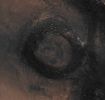
ESP_028957_2085-PCF-LXTT-IPF-01.jpgInteresting Surface Feature in Nilosyrtis Mensae (EDM - Absolute Natural Colors; credits for the additional process. and color.: Dr Paolo C. Fienga - Lunar Explorer Italia/Italian Planetary Foundation)76 visiteNilosyrtis Mensae is an ancient Terrain with a wonderful variety of Landforms and Rock Types. And so: what is this Circular Landform? It probably got its shape from an Impact Crater long ago, but was subsequently eroded and filled in, and then eroded again, so that now it is something like a "Low Mesa", surrounded by a Boulder-rich Geological Unit.
Mars Local Time: 15:34 (Middle Afternoon)
Coord. (centered): 28,286° North Lat. and 75,424° East Long.
Spacecraft altitude: 287,8 Km (such as about 179,9 miles)
Original image scale range: 28,8 cm/pixel (with 1 x 1 binning) so objects ~ 86 cm across are resolved
Map projected scale: 25 cm/pixel
Map projection: EQUIRECTANGULAR
Emission Angle: 8,5°
Sun-Mars-MRO (or "Phase") Angle: 50,4°
Solar Incidence Angle: 59° (meaning that the Sun was about 31° above the Local Horizon of the imaged Region, at the time that the picture was taken)
Solar Longitude: 180,1° (Northern Autumn - Southern Spring)
Credits: NASA/JPL/University of Arizona
Additional process. and coloring: Lunar Explorer ItaliaMareKromiumNov 03, 2012
|
|
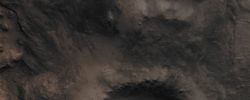
ESP_028957_2085-PCF-LXTT-IPF-00A.jpgFeatures of Nilosyrtis Mensae (CTX Frame "A" - Absolute Natural Colors; credits for the additional process. and color.: Dr Paolo C. Fienga - Lunar Explorer Italia/Italian Planetary Foundation)104 visiteMars Local Time: 15:34 (Middle Afternoon)
Coord. (centered): 28,286° North Lat. and 75,424° East Long.
Spacecraft altitude: 287,8 Km (such as about 179,9 miles)
Original image scale range: 28,8 cm/pixel (with 1 x 1 binning) so objects ~ 86 cm across are resolved
Map projected scale: 25 cm/pixel
Map projection: EQUIRECTANGULAR
Emission Angle: 8,5°
Sun-Mars-MRO (or "Phase") Angle: 50,4°
Solar Incidence Angle: 59° (meaning that the Sun was about 31° above the Local Horizon of the imaged Region, at the time that the picture was taken)
Solar Longitude: 180,1° (Northern Autumn - Southern Spring)
Credits: NASA/JPL/University of Arizona
Additional process. and coloring: Lunar Explorer ItaliaMareKromiumNov 03, 2012
|
|

ESP_028957_2085-PCF-LXTT-IPF-00B.jpgFeatures of Nilosyrtis Mensae (CTX Frame "B" - Absolute Natural Colors; credits for the additional process. and color.: Dr Paolo C. Fienga - Lunar Explorer Italia/Italian Planetary Foundation)86 visiteMars Local Time: 15:34 (Middle Afternoon)
Coord. (centered): 28,286° North Lat. and 75,424° East Long.
Spacecraft altitude: 287,8 Km (such as about 179,9 miles)
Original image scale range: 28,8 cm/pixel (with 1 x 1 binning) so objects ~ 86 cm across are resolved
Map projected scale: 25 cm/pixel
Map projection: EQUIRECTANGULAR
Emission Angle: 8,5°
Sun-Mars-MRO (or "Phase") Angle: 50,4°
Solar Incidence Angle: 59° (meaning that the Sun was about 31° above the Local Horizon of the imaged Region, at the time that the picture was taken)
Solar Longitude: 180,1° (Northern Autumn - Southern Spring)
Credits: NASA/JPL/University of Arizona
Additional process. and coloring: Lunar Explorer ItaliaMareKromiumNov 03, 2012
|
|

Phoebe-PIA06064-PCF-LXTT-IPF-1.jpgPhoebe (Absolute Natural Colors - Credits for the additional process. and color.: Dr Paolo C. Fienga/Lunar Explorer Italia/Italian Planetary Foundation)77 visitePhoebe's possibole true nature is partly revealed in this image-mosaic of two frames taken during the NASA - CASSINI Spacecraft's Fly-By that occurred on June 11, 2004. The image shows evidence for the emerging view that Phoebe may be an ice-rich Celestial Body coated with a thin Layer of Dark Material (probably Dust). This phenomenon has been observed on other Icy Satellites, such as Ganymede, in the Jovian System: when an impactor slammed into the Surface of Phoebe, the collision excavated fresh, bright Material - probably Water Ice - underlying the Surface Layer of Dust and other rocky debris. A further evidence supporting this hypothesis can be seen on some Crater Walls where the darker Material appears to have slid downwards, so to expose more light-colored Material. However, some areas of the image that are particularly bright - especially near the lower right - are just over-exposed. Small bright Impact Craters visible in the picture are probably fairly young Surface Features.
In addition to that, a number of interesting circumstances seem to indicate that Phoebe may have originated in the Outer Solar System. In fact, Phoebe's highly irregular and Dark Surface, its retrograde orbit, the presence, on its Surface, of a huge variety of large and small Impact Craters and, last but not least, its extremely low Average Density, appear consistent with the hypothesis that Phoebe was once part of the Kuiper Belt, before being captured by Saturn's Gravity (which is, most likely, the same origin of quite a few Minor moons of the Gas-Giant Planets Uranus, Neptune, Saturn and Jupiter).
This spectacular view was obtained at a Phase, or Sun-Phoebe-Spacecraft, Angle of 84°, and from a distance of approximately 32.500 Km (such as aabout 20.200 miles). The image scale is approximately 190 meters (624 feet) per pixel.
These image-mosaic (which is made of two Original NASA - CASSINI Spacecraft b/w frames published on the NASA - Planetary Photojournal with the ID n. PIA 06064) have been additionally processed and then colorized, according to an informed speculation carried out by Dr Paolo C. Fienga (LXXT/IPF), in Absolute Natural Colors (such as the colors that a human eye would actually perceive if someone were onboard the NASA - CASSINI Spacecraft and then looked outside, towards the Saturnian Outer moon, Phoebe), by using an original technique created - and, in time, dramatically improved - by the Lunar Explorer Italia Team. Different colors, as well as different shades of the same color, mean, among other things, the existence of different Elements (Minerals) present on the Surface of Phoebe, each having a different Albedo (---> Reflectivity) and Chemical Composition.MareKromiumNov 03, 2012
|
|
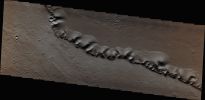
Volcanic_Regions-Tharsis-Uranius_Dorsum-PIA16336-PCF-LXTT-IPF.jpgUranius Dorsum (Absolute Natural Colors; credits for the research and the additional process.: Dr Paolo C. Fienga/Lunar Explorer Italia/Italian Planetary Foundation)62 visiteOrbit Number: 47664
Latitude (centered): 22,1827° North
Longitude (East): 282,689°
Instrument: VIS
Captured: September, 11th, 2012MareKromiumNov 03, 2012
|
|

Volcanic_Features-Lava_Flows_in_Tharsis-PIA16335-PCF-LXTT-IPF.jpgLava Flows in Tharsis (Absolute Natural Colors; credits for the additional process. and color.: Dr Paolo C. Fienga/Lunar Explorer Italia/Italian Planetary Foundation)65 visiteOrbit Number: 48151
Latitude (centered): 11,2222° North
Longitude (East): 279,398°
Instrument: VIS
Captured: October, 21st, 2012MareKromiumNov 03, 2012
|
|

Craters-Brashear_Crater-Dunefield-PIA16337-PCF-LXTT-IPF.jpgThe Dunes of Brashear Crater (Absolute Natural Colors; credits for the additional process. and color.: Dr Paolo C. Fienga/Lunar Explorer Italia/Italian Planetary Foundation)69 visiteOrbit Number: 48153
Latitude (centered): 53,3619° South
Longitude (East): 240,455°
Instrument: VIS
Captured: October, 22nd, 2012MareKromiumNov 03, 2012
|
|

ZZ-Mercury-Craters-Unnamed_Crater-PIA16392-PCF-LXTT-IPF.jpgUnnamed Mercurian Crater (Absolute Natural Colors; credits for the research and the additional process.: Dr Paolo C. Fienga/Lunar Explorer Italia/Italian Planetary Foundation)95 visiteThis dramatic image, where North is to the right, shows a Simple Impact Crater some 11 Km in diameter, located within the 290-Km-diameter Mendelssohn Basin. Its sharp Rim indicates that this Crater is a comparatively young Feature, though some parts of the Crater Walls have slumped (---> slowly fallen down) onto the Floor. The High Resolution of this image allows us to see quite a few distinctive textures along the Crater Walls.
Date acquired: July 21, 2012
Image Mission Elapsed Time (MET): 251400686
Image ID: 2244179
Instrument: Narrow Angle Camera (NAC) of the Mercury Dual Imaging System (MDIS)
Center Latitude: 70,28° North
Center Longitude: 105,38° East
Resolution: 19 meters/pixel
Scale: the field of view in this image is approx. 9,7 Km (such as about 2,3 miles) across
Solar Incidence Angle: 76,9° (menaing that the Sun was about 13,1° above the imaged Local Horizon at the time that the picture was taken)
Emission Angle: 11,0°
Sun-Mercury-MESSENGER (or "Phase") Angle: 87,9°MareKromiumOtt 28, 2012
|
|

ZZ-Mercury-Craters-Rachmaninoff_Crater-PIA16399-PCF-LXTT-IPF.jpgFeatures of Rachmaninoff Cratrer (Absolute Natural Colors; credits for the additional process. and color.: Dr Paolo C. Fienga/Lunar Explorer Italia/Italian Planetary Foundation)69 visiteRachmaninoff is a spectacular Double-Ring Impact Basin on Mercury, and this Absolute Natural Color view of it, is one of the highest resolution color image sets acquired of the Basin's Floor. Visible around the edges of the frame is a circle of Mountains that make up Rachmaninoff's Peak-Ring Structure, which surrounds concentric Troughs located on the on the Basin Floor. The color of the Basin's Floor inside the Peak-Ring differs from the darker material outside of it, as can also be seen in other images of this Feature.
Date acquired: July 31, 2012
Image Mission Elapsed Time (MET): 252265403, 252265399, 252265395
Image ID: 2305612, 2305611, 2305610
Instrument: Wide Angle Camera (WAC) of the Mercury Dual Imaging System (MDIS)
WAC filters: 9, 7, 6 (996, 748, 433 nanometers) in red, green, and blue
Center Latitude: 27,64° North
Center Longitude: 57,58° East
Resolution: 149 meters/pixel
Scale: Rachmaninoff's Inner Ring is approximately 140 Km (about 87 miles) in diameter
Solar Incidence Angle: 39,7° (meaning that the Sun was about 50,3° above the imaged Local Horizon at the time that the picture was taken)
Emission Angle: 19,2°
Sun-Mercury-MESSENGER (or "Phase") Angle: 59,0°MareKromiumOtt 28, 2012
|
|

ZZ-Mercury-Limb-PIA16429-PCF-LXTT-IPF.jpgMercurian Horizon (Absolute Natural Colors; credits for the additional process. and color.: Dr Paolo C. Fienga/Lunar Explorer Italia/Italian Planetary Foundation)76 visiteImages of Mercury's Limb provide information about the shape and topography of Mercury, but they also provide a sense of what it would be like to fly over the Innermost Planet, and to look out of the Spacecraft's window and toward the distant Horizon. See anywhere good to land?
Date acquired: July 24, 2012
Image Mission Elapsed Time (MET): 251598850
Image ID: 2258481
Instrument: Narrow Angle Camera (NAC) of the Mercury Dual Imaging System (MDIS)
Center Latitude: 18,25° South
Center Longitude: 353,70° East
Scale: the bottom of this scene is approximately 150 Km (about 93 miles) across, from left to right
Solar Incidence Angle: 58,6° (meaning that the Sun was about 31,4° above the imaged Local Horizon at the time the picture was taken)
Emission Angle: 80,0°
Sun-Mercury-MESSENGER (or "Phase") Angle: 138,6°MareKromiumOtt 28, 2012
|
|

ZZ-Mercury-Limb-PIA16398-PCF-LXTT-IPF.jpgMercurian Horizon (Absolute Natural Colors; credits for the additional process. and color.: Dr Paolo C. Fienga/Lunar Explorer Italia/Italian Planetary Foundation)67 visiteIn this image, Mercury's Cratered Surface stretches to the Horizon. Limb images with the Wide Angle Camera (WAC) have been a part of MDIS imaging campaigns since the beginning of orbital operations. A few months ago, in June 2012, NAC images of Mercury's Limb were added to the regular weekly observations, resulting in a few images each week with dramatic views of Mercury's Horizon such as seen here.
This image was acquired as part of MDIS's limb imaging campaign. Once per week, MDIS captures images of Mercury's Limb, with an emphasis on imaging the Limb of the Southern Hemisphere. These Limb images provide information about Mercury's shape and complement measurements of topography made by the Mercury Laser Altimeter (MLA) of Mercury's Northern Hemisphere.
Date acquired: July 17, 2012
Image Mission Elapsed Time (MET): 250986760
Image ID: 2215464
Instrument: Narrow Angle Camera (NAC) of the Mercury Dual Imaging System (MDIS)
Center Latitude: 30,3° South
Center Longitude: 59,4° East
Scale: the bottom of the image is approximately 300 Km (about 190 miles) in lengthMareKromiumOtt 28, 2012
|
|
| 25353 immagini su 2113 pagina(e) |
 |
|
|
|
|
94 | |
|
|
|
|
|
|





