| |
| Ultimi arrivi |

SOL0127-2-GB-LXTT-IPF.jpgFeatures of Yellowknife Bay - Sol 127 (an Image-Mosaic in Calibrated Natural Colors; credits for the additional process. and color.: Dr Gianluigi Barca/Lunar Explorer Italia/Italian Planetary Foundation)101 visitenessun commentoMareKromiumGen 01, 2013
|
|

SOL0127-1-GB-LXTT-IPF.jpgFeatures of Yellowknife Bay - Sol 127 (an Image-Mosaic in Calibrated Natural Colors; credits for the additional process. and color.: Dr Gianluigi Barca/Lunar Explorer Italia/Italian Planetary Foundation)83 visitenessun commentoMareKromiumGen 01, 2013
|
|

SOL0130-1-GB-LXTT-IPF.jpgFeatures of Yellowknife Bay - Sol 130 (an Image-Mosaic in Calibrated Natural Colors; credits for the additional process. and color.: Dr Gianluigi Barca/Lunar Explorer Italia/Italian Planetary Foundation)82 visitenessun commentoMareKromiumGen 01, 2013
|
|
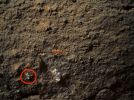
SOL0132-EB-MF-LXTT-IPF.jpgExtremely unusually-looking Surface Feature on the Surface of Gale Crater: the "Martian Flower" - Sol 132 (Credits: Research, additional process. and color.: Elisabetta Bonora and Marco Faccin/Lunar Explorer Italia/Italian Planetary Foundation)160 visiteDopo tantissimo tempo, ecco una nuova e, a nostro parere, assai intrigante Surface Feature individuata dal Rover "Curiosity" all'interno del Cratere Gale. Di che si può trattare? Beh, se rivolgessimo questa domanda ai Tecnici di Pasadena la risposta sarebbe ovvia: "...è un pezzo - l'ennesimo, aggiungeremmo noi... - di Curiosity. Probabilmente un frammento di plastica o il rivestimento di un cavetto...". Ma noi, proprio perchè già conosciamo la risposta degli Amici di Pasadena, questa domanda la rivolgiamo a Voi, Amici Lettori: che cosa stiamo guardando? Qualche piccolo aiuto: l'Albedo (o Riflettività della Luce Solare) dell'oggetto è elevata, la sua apparenza traslucida, la conformazione è irregolare ma, apparentemente, la texture delle sue aree più ampie è liscia. L'oggetto, se osservate attentamente il suo lato alla Vostra Dx, "SEMBRA" essere attaccato al suolo (o comunque pare costituirne parte, il che escluderebbe la sua provenienza da Curiosity) e, in alcuni suoi punti, la polvere giallastra che copre l'intera superficie fotografata, sembra che lo abbia parzialmente intaccato (porzioni superiori ed inferiori a Sx). Questo dato ulteriore ci spinge a ritenere che l'oggetto sia in quella posizione già da un pò di tempo (comunque non tantissimo). Infine (last but not least), Vi suggeriamo di notare l'apparente "sgranatura" ed "apertura secondo linee di frammentazione" delle sue componenti emergenti (una sorta di micro-pistilli - passateci il paragone, please...).
La nostra ipotesi "esotica"? E' un "fiore", oppure il residuo madreperlaceo di una qualche Forma Vitale Indigena. E Voi? Che ne pensate?MareKromiumDic 25, 2012
|
|

SOL0130-PIA16562-PCF-LXTT-IPF-2.jpgOn the Edge of "Yellowknife Bay" - Sol 130 (an Image-Mosaic in Absolute Natural Colors; credits for the additional process. and color. Dr Paolo C. Fienga/Lunar Explorer Italia/Italian Planetary Foundation)84 visitenessun commentoMareKromiumDic 25, 2012
|
|

Telesto-PIA07696-PCF-LXTT-IPF.jpgTelesto (Absolute Natural Colors; credits for the additional process. and color.: Dr Paolo C. Fienga - Lunar Explorer Italia/Italian Planetary Foundation) 82 visiteThis view - obtained by the NASA - CASSINI Spacecraft - shows us a few interesting Surface Features (mostly old Impact Craters and Mountains) as well as fine color variations that are found on the Trojan Saturnian moon Telesto. The smooth Surface of this moon suggests that, like Pandora, even Telesto is covered by a mantle of fine, dust-sized Icy Material. The origin of the color differences is not yet understood, but it may reasonably be caused by extremely subtle variations in the Mineralogical Composition of its Surface, or by the (extremely small) size of the Dusty Grains which make up the Icy Soil. Tiny Telesto is a Celestial Body that is approx. 24 Km (such as about 15 miles) wide only.
The image was acquired with the NASA - Cassini Spacecraft Narrow-Angle Camera on December, 25th, 2005 at a distance of approximately 20.000 Km (such as about 12.000 miles) from Telesto and at a Sun-Telesto-CASSINI Spacecraft, or Phase, Angle of 58°. Image scale is 118 meters (387 feet) per pixel.
This picture (which is an Original NASA - CASSINI Spacecraft b/w frame published on the NASA - Planetary Photojournal with the ID n. PIA 07696) has been additionally processed and then colorized, according to an informed speculation carried out by Dr Paolo C. Fienga (LXXT/IPF), in Absolute Natural Colors (such as the colors that a human eye would actually perceive if someone were onboard the NASA - CASSINI Spacecraft and then looked outside, towards the Saturnian moon, Telesto), by using an original technique created - and, in time, dramatically improved - by the Lunar Explorer Italia Team. Different colors, as well as different shades of the same color, mean, among other things, the existence of different Elements (Minerals) present on the Surface of Telesto, each having a different Albedo (---> Reflectivity) and Chemical Composition.MareKromiumDic 25, 2012
|
|

SOL0120-PIA16550-PCF-LXTT-IPF.jpgFeatures of the Surface of Gale Crater - Sol 120 (Slightly Saturated Absolute Natural Colors; credits for the additional process. and color.: Dr Paolo C. Fienga/Lunar Explorer Italia/Italian Planetary Foundation) 81 visitenessun commentoMareKromiumDic 25, 2012
|
|

ZZ-Mercury-Craters-Kertész_Crater-PIA16624-PCF-LXTT-IPF.jpgKertész Crater (Absolute Natural Colors; credits for the additional process. and color.: Dr Paolo C. Fienga/Lunar Explorer Italia/Italian Planetary Foundation)71 visiteThe bright and white-colored Material so clearly visible all over the Floor of Kertész Crater (whose diameter is approx. 31 Km - such as a little more than 19 miles) is not - despite its color and physical appearence - the Water Ice that has been recently confirmed to be present deep inside many Impact Craters located near Mercury's Poles, but it might well be behaving as Ice would on another Planet.
As a matter of fact, Mercury's Daytime Temperatures are so hot at most Latitudes that several kinds of Rocks (---> Minerals) which would be quite stable at other places in the Solar System, may essentially evaporate on Mercury. That is just one (a new one, we believe) theory that could explain the formation of these bright, irregular Features known as "Hollows" and seen here and, as you should already know very well, in many other places on the Planet Mercury (however, these fascinating Surface Features must, somehow - and in our humble opinion, as IPF -, be related to Impact Mechanics since they can mostly - if not exclusively - be found either inside, or on the Rims and/or, often, in close proximities with Impact Craters).
Date acquired: November, 17th, 2012
Image Mission Elapsed Time (MET): 261598284
Image ID: 2969138
Instrument: Narrow Angle Camera (NAC) of the Mercury Dual Imaging System (MDIS)
Center Latitude: 27,38° North
Center Longitude: 145,5° East
Resolution: 46 meters/pixel
Solar Incidence Angle: 42,6° (meaning that the Sun, at the time that the pictures were taken, was about 47,4° above the imaged Local Mercurian Horizon)
Emission Angle: 59,7°
Sun-Mercury-Messenger (or "Phase") Angle: 91,4°
This picture (which is an Original NASA - MESSENGER Spacecraft b/w frame published on the NASA - Planetary Photojournal with the ID n. PIA 16624) has been additionally processed and then colorized in Absolute Natural Colors (such as the colors that a human eye would actually perceive if someone were onboard the NASA - MESSENGER Spacecraft and then looked down, towards the Surface of Mercury), by using an original technique created - and, in time, dramatically improved - by the Lunar Explorer Italia Team. Different colors, as well as different shades of the same color, mean, among other things, the existence of different Elements (Minerals) present on the Surface of Mercury, each having a different Albedo (---> Reflectivity) and Chemical Composition.MareKromiumDic 25, 2012
|
|

ZZ-Mercury-Volcanic_Features-Vents-PIA16627-PCF-LXTT-IPF.jpgVolcanic Vents near Caloris' Outer Edge - Credits for the additional process. and color.: Dr Paolo C. Fienga/Lunar Explorer Italia/Italian Planetary Foundation)67 visiteThis image highlights the velvety texture that surrounds several Volcanic Vents located near the Outer Rim of the huge Impact Basin known as "Caloris Basin", on Mercury. This (apparently) soft texture, like freshly fallen snow, is formed by the emplacement of tiny beads of Lava that were explosively erupted and then quenched and solidified just before they reached the Surface. This diffuse Deposit heavily blankets several Impact Craters and older Vents, while it becomes thinner as long as it goes farther away from the Source of the Eruption. A large amount of the typical Mercurian Surface Features known as "Hollows" is also very well visible on the Rims of a number of Unnamed (and relatively modest in size) Impact Craters. This whole scene is approx. 106 Km across.
Date acquired: November, 17th, 2012
Image Mission Elapsed Time (MET): 261627279
Image ID: 2971208
Instrument: Narrow Angle Camera (NAC) of the Mercury Dual Imaging System (MDIS)
Center Latitude: 22,03° North
Center Longitude: 146,4° East
Resolution: 54 meters/pixel
Solar Incidence Angle: 39,1° (meaning that the Sun, at the time that the pictures were taken, was about 50,9° above the imaged Local Mercurian Horizon)
Emission Angle: 61,4°
Sun-Mercury-Messenger (or "Phase") Angle: 90,9°
This picture (which is an Original NASA - MESSENGER Spacecraft b/w frame published on the NASA - Planetary Photojournal with the ID n. PIA 16627) has been additionally processed and then colorized in Absolute Natural Colors (such as the colors that a human eye would actually perceive if someone were onboard the NASA - MESSENGER Spacecraft and then looked down, towards the Surface of Mercury), by using an original technique created - and, in time, dramatically improved - by the Lunar Explorer Italia Team. Different colors, as well as different shades of the same color, mean, among other things, the existence of different Elements (Minerals) present on the Surface of Mercury, each having a different Albedo (---> Reflectivity) and Chemical Composition.MareKromiumDic 25, 2012
|
|

SOL0059-PIA16452-PCF-LXTT-IPF.jpgRocknest 3 - Sol 59 (Absolute Natural Colors; credits for the additional process. and color.: Dr Paolo C. Fienga/Lunar Explorer Italia/Italian Planetary Foundation)88 visiteThis view of a Martian Rock nicknamed "Rocknest 3" combines 4 (four) images taken by the right-eye camera of the Mast Camera (MastCam) Instrument located onboard the NASA - Mars Exploration Rover - Mars Laboratory "Curiosity", which has a telephoto, 100-millimeter-focal-length lens. The component images were taken a few minutes after Martian noon (---> 12:00 Mars Local Solar Time) on the 59th Martian Day, or Sol, of Curiosity's operations at Gale Crater, Mars.
Rocknest 3 is a Sedimentary Rock approximately 15" (such as about 40 centimeters) long and about 4" (approx. 10 centimeters) tall; next to "Rocknest 3" there is a patch of windblown Dust and Sand where Curiosity scooped and analyzed several Soil Samples. The MastCam was about 13 feet (approx. 4 meters) from Rocknest 3 when the component images were taken, thus providing an image scale of about 0,01" (approx. 0,3 millimeter) per pixel.
This picture (which is an Original NASA - Mars Exploration Rover - Mars Laboratory "Curiosity" white-balanced color frame published on the NASA - Planetary Photojournal with the ID n. PIA 16452) has been additionally processed and then re-colorized in Absolute Natural Colors (such as the colors that a human eye would actually perceive if someone were near the NASA - Mars Exploration Rover (MER) - Mars Laboratory "Curiosity" and then looked down, towards the Rock known as Rocknest 3), by using an original technique created - and, in time, dramatically improved - by the Lunar Explorer Italia Team. Different colors, as well as different shades of the same color, mean, among other things, the existence of different Elements (Minerals) present on the Surface of Gale Crater, each having a different Albedo (---> Reflectivity) and Chemical Composition.MareKromiumDic 25, 2012
|
|

SOL0107-GB-LXTT-IPF-4~0.jpgThe Surface of Gale Crater - Sol 107 (An Image-Mosaic in Calibrated Natural Colors; credits for the additional process. and color.: Dr Gianluigi Barca/Lunar Explorer Italia/Italian Planetary Foundation) 73 visitenessun commentoMareKromiumDic 25, 2012
|
|

SOL0107-GB-LXTT-IPF-1~0.jpgThe Surface of Gale Crater - Sol 107 (An Image-Mosaic in Calibrated Natural Colors; credits for the additional process. and color.: Dr Gianluigi Barca/Lunar Explorer Italia/Italian Planetary Foundation) 78 visitenessun commentoMareKromiumDic 25, 2012
|
|
| 25353 immagini su 2113 pagina(e) |
 |
|
|
|
|
88 | |
|
|
|
|
|
|





