| |
| Ultimi arrivi |

SOL0153-1-GB-LXTT-IPF.jpgThe "Paving" of Yellowknife Bay - Sol 153 (an Image-Mosaic in Calibrated Natural Colors; credits for the additional process. and color.: Dr Gianluigi Barca/Lunar Explorer Italia/Italian Planetary Foundation)78 visiteUn frame troppo bello per commentarlo "tecnicamente"...MareKromiumGen 18, 2013
|
|

SOL0139-PIA16706-PCF-LXTT-IPF.jpgSpherules at Gale Crater - Sol 139 (Absolute Natural Colors; credits for the additional process. and color.: Dr Paolo C. Fienga/Lunar Explorer Italia/Italian Planetary Foundation)86 visiteCaption NASA:"This image from the Right Mast Camera (MastCam) onboard the NASA - Curiosity Mars Exploration Rover shows roughly Spherical Features, which are VERY similar to the ones found by the Mars Exploration Rover Opportunity in the Meridiani Planum Region of Mars. These "Gale Crater's" Spherules are apparently common in this Stratigraphic Unit, informally "Sheepbed"; a Stratigraphic Unit which defines the lower part of the sequences of Strata exposed in the area known as "Yellowknife Bay". These Spherical Features have been interpreted as "Concretions": a definition which implies that they have formed in Water that percolated (---> the movement and filtering of fluids through porous materials) through the Sediment. Curiosity's MastCam obtained these images on the 139th Martian day, or Sol, of the Rover's Surface Operations at Gale Crater (such as December, 25th, 2012)". MareKromiumGen 18, 2013
|
|

SOL0120-PIA16707-PCF-LXTT-IPF.jpg"Shaler Unit" - Sol 120 (Slightly Darkened Absolute Natural Colors; credits for the additional process. and color.: Dr Paolo C. Fienga/Lunar Explorer Italia/Italian Planetary Foundation)62 visiteCaption NASA:"This image from the Mast Camera (MastCam) onboard NASA's MER Curiosity shows a bizarre-looking Stratigraphic Unit (known as "Cross-Bedding") located in an Outcrop called "Shaler". This Stratigraphic Unit has been informally dubbed "Shaler Unit". This kind of "Cross-Bedding" in the Shaler Unit is indicative of Sediment transport in Stream Flows. Currents mold the Sediments into Small Underwater Dunes that migrated downstream. When exposed in cross-section, evidence of this Migration is preserved in the form of Strata that are steeply inclined as to the Bed (---> River or Lake's Floor) they lay on (thus the term "Cross-Bedding." The grain sizes here are coarse enough to exclude an Aeolian transport.
This Cross-Bedding occurs stratigraphically above the Gillespie Unit located in the "Yellowknife Bay" area of Gale Crater, and is therefore geologically younger. The MastCam obtained the image on the 120th Martian day, or sol, of Curiosity's Operations (such as December, 7th, 2012).MareKromiumGen 18, 2013
|
|
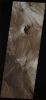
Volcanoes-Nili_Patera-PIA16653-PCF-LXTT-IPF.jpgFeatures of Nili Patera (Absolute Natural Colors; credits for the additional process. and color.: Dr Paolo C. Fienga/Lunar Explorer Italia/Italian Planetary Foundation)74 visiteThis frame, taken by the NASA - Mars Odyssey Orbiter during its 48021st orbit around the Red Planet shows us a portion of the very large Dunefield that covers most of the Floor of Nili Patera. This ancient Volcano, located in the Martian Region of Syrtis Major, spans about 50 Km (about. 31,5 miles) wide, 2 Km (such as a little more than 1 mile) deep, and forms part of a bigger Caldera Complex that stretches some 400 Km (a little less than 250 miles) along a North-to-South direction. What gives Nili Patera special interest for Planetary Geologists is that it contains two kinds of Lava: Basalt and Dacite. This is an unusual circumstance for Mars, where most Lavas are Basalt, and this discovery showed that the Red Planet is, even from a Volcainc point of view, an extremely complex world.
Furthermore, the execution of a series of Gravity Field Measurements which covered the whole Region, showed evidence of a Positive Gravity Anomaly, centered on the Caldera Complex, and suggesting the presence, deep under the Surface, of an approx. 600-by-300 Km (such as about 373-by-186 miles), North-to-South oriented and elongated (now extinct) Magma Chamber, probably containing some very dense Minerals (like, for instance and mainly, Pyroxene, with Olivine also possible).
Latitude: 8,95193° North
Longitude: 67,3367° East
Instrument: VIS
Captured: October, 11th, 2012
This frame (which is an Original Mars Odyssey Orbiter b/w frame published on the NASA - Planetary Photojournal with the ID n. PIA 16653) has been additionally processed and then colorized in Absolute Natural Colors (such as the colors that a human eye would actually perceive if someone were onboard the NASA - Mars Odyssey Orbiter and then looked down, towards the Surface of Mars), by using an original technique created - and, in time, dramatically improved - by the Lunar Explorer Italia Team.MareKromiumGen 11, 2013
|
|
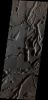
Volcanic_Features-Collapse_Pits_and_Chains-AM-PIA16647-PCF-LXTT-IPF.jpgCollapse Features on the Northern Flank of Ascraeus Mons (Absolute Natural Colors; credits for the additional process. and color.: Dr Paolo C. Fienga/Lunar Explorer Italia/Italian Planetary Foundation)66 visiteThis image was taken by the NASA - Mars Odyssey Orbiter, this time during its 47952nd Orbit, and it shows us a small fraction of the unbelievably compllicated Network of Collapse Features (Pits, Pit-Chains, Channels and Fissures) which are located on the Northern Flank of the Martian Volcano known as Ascreaus Mons (a large Shield Volcano located in the Tharsis Region of the Red Planet). Ascraeus Mons is the Northernmost and tallest of the 3 (three) Shield Volcanoes collectively known as the Tharsis Montes,being the other two huge Volcanoes known as Pavonis and Arsia Mons (if you wish to have an orbital vision of all these three fascinating Volcanoes, as well as a portion of the Noctis Labyrinthus Region of Mars, please go to Archive and refer to the APOD of February, 14th, 2012). Out of curiosity, Ascraeus Mons' location corresponds to the so-called "Classical Albedo Feature" which was known as Ascraeus Lacus.
Ascraeus Mons was actually discovered by the NASA - Mariner 9 Spacecraft in 1971. This enormous Volcano, however, was originally just called "North Spot", since it was the Northernmost of the only 4 (four) "Spots" (---> Reliefs) visible on the whole Surface of Mars which, at that time (and due to a Global Dust Storm), looked completely featureless from the orbit. As the Dust cleared, the abovementioned "Spots" were revealed to be extremely tall Shield Volcanoes whose Summits stood above the Dust-flooded, Lower Atmosphere. The Volcano's name officially became Ascraeus Mons in 1973.
Latitude: 13,6538° North
Longitude: 257,429° East
Instrument: VIS
Captured: October, 5th, 2012
This frame (which is an Original Mars Odyssey Orbiter b/w frame published on the NASA - Planetary Photojournal with the ID n. PIA 16647) has been additionally processed and then colorized in Absolute Natural Colors (such as the colors that a human eye would actually perceive if someone were onboard the NASA - Mars Odyssey Orbiter and then looked down, towards the Surface of Mars), by using an original technique created - and, in time, dramatically improved - by the Lunar Explorer Italia Team.MareKromiumGen 11, 2013
|
|
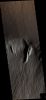
Volcanic_Features-Escarpment-OM-PIA16651-PCF-LXTT-IPF.jpgOlympus' Escarpment (Absolute Natural Colors; credits for the additional process. and color. Dr Paolo C. Fienga/Lunar Explorer Italia/Italian Planetary Foundation)65 visiteThis image, taken by the NASA - Mars Odyssey Orbiter during its 48003rd Orbit, shows us a VERY small (but still extremely interesting, as you can see by yourself) portion of the steep Escarpment existing between the Main Edifice of the Great Martian Volcano known as Olympus Mons and the surrounding Volcanic Plains (remember that an Escarpment is a - usually - steep Slope or a long Cliff that occurs from Erosion or Faulting and separates 2 (two) - relatively levelled/flat - areas/terrains which are situated at different elevations with regard to a certain, and given, Datum - such as that Point, Place or Region of a Celestial Body that is conventionally considered to be situated at Zero Altitude (the Sea Level, for instance, and as far as the Planet Earth is concerned).
Latitude: 13,9669° North
Longitude: 227,030° East
Instrument: VIS
Captured: October, 9th, 2012
The picture (which is an Original Mars Odyssey Orbiter b/w frame published on the NASA - Planetary Photojournal with the ID n. PIA 16651) has been additionally processed and then colorized in Absolute Natural Colors (such as the colors that a human eye would actually perceive if someone were onboard the NASA - Mars Odyssey Orbiter and then looked down, towards the Surface of Mars), by using an original technique created - and, in time, dramatically improved - by the Lunar Explorer Italia Team.MareKromiumGen 11, 2013
|
|
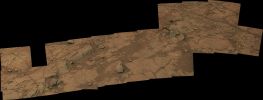
SOL0141-1-GB-LXTT-IPF.jpgThe "Paving" of Yellowknife Bay - Sol 141 (an Image-Mosaic in Calibrated Natural Colors; credits for the additional process. and color.: Dr Gianluigi Barca/Lunar Explorer Italia/Italian Planetary Foundation)74 visitenessun commentoMareKromiumGen 11, 2013
|
|
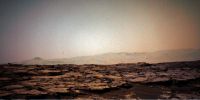
SOL0146-MF-EB-LXTT-IPF.jpgGale's "Foggy" Horizon - Sol 146 (L-Filter - RAW Natural Colors; credits for the additional process. and color.: Elisabetta Bonora and Marco Faccin/Lunar Explorer Italia/Italian Planetary Foundation)74 visitenessun commentoMareKromiumGen 11, 2013
|
|

ZZ-Mercury-Craters-Bek_Crater-PIA16626-PCF-LXTT-IPF.jpgBek Crater (Absolute Natural Colors; credts for the additional process. and color.: Dr Paolo C. Fienga/Lunar Explorer Italia/Italian Planetary Foundation)71 visiteIn this frame, which is a composite of imagest taken by the NASA - MESSENGER Spacecraft, now orbiting the Planet Mercury, shows us the beautiful Bright Rays of Bek Crater (whose diameter is about 32 Km - such as approx. 20 miles) which dominate this scene, covering a few nearby Unnamed Impact Craters with Wisps of fresh Material. On the other hand, Lermontov Crater, seen at the bottom of the image, is thought to have been the site of explosive Volcanic Eruptions.
Date acquired: April, 12th, 2011
Images Mission Elapsed Time (MET): 211111707, 211111727, 211111711
Images ID: 122544, 122549, 122545
Instrument: Wide Angle Camera (WAC) of the Mercury Dual Imaging System (MDIS)
Center Latitude: 21,31° North
Center Longitude: 308,8° East
Resolution: 401 meters/pixel
Solar Incidence Angle: 25,8° (meaning that the Sun, at the time that the pictures were taken, was about 64,2° above the imaged Local Mercurian Horizon)
Emission Angle: 30,0°
Sun-Mercury-Messenger (or "Phase") Angle: 55,9°
This picture (which is an Original NASA - MESSENGER Spacecraft color image mosaic published on the NASA - Planetary Photojournal with the ID n. PIA 16626) has been additionally processed and then re-colorized in Absolute Natural Colors (such as the colors that a human eye would actually perceive if someone were onboard the NASA - MESSENGER Spacecraft and then looked down, towards the Surface of Mercury), by using an original technique created - and, in time, dramatically improved - by the Lunar Explorer Italia Team. Different colors, as well as different shades of the same color, mean, among other things, the existence of different Elements (Minerals) present on the Surface of Mercury, each having a different Albedo (---> Reflectivity) and Chemical Composition.MareKromiumGen 11, 2013
|
|

SOL0133-PIA16564-PCF-LXTT-IPF.jpgSnake River - Sol 133 (Absolute Natural Colors; credits for the additional process. and color.: Dr Paolo C. Fienga/Lunar Explorer Italia/Italian Planetary Foundation)86 visiteThe sinuous Rock Feature visible in the lower center and left (Sx) side of this mosaic of frames recorded by the NASA - Mars Exploration Rover (MER) - Mars Laboratory "Curiosity" has been nicknamed "Snake River" (and we honestly believe that, once you notice the actual physical configuration of the Rocky Feature that is now under a - relatively - close observation, the reason of the nickname will result more than obvious...).
The images forming the mosaic were taken by Curiosity's Navigation Camera (NavCam) during the 133rd Martian Day, or Sol, of the Rover's Mission in Gale Crater - Mars (such as December, 20th, 2012). On Sol 147 (such as January, 3rd, 2013), the NASA - Mars Exploration Rover (MER) - Mars Laboratory "Curiosity" drove about 10 feet (approx. 3 meters) to get a closer look at "Snake River", before proceeding to watch, photograph and then examine other Rocky Features located in the same area as well as in other areas nearby.
This picture (which is an Original NASA - Mars Exploration Rover - Mars Laboratory "Curiosity" b/w image-mosaic published on the NASA - Planetary Photojournal with the ID n. PIA 16564) has been additionally processed and then colorized in Absolute Natural Colors (such as the colors that a human eye would actually perceive if someone were near the NASA - Mars Exploration Rover (MER) - Mars Laboratory "Curiosity" and then looked ahead, towards the Rocky Surface Feature called "Snake River", the Rocky Paving located in front of and around the Rover, as well as the more distant Horizon of Gale Crater), by using an original technique created - and, in time, dramatically improved - by the Lunar Explorer Italia Team. Different colors, as well as different shades of the same color, mean, among other things, the existence of different Elements (Minerals) present on the Surface of Gale Crater, each having a different Albedo (---> Reflectivity) and Chemical Composition.MareKromiumGen 11, 2013
|
|

SOL0136-2-GB-LXTT-IPF.jpgHorizon, from Yellowknife Bay - Sol 135 (an Image-Mosaic in Slightly Saturated Natural Colors; credits for the additional process. and color.: Dr Gianluigi Barca/Lunar Explorer Italia/Italian Planetary Foundation) 69 visitenessun commentoMareKromiumGen 11, 2013
|
|

SOL0138-1-GB-LXTT-IPF.jpgThe "Paving" of Yellowknife Bay - Sol 127 (an Image-Mosaic in Calibrated Natural Colors; credits for the additional process. and color.: Dr Gianluigi Barca/Lunar Explorer Italia/Italian Planetary Foundation)64 visitenessun commentoMareKromiumGen 11, 2013
|
|
| 25353 immagini su 2113 pagina(e) |
 |
|
|
|
|
86 | |
|
|
|
|
|
|





