| |
| Ultimi arrivi |

Callisto-PIA02277-PCF-LXTT-IPF.jpgValhalla! (Absokute Natural Colors; credits for the additional process. and color.: Dr Paolo C. Fienga/Lunar Explorer Italia/Italian Planetary Foundation)78 visiteThis picture of the gigantic Multi-Ring Impact Basin named "Valhalla" and located on the Jovian moon Callisto, was taken by the NASA - Voyager 1 Spacecraft in the morning of March 6, of the AD 1979, at a distance of about 200.000 Km (such as approx. 124.000 miles) from the Surface of the farthermost of the 4 (four) so-called "Galilean" Natural Satellites (or moons) of the Gas-Giant Planet Jupiter. The complicated Circular Structure which characterizes Valhalla is, in a way (and according to NASA), relatively similar to other large Circular Impact Basins that can be seen on the Surface of the Earth's Moon as well as on the Planet Mercury but, as we already wrote and underlined in the past, we, as IPF, do believe that a true and strong resemblance between Valhalla and another Multi-Ring Impact Basin can only be found with the huge Tyre Crater; a Multi-Ring Impact Crater that is located, as you know, on the Jovian moon Europa.
Usually, the inner portions of these Multi-Ring Impact Basins are generally surrounded by Radially Lineated Ejecta and several Concentric Mountainous Ring Structures, which are thought to have formed during the Impact Event itself. However, the Callistoan Valhalla Multi-Ring Impact Basin consists of a Light-Floored Central Basin, that is approx. 300 Km (such as a little more than 186 miles) in diameter, surrounded by at least 8 (eight) to 10 (ten) discontinuous and rhythmically spaced Ridges, but no Radially Lineated Ejecta can be seen. In any case, the great number of Rings observed around Valhalla is a fact which is consistent with the hypothesis that Callisto possesses a very low Planetary Density and, also, a low internal strength. Furthermore, if you look carefully on the upper right side of the frame, at about 2 o'clock, a beautiful and extremely long and regular Catena (---> Chain of Craters, probably originated by a Cometary Strike or a Meteor that was heavily fragmented at the time of the Impact) can be seen.
This frame (which is an Original NASA - Voyager 1 Spacecraft b/w image published on the NASA - Planetary Photojournal with the ID n. PIA 02277) has been additionally processed and then colorized, according to an educated guess, by Dr Paolo C. Fienga (LXTT-IPF), in Absolute Natural Colors (such as the colors that a human eye would actually perceive if someone were onboard the NASA - Voyager 1 Spacecraft and then looked outside, towards the Jovian moon Callisto), by using an original technique created - and, in time, dramatically improved - by the Lunar Explorer Italia Team. Different colors, as well as different shades of the same color, mean, among others, the existence of different Elements present on the Surface of Callisto, each having a different Albedo (---> Reflectivity) and Chemical Composition.MareKromiumFeb 14, 2013
|
|

Callisto-PIA00080-PCF-LXTT-IPF.jpgClosing-up on Valhalla (Absokute Natural Colors; credits for the additional process. and color.: Dr Paolo C. Fienga/Lunar Explorer Italia/Italian Planetary Foundation)71 visiteCallisto was revealed by the NASA - Voyager 1 cameras to be a heavily cratered and - most likely (as it was thought at that time) - geologically inactive Celestial Body. This mosaic of Voyager 1 images, obtained at a distance of about 400,000 Km (about 248.000 miles) from Callisto, shows Surface details as small as 10 Km (such as 6,2 miles) across. The largest Impact Features on the Callistoan Surface are the so-called "Multi-Ring Impact Basins"; two of them are enormous and Valhalla - the prominent Impact Feature visible here, in today's APOD - is the largest one, with a Bright Central Region approx. 600 Km (a little more than 372 miles) in diameter, and Rings extending as far as about 1800 Km (approx. 1118 miles) from the center. The second largest Impact Multi-Ring Basin is named Asgard, and it measures about 1600 Km (a little more than 993 miles) in diameter.
Multi-Ring Impact Structures probably originated as a result of a Post-Impact Concentric Fracturing of the Lithosphere lying on a layer of soft or - maybe - even Liquid Material: possibly, an Ocean. Last, but not least, in our opinion, as IPF, the remarkable resemblances existing between the Callistoan Valhalla Crater and the Tyre Crater, located on the other Jovian moon Europa, (*) may tell us, in the end, VERY similar stories about these two mysterious Celestial Bodies. Stories that may talk about worlds that, certainly a long, long time ago, were completely (or almost completely) covered by water. Stories that should also tell us something about what could still be happening, even now, up there: in the depths of Callisto, Europa and, maybe, of a few other Celestial Objects orbiting around the four Gas-Giant Planets of the Solar System...
(*) note: if you want to take a look at Tyre Crater, please refer to the APOD of January, 29, 2013
The Catenae, on the other hand (for example the Gomul Catena), are long Chains of Impact Craters lined up in straight lines across the Surface of Callisto. They were probably created by objects that were tidally disrupted as they passed close to Jupiter prior to the impact on Callisto, or by very oblique Impacts.
This frame (which is an Original NASA - Voyager 1 Spacecraft false color image mosaic published on the NASA - Planetary Photojournal with the ID n. PIA 00080) has been additionally processed and then re-colorized, according to an educated guess, by Dr Paolo C. Fienga (LXTT-IPF), in Absolute Natural Colors (such as the colors that a human eye would actually perceive if someone were onboard the NASA - Voyager 1 Spacecraft and then looked outside, towards the Jovian moon Callisto), by using an original technique created - and, in time, dramatically improved - by the Lunar Explorer Italia Team. Different colors, as well as different shades of the same color, mean, among others, the existence of different Elements present on the Surface of Callisto, each having a different Albedo (---> Reflectivity) and Chemical Composition.MareKromiumFeb 14, 2013
|
|
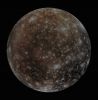
Callisto-PIA03456-PCF-LXTT-IPF.jpgApproaching Callisto (Absolute Natural Colors; credits for the additional process. and color.: Dr Paolo C. Fienga/Lunar Explorer Italia/Italian Planetary Foundation)76 visiteBright scars on a darker Surface testify to a long history of impacts on the Jovian moon Callisto, as it can be seen in this image obtained by the NASA - Galileo Spacecraft. The picture, taken in May 2001, is the only complete global Absolute Natural Color image of Callisto ever obtained by the NASA - Galileo Spacecraft, which orbited around Jupiter from December, 7, of the AD 1995 and until September 21, of the AD 2003, when the Spacecraft was destroyed during a controlled impact with Jupiter itself.
Of Jupiter's 4 (four) largest moons (also known as the "Galilean Moons"), Callisto orbits farthest from the Giant Gas Planet. Furthermore, Callisto's Surface is uniformly cratered but, as you can see for yourself, is not uniform in color or brightness at all. At present day, Planetary Scientists believe that the brighter areas are mainly Ice while the darker ones should be made of highly eroded (and Ice-poor) Rocky Materials.
This frame (which is an Original NASA - Galileo Spacecraft color frame published on the NASA - Planetary Photojournal with the ID n. PIA 03456) has been additionally processed and then re-colorized, according to an educated guess, by Dr Paolo C. Fienga (LXTT-IPF), in Absolute Natural Colors (such as the colors that a human eye would actually perceive if someone were onboard the NASA - Galileo Spacecraft and then looked outside, towards the Jovian moon Callisto), by using an original technique created - and, in time, dramatically improved - by the Lunar Explorer Italia Team. Different colors, as well as different shades of the same color, mean, among others, the existence of different Elements present on the Surface of Callisto, each having a different Albedo (---> Reflectivity) and Chemical Composition.MareKromiumFeb 14, 2013
|
|

SOL130-1-GB-IT-LXTT-IPF-01.jpgLook who is watching... - Sol 130 (an EDM in Calibrated Natural Colors; credits for the Research: Ivana Tognoloni/Lunar Explorer Italia/Italian Planetary Foundation)4860 visiteIl "testone" con occhi neri (straordinariamente SIMMETRICI) c'è, e - anche se non siamo in grado di produrre un anaglifo - sembra evidente che esso si posiziona DIETRO al macigno in primo piano e DAVANTI ai macigni sullo sfondo. Giudicate Voi....MareKromiumFeb 10, 2013
|
|

SOL0130-1-GB-IT-LXTT-IPF-00.jpgLook who's watching!... - Sol 130 (an Image-Mosaic in Calibrated Natural Colors; credits for the Research: Ivana Tognoloni/Lunar Explorer Italia/Italian Planetary Foundation)113 visiteSenza parole, o quasi: da dietro una roccia, posizionata (andiamo "a occhio"...) ad una trentina di metri da "Curiosity", SEMBRA (e sottolineiamo: SEMBRA!) che ci sia un volto "familiare" che spia i movimenti del Rover.
Il volto i chi? Ma di un "Grigio", naturalmente! Un Grigio il quale, per l'occasione, ha adottato un camouflage perfetto, ha cambiato colore e si è neascosto benissimo tra le rocce di Yellowknife Bay. Ma i suoi grandi ed affusolati occhi neri, uniti al suo inconfondibile "testone", non sono sfuggiti all'occhio della nostra eccezionale Amica e Partner, Ivana Tognoloni.
Che cosa stiamo guardando, quindi? Un'ennesima illusione ottica? Un'ennesima distorsione dell'immagine derivata dall'eccessiva compressione del frame? O forse un Alieno che osserva Curiosity, cercando di non farsi notare?
Cari Amici, il dettaglio è lì, bello chiaro, e l'ingrandimento isolato del dettaglio è nel prossimo frame. Giudicate Voi, ovviamente. Con benevolenza, equilibrio e, soprattutto, tanto acume. Perchè su Marte, a quanto abbiamo imparato in anni di analisi ed investigazione, "qualcosa" (o "qualcuno"), in Superficie, che si muove e lascia tracce del suo passare, SEMBRA esserci davvero.....MareKromiumFeb 10, 2013
|
|

SOL0173-GB-LXTT-IPF-CTX+EDM_ivana_p3_(3).jpgAnother "Rat" on Mars! - Sol 173 (EDM; False Colors; credits for the Research and the additional process.: Lorenzo Leone/Lunar Explorer Italia/Italian Planetary Foundation)230 visiteE dal nostro Amico e Senior Partner, Lorenzo Leone, ecco una serie di elaborazioni in Falsi Colori del bizzarro dettaglio superficiale individuato qualche giorno fa dalla bravissima Ivana Tognoloni, e che abbiamo battezzato come "Il Topo di Gale". Queste elaborazioni servono, fondamentalmente, a dimostrare una cosa sola: "Il Topo di Gale" NON E' un'illusione ottica o uno "scherzo di luci ed ombre". "Il Topo di Gale" è una Surface Feature REALE. Poi, come già abbiamo già detto e scritto, non sarà un "topo"... Ma qualunque cosa sia, esso è una "cosa VERA". Reale. Ed è lì, a pochissimi metri dal Rover il quale, ovviamente, non se ne cura minimamente... Un GRANDE RINGRAZIAMENTO a Lorenzo Leone per l'Amicizia, il supporto e questa eloquente elaborazione.MareKromiumFeb 07, 2013
|
|

SOL0173-GB-LXTT-IPF-crop.jpgNew extremely unusually-looking Surface Features at Yellowknife Bay - Sol 173 (an EDM in Calibrated Natural Colors; credits for the Research: "Mirko - Broken"/Lunar Explorer Italia/Italian Planetary Foundation)147 visiteC'è qualcosa di VERAMENTE inusuale in questa zona di Gale Crater nota come "Yellowknife Bay", ed il quantitativo di Stranezze (o Anomalie di Superficie, se preferite) sino ad ora localizzato ne è la prova lampante. Questo dettaglio, individuato dall'Amico e Senior Partner Mirko, è di quelli che lasciano davvero perplessi: su un lato di un macigno distante pochi metri dal Rover, c'è (sembra esserci) un'apertura a forma nettamente (ed inequivocabilmente) squadrata; e poi, proprio al di sotto di questa apertura, ce n'è un'altra, che sembra essere addirittura la porzione terminale di una canalina di scolo (o, comunque, di una sorta di - vecchissima ed incrostata - tubazione).
Strano, veramente strano. Per i Lettori più affezionati e di buona memoria, ricordiamo che un dettaglio simile a quello della "canalina di scolo" venne da noi individuato in due frames ottenuti dal Rover "Spirit", quando si trovava nei pressi del Summit della collinetta "Husband", durante i Soles 620 e 621 della sua esplorazione del Cratere Gusev. Eravamo nel Luglio 2006. Un GRANDE COMPLIMENTO al nostro Senior Partner Mirko per l'incredibile colpo d'occhio avuto e per la sua Amicizia ed il suo costante supporto.MareKromiumFeb 07, 2013
|
|

SOL0173-GB-LXTT-IPF-CTX+EDM_ivana_p3_(1).jpgMartian Oddities - Sol 173217 visiteAs we wrote in yesterday's, February 4th, 2013, APOD, nobody knows for sure what this bright and metal-looking Feature that shines in the Sun right in front of the NASA - Mars Exploration Rover - Mars Laboratory "Curiosity" - and highlighted by a red circle that we drew around it - can be. As a matter of fact, the texture of the whole Feature (that looks extremely smooth) and the color of its upper portion, are completely different from the texture and color of the Rocky Paving that the Feature appears to be part of, and which characterizes the area currently explored by the Rover, and known as Yellowknife Bay. Maybe, if the NASA People will decide to get closer to this intriguing Feature and so take a better look at it, we may know more. But for now, we can only draw your attention on what it seems to be one of the greatest oddities ever discovered on the Red Planet.
And that is not all! Look at the Feature highlighted by the yellow square that we drew around it and then take a careful look at what seems to be hiding in an horizontal crack of the huge boulder that is only a few meters away from the Rover... Is that an optical illusion? A very oddly-shaped rock? Or - maybe - we are really looking at something that looks like a small rodent that can perfectly "hide in plain sight"? Of course, we do not know. What we do know is that this second Feature is not just a a light-trick (actually, it casts a small shadow on the wall of the crack behind it), but something real. Something that, in our opinion, as IPF, should really be investigated...
This picture (which is an image-mosaic obtained from several Original NASA - Mars Exploration Rover - Mars Laboratory "Curiosity" b/w frames taken during the 173rd Sol of the Rover's exploration of Gale Crater) has been additionally processed, calibrated and colorized in Natural Colors (such as the colors that a perfect human eye - or an Electronic Eye - would actually perceive if someone were near the NASA - Mars Exploration Rover (MER) - Mars Laboratory "Curiosity" and then looked ahead, towards the Rocky Paving located in front of and around the Rover), by using an original technique created - and, in time, dramatically improved - by the Lunar Explorer Italia Team. Different colors, as well as different shades of the same color, mean, among other things, the existence of different Elements (Minerals) present on the Surface of Gale Crater, each having a different Albedo (---> Reflectivity) and Chemical Composition.MareKromiumFeb 05, 2013
|
|

SOL0173-GB-LXTT-IPF-CTX+EDM_ivana_p3_(2).jpgAnother "Rat" on Mars! - Sol 173 (EDM; Enhanced and Saturated Natural Colors; credits for the Research: Ivana Tognoloni/Lunar Explorer Italia/Italian Planetary Foundation)271 visite...certo, non è un "topo", molto probabilmente... Ma non dite che non ci assomiglia in maniera quasi perfetta. E comunque, a parere di chi scrive, su Marte, Superficie e Sub-Superficie e, a maggior ragione, ancora più in profondità, c'è Vita. Vita Animale. Vita Animale che si muove, respira, agisce, si nutre, pensa e fa quello che fa, in accordo a Leggi e Schemi Biologici che noi, poveri "terricoli", semplicemente non comprendiamo. E che di conseguenza, non comprendendo, nella nostra arroganza senza fine, rifiutiamo a priori. Pensateci sopra....MareKromiumFeb 05, 2013
|
|

SOL0173-EDM-MR0926020000E1_DXXX.jpgExtremely unusually-looking Feature on the Floor of Yellowknife Bay: "The Metal Head" - Sol 173 (EDM: Calibrated Natural Colors - Credits: Dr Gianluigi Barca/Lunar Explorer Italia/Italian Planetary Foundation324 visiteMareKromiumFeb 02, 2013
|
|

SOL0173-GB-LXTT-IPF-CTX+EDM.jpgExtremely unusually-looking Feature on the Floor of Yellowknife Bay: "The Metal Head" - Sol 173 (CTX Frame: RAW Natural Colors and EDM: Calibrated Natural Colors - Credits: Dr Gianluigi Barca/Lunar Explorer Italia/Italian Planetary Foundation275 visiteMareKromiumFeb 02, 2013
|
|

Dione-N00199629-33-EB-MF-LXTT-IPF.jpgThe Many faces of Dione (Superdefinition and Natural Colors; credits for the additional process. and color.: Elisabetta Bonora and Marco Faccin/Lunar Explorer Italia/Italian Planetary Foundation)175 visiteThe Icy Surface of the Saturnian moon Dione includes, among other things, some Heavily Cratered Terrain, Moderately Cratered Plains, Lightly Cratered Plains, and several Areas which show the presence of deep and wide Tectonic Fractures (notice that all these Geological Features are well visible in this beautiful picture). The Heavily Cratered Terrain shows a number of Impact Craters which are larger than 100 Km (a little more than 62 miles) in diameter. The Plain Areas, on the other hand, tend to have Impact Craters which are less than 30 Km (such as about 18,6 miles) in diameter. Some of the Plains, however, are more Heavily Cratered than others. Much of the Heavily Cratered Terrain is located on the Trailing Hemisphere of Dione, while the less Cratered Plains are found on the Leading one.
This characteristic of Dione tells us just the opposite of what a few scientists would have expected; Shoemaker and Wolfe, for instance, proposed a Cratering Model for a Tidally Locked Satellite with the highest Cratering Rates on its Leading Hemisphere and the lowest ones on the Trailing Hemisphere. This Model, therefore (if it is one-hundred-percent correct - a fact, this one, that we have no way to prove with absolute cetainty), suggests that during the period of heavy bombardment, Dione was (better yet: could have been) tidally locked to Saturn in an opposite orientation as to the present one. Just because Dione is a relatively small Celestial Body (approx. 1120 Km - such as about 695,5 miles - in diameter), we can assume that an impact causing an approx. 35-Km-diameter Impact Crater should have been strong enough to alter the Course (---> Motion and Orientation) of the moon, as to its Parent Planet. Now, since there are so many Impact Craters on Dione which are way larger than 35 Km (such as about 21,7 miles), we can logically speculate that Dione itself might have changed both its Motion and Orientation a few times during the aforementioned period of heavy bombardment. Eventually, once that the bombardment ended, the moon was finally able to set itself on a definitive and stable Course around Saturn.
As a matter of fact, the Pattern of Cratering and the bright Albedo of its Leading Side suggest that Dione has remained in its current Course for several billion years. Like the Jovian moon Callisto, Dione's Impact Craters lack the high Central Features (---> Peaks/Uplifts) that are often seen, instead, on the Moon and Mercury; this circumstance, in our opinion, is probably due to slumping (---> Mass Wasting) of the weak Icy Crust over Geologic Times, but a final answer to this kind of question, as you can imagine, will probably never given with an absolute certainty. Just out of curiosity, if you pay special attention to the visible portion of the Limb of Dione, as it appears in this highly defined picture, you may realize that its shape is NOT, in fact, perfectly spherical.
This image, which is a combination of 5 (five) Original NASA - CASSINI Spacecraft b/w frames whose ID numbers are N00199629/30/31/32 and 33, has been additionally processed and then colorized in Natural Colors (such as the colors that a perfect human eye - or an Electronic Eye - would have perceived while looking at Dione from Cassini's vantage point) by using an original technique created - and, in time, dramatically improved - by the Lunar Explorer Italia Team. Different colors, as well as different shades of the same color, mean, among others, the existence of different Elements present on the Surface of Dione, each having a different Albedo (---> Reflectivity) and Chemical Composition. MareKromiumGen 31, 2013
|
|
| 25353 immagini su 2113 pagina(e) |
 |
|
|
|
|
83 | |
|
|
|
|
|
|





