| |
| Ultimi arrivi |

ZZ-Mercury-Craters-Poe_Crater-PIA16755-PCF-LXTT-IPF.jpgPoe Crater (Absolute Natural Colors; credits for the additional process. and color.: Dr Paolo C. Fienga/Lunar Explorer Italia/Italian Planetary Foundation)75 visiteThis picture is an image-mosaic made of 3 (three) frames taken by the NASA - MESSENGER Spacecraft in July 2011; it shows the huge and magnificent Mercurian Crater Poe (so named after the American writer, and whose diameter is approx. 77 Km - or about 48 miles), with its almost black colored Rim standing out from the reddish Volcanic Plains that surround it. Even in this case, a number of relatively small Hollows speckles the dark Rim of Poe Crater like stars, in the blackness of night.
Date acquired: July, 3rd, 2011
Images Mission Elapsed Time (MET): 218204194, 218204190, 218204186
Images ID: 458399, 458398, 458397
Instrument: Narrow Angle Camera (NAC) of the Mercury Dual Imaging System (MDIS)
Center Latitude: 42,83° North
Center Longitude: 158,9° East
Resolution: 213 meters/pixel
Solar Incidence Angle: 42,8° (meaning that the Sun, at the time that the pictures were taken, was about 47,2° above the imaged Local Mercurian Horizon)
Emission Angle: 35,9°
Sun-Mercury-Messenger (or "Phase") Angle: 78,7°
This picture (which is an Original NASA - MESSENGER Spacecraft b/w image mosaic published on the NASA - Planetary Photojournal with the ID n. PIA 16770) has been additionally processed and then colorized in Absolute Natural Colors (such as the colors that a human eye would actually perceive if someone were onboard the NASA - MESSENGER Spacecraft and then looked down, towards the Surface of Mercury), by using an original technique created - and, in time, dramatically improved - by the Lunar Explorer Italia Team. Different colors, as well as different shades of the same color, mean, among other things, the existence of different Elements (Minerals) present on the Surface of Mercury, each having a different Albedo (---> Reflectivity) and Chemical Composition.MareKromiumFeb 24, 2013
|
|

ESP_023024_1010-GB-PCF-LXTT-IPF-Possible_Paleo-Lake-02.jpgPossible Paleo-Lake near the South Pole of Mars (an Image-Mosaic in Absolute Natural Colors; credits for the Research, additional process. and color.: Drr Gianluigi Barca and Paolo C. Fienga/Lunar Explorer Italia/Italian Planetary Foundation)111 visiteIn this image-mosaic showing the "Smooth South Polar Region", as NASA defined this Surface Feature, we wish to draw to your attention the extremely linear and, in a way, unusually-looking Chain of "oblong-shaped" Impact Craters that can easily be seen on the East Side (better yet: East Wall) of the Feature, from its upper right (Dx) corner and then down, for about 1/4 (one fourth) of its full length. This Chain of Craters litterally "follows" the Eastern Margin of the Lake-like Feature, then it suddenly stops (or, perhaps, quite a few of the Craters forming the Chain were simply "erased" by the occurrence of some Geological and/or Atmospherical - or both, probably - Events, still unknown at this point), and then it starts again, still remaining sharp and linear, but with a lesser Craters' Density.
Furthermore, on the left (Sx) side of the Craters forming the Chain, the Surface appears to be characterized by the presence of Gullies (---> remember that a so-called "Gully" is a landform created by running water, eroding sharply into the Soil. Gullies may resemble to large ditches or small valleys, but they can be a few meters, to tens of meters, deep and wide. When the Gully Formation is in process, the Water Flow Rate can be substantial, and this fact causes a significant deep cutting action into the Soil). So, one - perhaps remote, but, in any case, extremely intriguing - possibility, is that the Chain of Craters (or whatever those "oblong-shaped holes in the ground" may be) was the actual "passageway" through which a more than significant amount of running water once flew and, in the end (an end that occurred, very likely, in a distant past), filled up the whole Surface Depression and formed a true South Polar Lake. Then the water froze, and the Surface of this Martian Lake got slowly covered by Dust and Ashes but, in any case, it remained very smooth, like the still waters that once must have been there and that, in our opinion, froze very quickly.
All that said, we humbly believe, as IPF, that this whole Surface Feature has too quickly (and superficially) been called "Smooth South Polar Region", and then (at least as far as we know) forgotten by the many Spacecrafts that we still have orbiting around the Red Planet. In other words, if we had the chance, we would strongly suggest NASA (and ESA) to send the Mars Reconnaissance Orbiter and the Mars Express Spacecraft over this Region, and then take a new and better look at was lies down below, on the Surface. And this because, as they should know very well, "Science is always full of surprises"!...
Your opinions and insights about this topic are and shall always be appreciated.
Mars Local Time: 14:56 (Early Afternoon)
Coord. (centered): 78,638° South Lat. and 68,111° East Long.
Spacecraft altitude: 248,0 Km (such as about 154,008 miles)
Original image scale range: 49,6 cm/pixel (with 2 x 2 binning) so objects ~ 1 mt and 49 cm across are resolved
Map projected scale: 50 cm/pixel
Map projection: POLAR STEREOGRAPHIC
Emission Angle: 4,5°
Sun-Martian Surface-MRO Spacecraft (or Phase) Angle: 67,9°
Solar Incidence Angle: 65° (meaning that the Sun was about 25° above the Local Horizon at the time the picture was taken)
Solar Longitude: 317,2° (Northern Winter - Southern Summer)
Credits: NASA/JPL/University of Arizona
Additional process. and coloring: Lunar Explorer Italia
This picture (which is a cropped and NON-Map Projected NASA - Original Mars Reconnaissance Orbiter CTX b/w frame, identified by the serial n. ESP_023024_1010) has been additionally processed and then colorized in Absolute Natural Colors (such as the colors that a human eye would actually perceive if someone were onboard the NASA - Mars Reconnaissance Orbiter and then looked down, towards the Surface of Mars), by using an original technique created - and, in time, dramatically improved - by the Lunar Explorer Italia Team.MareKromiumFeb 24, 2013
|
|

ESP_023024_1010-GB-PCF-LXTT-IPF-Possible_Paleo-Lake-01.jpgPossible Paleo-Lake near the South Pole of Mars (EDM; Absolute Natural Colors - credits for the Research, additional process. and color.: Drr Gianluigi Barca and Paolo C. Fienga/Lunar Explorer Italia/Italian Planetary Foundation)117 visiteThis Surface Feature, now pictured by the NASA - Mars Reconnaissance Orbiter, but already known to Planetary Researchers (since it had already been photographed by the NASA - Mars Global Surveyor Orbiter a few years ago - see the MGS-MOC Image identified by the serial n. M09-01354), it is certainly very intriguing and highly suggestive. The NASA People, however, called this Surface Feature (that, in our humble opinion, as IPF, looks like a frozen Lake and it is also well characterized by the presence, on its Eastern Side, of a long line of almost perfectly lined-up and unusually-looking - "oblong" - Impact Craters) "Smooth South Polar Region".
This Surface Feature (as you will better see in the next few days, when we shall show you its smallest details) is (or "looks", if you prefer) very peculiar, and that is a fact that can hardly be disputed. Said that, we, as IPF, expected that NASA told us something more about this Smooth South Polar Region. We honestly thought that NASA would (and should) have showed us soon enough this intriguing Surface Feature from other visual angles, maybe (if possible) from a lower altitude, certainly during other seasons/periods of the Martian Year and, last but not least, under different Illumination Geometries, but...Nothing happened. Not a word of explanation was ever said or written (as far as we know) and not an "official" comment whatsoever was ever released.
Now, in the light of the aformentioned considerations, we decided to draw to your attention - through our Daily APOD - this "Smooth South Polar Region" and ask you a couple of simple questions: what do you really think or believe that this Surface Feature could be representing? Do you think that it could actually be the frozen remnant of an ancient (and once much bigger) Martian Lake or it is just a flat area surrounded by the typical Polar Terrain? If you wish to express your opinion, please write us at Alphacentauri@intercom.it . The most interesting and well substantiated ideas and theories that we hope to receive, shall be published here (giving to the Writer/s all the due credits), as additional comments to other (VERY detailed) orbital views of this very same Smooth South Polar Region. Thanks, as usual, for you interest and support!
Dr Paolo C. Fienga/LXTT/IPF
Mars Local Time: 14:56 (Early Afternoon)
Coord. (centered): 78,638° South Lat. and 68,111° East Long.
Spacecraft altitude: 248,0 Km (such as about 154,008 miles)
Original image scale range: 49,6 cm/pixel (with 2 x 2 binning) so objects ~ 1 mt and 49 cm across are resolved
Map projected scale: 50 cm/pixel
Map projection: POLAR STEREOGRAPHIC
Emission Angle: 4,5°
Sun-Martian Surface-MRO Spacecraft (or Phase) Angle: 67,9°
Solar Incidence Angle: 65° (meaning that the Sun was about 25° above the Local Horizon at the time the picture was taken)
Solar Longitude: 317,2° (Northern Winter - Southern Summer)
Credits: NASA/JPL/University of Arizona
Additional process. and coloring: Lunar Explorer Italia
This picture (which is a cropped and NON-Map Projected NASA - Original Mars Reconnaissance Orbiter CTX b/w frame, identified by the serial n. ESP_023024_1010) has been additionally processed and then colorized in Absolute Natural Colors (such as the colors that a human eye would actually perceive if someone were onboard the NASA - Mars Reconnaissance Orbiter and then looked down, towards the Surface of Mars), by using an original technique created - and, in time, dramatically improved - by the Lunar Explorer Italia Team.MareKromiumFeb 24, 2013
|
|

Triton-PIA02246-PCF-LXTT-IPF.jpgStill in the Abyss (Absolute Natural Colors; credits for the additional process. and color.: Dr Paolo C. Fienga - Lunar Explorer Italia/Italian Planetary Foundation)77 visiteFeatures as small as approx. 100 Km (such as a little more than 62 miles) across can be seen in this Absolut Color Image of Neptune's moon Triton, photographed by the NASA - Voyager 2 Spacecraft on August 20, 1989, while it was still approx. 5,4 Million KiloMeters (such as about 3,35 Million Miles) from Neptune. Triton's overall light pinkish color may be due to the heavy irradiation (---> the action of the Cosmic Rays and other Charged Particles, including the ones forming the Solar Wind) of the Ice (and, maybe, other Elements which were already) existing on the Surface of this distant Celestial Body.
The dark areas near the top of the image seem to be part of a belt of dark markings observed near Triton's Equator at different Longitudes. However - and generally speaking -, the darker areas visible on Triton appear to be somewhat redder in color than the brighter ones. The central Longitude in the image is 123° East. The South Pole of Triton is at about 6 o'clock of the disk, approximately 1/6th (one sixth) of the way up from its lower limb.
This frame (which is the Original NASA - Voyager 2 color frame published on the NASA - Planetary Photojournal with the ID n. PIA 02246) has been additionally processed and then re-colorized, according to an educated guess carried out by Dr Paolo C. Fienga (LXTT-IPF), in Absolute Natural Colors (such as the colors that a human eye would actually perceive if someone were onboard the NASA - Voyager 2 Spacecraft and then looked outside, towards the Neptunian moon Triton), by using an original technique created - and, in time, dramatically improved - by the Lunar Explorer Italia Team. Different colors, as well as different shades of the same color, mean, among others, the existence of different Elements present on the Surface of Triton, each having a different Albedo (---> Reflectivity) and Chemical Composition.MareKromiumFeb 24, 2013
|
|

Triton-PIA00317-PCF-LXTT-IPF.jpgThe Southern Regions of Triton (Absolute Natural Colors; credits for the additional process. and color.: Dr Paolo C. Fienga/Lunar Explorer Italia/Italian Planetary Foundation)77 visiteThis wonderful and highly detailed global Absolute Natural Color image mosaic of Triton was obtained in the AD 1989 by the NASA - Voyager 2 Spacecraft during its Fly-By of the Neptunian System.
With a radius of approx. 1350 Km (such as a little more than 838 miles) and therefore some 22% smaller than Earth's Moon, Triton is by far the largest Natural Satellite of Neptune. Furthermore, Triton is one of the only 3 (three) objects in the Solar System known to have a Nitrogen-dominated Atmosphere (the others are our Home Planet Earth and the Saturnian giant moon, Titan). Triton has the coldest Surface known anywhere in the Solar System (38 K, or about - 391 degrees Fahrenheit, or - 235° Celsius): it is so cold that most of Triton's Nitrogen is condensed as Frost, making it the only Celestial Body in the whole Solar System that is known to have a Surface mainly composed of Nitrogen Ice.
The pinkish deposits constitute a vast South Polar Cap, that is believed to contain Methane Ice, which somehow reacted under Sunlight so to form pink or red Compounds. The Dark Streaks overlying these pink ices are believed to be an Icy and - perhaps - Carbonaceous Dust deposited from huge Geyser-like Plumes, some of which were found to be active during the Voyager 2 Fly-By. The light gray colored band visible in this image extends all the way around Triton, near the Equator and it may consist of relatively fresh Nitrogen Frost Deposits. The vaguely greenish areas of Triton (central and upper right side) include what is known as "The Cantaloupe Terrain", whose origin is still unknown, and a set of "Cryovolcanic" Landscapes apparently produced by Icy-cold Liquids (now totally frozen) that were erupted from Triton's interior.
This frame (which is the Original NASA - Voyager 2 color image mosaic published on the NASA - Planetary Photojournal with the ID n. PIA 00317) has been additionally processed and then re-colorized, according to an educated guess carried out by Dr Paolo C. Fienga (LXTT-IPF), in Absolute Natural Colors (such as the colors that a human eye would actually perceive if someone were onboard the NASA - Voyager 2 Spacecraft and then looked outside, towards the Neptunian moon Triton), by using an original technique created - and, in time, dramatically improved - by the Lunar Explorer Italia Team. Different colors, as well as different shades of the same color, mean, among others, the existence of different Elements present on the Surface of Triton, each having a different Albedo (---> Reflectivity) and Chemical Composition.MareKromiumFeb 24, 2013
|
|

UMBRIEL-PIA00040-PCF-LXTT-IPF.jpgUmbriel (Absolute Natural Colors; credits for the additional process. and color.: Dr Paolo C. Fienga/Lunar Explorer Italia/Italian Planetary Foundation)76 visiteThe Southern Hemisphere of the Uranian moon Umbriel displays heavy Cratering in this NASA - Voyager 2 image, taken on January 24, 1986, at a distance of approx. 557.000 Km (such as a little less than 346.000 miles) from the Surface of the moon. This frame, taken through the Clear-Filter of Voyager's Narrow-Angle Camera, is the most detailed image of Umbriel that we have, with a resolution of about 10 Km (such as 6,21 miles) per picture element.
Umbriel is the darkest of Uranus' larger moons and the one that appears to have experienced the lowest level of Geological Activity. It has a diameter of about 1200 Km (a little more than 745 miles) and its Surface reflects only 16% of the light that receives; in the latter respect, Umbriel is similar to the Lunar Highland Areas of our own Moon. Umbriel, as we wrote herebefore, is heavily cratered, but it lacks the numerous Bright-Ray Craters that are commonly seen on the other large Uranian Natural Satellites; this fact, among other things, results in a relatively uniform Surface Albedo (---> Reflectivity).
The prominent Impact Crater visible on the Terminator (at about 11 o'clock of Umbriel's disk) is approx. 110 Km (such as 68,3 miles) across and it shows a really bright Central Peak. On the other hand, the strangest Surface Feature visible in this image (on the Limb of Umbriel, right at 12 o'clock of the disk) is a curious-looking Bright Ring which represents the most reflective area seen on Umbriel itself. The Bright Ring is about 140 Km (approx. 87 miles) in diameter and it lies near the moon's Equator. The nature of the Bright Ring is unknown, although it might be a very large Frost Deposit, perhaps associated with (located on top and near) the Rim of a huge Impact Cater. The few white spots that can be barely seen against the black background are not stars, but just just image artifacts, due to 'noise' in the data received on Earth.
This frame (which is the Original NASA - Voyager 2 b/w image published on the NASA - Planetary Photojournal with the ID n. PIA 00040) has been additionally processed and then colorized, according to an educated guess carried out by Dr Paolo C. Fienga (LXTT-IPF), in Absolute Natural Colors (such as the colors that a human eye would actually perceive if someone were onboard the NASA - Voyager 2 Spacecraft and then looked outside, towards the Neptunian moon Triton), by using an original technique created - and, in time, dramatically improved - by the Lunar Explorer Italia Team. Different colors, as well as different shades of the same color, mean, among others, the existence of different Elements present on the Surface of Triton, each having a different Albedo (---> Reflectivity) and Chemical Composition.MareKromiumFeb 24, 2013
|
|

Mimas-PIA12572-PCF-LXTT-IPF.jpgIn and around the Magnificent Herschel Crater (Absolute Natural Colors; credits for the additional process. and color.: Dr Paolo C. Fienga - Lunar Explorer Italia/Italian Planetary Foundation)79 visiteRemarkable color differences on the Saturnian moon Mimas are apparent in this (enhanced) Absolute Natural Color view of Herschel Crater that was captured by the NASA - Cassini Spacecraft during its closest (so far) Fly-By of that Celestial Body which occurred on February 13, 2010. The image shows Terrain-dependent color variations and, in particular, the contrast between the light-gray (with slightly pale blue nuances) Surface Materials which are found in and around Herschel Crater and the brownish cast that, on the other hand, is found on older and more heavily Cratered Terrain elsewhere.
The origin of the color differences between these two types of Terrain is not yet understood, but it is quite logical to assume that it should be caused by the existence of some considerable differences in the Surface Elements which form the Terrains themselves (and a few false color images which were obtained from Cassini's previous closest encounter with Mimas, during the AD 2005, also showed such variations, which are, therefore, something real and NOT a simple optical effect caused, for instance, by the Illumination Geometry existing at the time whan the different pictures were taken). The huge Herschel Crater (approx. 130 Km, or a little more than 80 miles, wide) covers most of the bottom of the image.
To create the original false-color view of Mimas, UltraViolet, Green and InfraRed images were combined into a single picture that was fit to exaggerate the color differences of the photographed Terrains; these data were then combined with a High-Resolution image taken in Visible Light so to obtain a mix between the High-Resolution information coming from the Clear-Filter image and the color information coming from the UltraViolet, Green and InfraRed filter images.
During the Fly-By, the NASA - Cassini Spacecraft came within about 9500 Km (such as about 5900 miles) of Mimas and this view looks toward the Northern part of the Hemisphere that leads the moon in its orbit around Saturn (---> Leading Hemisphere, in contrast with the Trailing Hemisphere). The images were obtained with Cassini's Narrow-Angle Camera at a distance of approximately 16.000 Km (such as 9936 miles) from Mimas. Afterwards, the images were re-projected into an Orthographic Map Projection. Furthermore, a black and white image, taken in Visible Light with the Wide-Angle Camera, was also used to fill in parts of the mosaic. The global scale of the mosaic is 90 meters (295 feet) per pixel.
This frame (which is an Original NASA - Cassini Spacecraft false color image mosaic published on the NASA - Planetary Photojournal with the ID n. PIA 12572) has been additionally processed, contrast enhanced, and then re-colorized in (slightly enhanced) Absolute Natural Colors (such as the colors that a human eye would actually perceive if someone were onboard the NASA - Cassini Spacecraft and then looked outside, towards the Surface and Limb of the Saturnian moon Mimas), by using an original technique created - and, in time, dramatically improved - by the Lunar Explorer Italia Team. Different colors, as well as different shades of the same color, mean, among others, the existence of different Elements present on the Surface of Mimas, each having a different Albedo (---> Reflectivity) and Chemical Composition.MareKromiumFeb 24, 2013
|
|

vl2-22a018-rgb_-MF-PCF-LXTT-IPF.jpgUtopian Horizon (Frame Viking Lander 2 n. 22a018 - Absolute Natural Colors; credits for the additional process. and color.: Dr Paolo C. Fienga and Marco Faccin/Lunar Explorer Italia/Italian Planetary Foundation) 131 visitenessun commentoMareKromiumFeb 14, 2013
|
|

vl2-22b107-rgb-MF-PCF-LXTT-IPF.jpgUtopian Horizon (Frame Viking Lander 2 n. 22b107 - Absolute Natural Colors; credits for the additional process. and color.: Dr Paolo C. Fienga and Marco Faccin/Lunar Explorer Italia/Italian Planetary Foundation) 109 visitenessun commentoMareKromiumFeb 14, 2013
|
|

ZZ-Mercury-Limb-PIA16820-PCF-LXTT-IPF.jpgSouthern Craters (Absolute Natural Colors; credits for the additional process. and color.: Dr Paolo C. Fienga - Lunar Explorer Italia/Italian Planetary Foundation)75 visiteThe set of 3 (three) frames shown here in Absolute Natural Colors and forming this image mosaic, was acquired by the NASA - MESSENGER Spacecraft as part of a sequence intended to monitor any changes in the calibration of the Multispectral Wide Angle Camera onboard the Spacecraft over time. However, the final result of this "calibration" also gives us a simply beautiful view of a wide portion (the whole scene is approx. 1900 Km - such as a little less of 1180 miles - across) of Mercury's heavily cratered Southern Hemisphere. Furthermore, the Impact Craters Magritte, Neruda, and Sher-Gil can be easily spotted within this scene. North is towards the top-left of the image.
Date acquired: December, 17th, 2012
Images Mission Elapsed Time (MET): 264237810, 264237814, 264237830
Images ID: 3157538, 3157539, 3157543
Instrument: Wide Angle Camera (WAC) of the Mercury Dual Imaging System (MDIS)
Center Latitude: 59,16° South
Center Longitude: 149,3° East
Resolution: 1663 meters/pixel
Solar Incidence Angle: 59,2° (meaning that the Sun, at the time that the pictures were taken, was about 30,8° above the imaged Local Mercurian Horizon)
Emission Angle: 28,8°
Sun-Mercury-Messenger (or "Phase") Angle: 78,1°
This picture (which is an Original NASA - MESSENGER Spacecraft color image mosaic published on the NASA - Planetary Photojournal with the ID n. PIA 16820) has been additionally processed and then re-colorized in Absolute Natural Colors (such as the colors that a human eye would actually perceive if someone were onboard the NASA - MESSENGER Spacecraft and then looked outside, towards the Surface of Mercury), by using an original technique created - and, in time, dramatically improved - by the Lunar Explorer Italia Team. Different colors, as well as different shades of the same color, mean, among other things, the existence of different Elements (Minerals) present on the Surface of Mercury, each having a different Albedo (---> Reflectivity) and Chemical Composition.MareKromiumFeb 14, 2013
|
|

ESP_025010_2650-PCF-LXTT-IPF.jpgOn the North Polar Scarp (EDM - Absolute Natural Colors; credits for the additional process. and color. Dr Paolo C. Fienga/Lunar Explorer Italia/Italian Planetary Foundation)80 visiteThis image, taken by the NASA - Mars Reconnaissance Orbiter in the late November of the AD 2011, was acquired in order to monitor the effects on the North Polar Scarp of the so-called "Frost Avalanches" that occurred the year prior. HiRISE often re-images certain areas of Mars so to track those changes which, over time, might have occurred in some particularly interesting Regions and, in this case, the NASA People wanted to photograph the North Polar Scarp near the onset of the Martian Springtime, so to get a better understanding, among other things, of the number, extent and frequency of these Frost Avalanches; their possible causes (beside the thawing ---> the fact that Ice, Snow, or other frozen substances, start to become liquid, or just soft, as a result of warming) and the role that they have in the evolution of the North Poalr Scarp itself.
It is a fact that, even though the HiRISE has captured the occurrence of many other Frost Avalanches in the past, their view never ceases to amaze, since it demonstrates (but we, as IPF, just like many other Researchers and Scientists all over the World, had no doubts about it) that there still are, even at present time, several Active Geologic and Atmospheric Processes which keep happening (or regular bases) on the Red Planet. And this one, in other words, is just "one of the many"...
Mars Local Time: 12:33 (Early Afternoon)
Coord. (centered): 84,995° North Lat. and 151,528° East Long.
Spacecraft altitude: 320,4 Km (such as about 200,2 miles)
Original image scale range: 32,1 cm/pixel (with 1 x 1 binning) so objects ~ 96 cm across are resolved
Map projected scale: 25 cm/pixel
Map projection: POLAR STEREOGRAPHIC
Emission Angle: 0,5°
Phase Angle: 71,1°
Solar Incidence Angle: 71° (meaning that the Sun was about 19° above the Local Horizon at the time the picture was taken)
Solar Longitude: 35,4° (Northern Spring - Southern Fall)
Credits: NASA/JPL/University of Arizona
Additional process. and coloring: Lunar Explorer Italia
This picture (which is a cropped and NON-Map Projected NASA - Original Mars Reconnaissance Orbiter CTX b/w frame, identified by the serial n. ESP_025010_2650) has been additionally processed and then colorized in Absolute Natural Colors (such as the colors that a human eye would actually perceive if someone were onboard the NASA - Mars Reconnaissance Orbiter and then looked down, towards the Surface of Mars), by using an original technique created - and, in time, dramatically improved - by the Lunar Explorer Italia Team.MareKromiumFeb 14, 2013
|
|
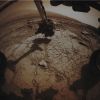
SOL0182-PIA16728-PCF-LXTT-IPF.jpgDrilling Time! - Sol 182 (Absolute Natural Colors; credits for the additional process. and color.: Dr Paolo C. Fienga/Lunar Explorer Italia/IPF)75 visitenessun commentoMareKromiumFeb 14, 2013
|
|
| 25353 immagini su 2113 pagina(e) |
 |
|
|
|
|
82 | |
|
|
|
|
|
|





