| |
| Ultimi arrivi |

Titan-Lakes-South_Polar_Lake-01-PIA06241-PCF-LXTT-IPF-001.jpgOntario Lacus and the South Polar Regions of Titan (Absolute Natural Colors; credits for the additional process. and color. Dr Paolo C. Fienga/Lunar Explorer Italia/Italian Planetary Foundation)97 visiteThis view of Titan’s South Pole reveals the intriguing Dark Feature named Ontario Lacus and a host of smaller features dotting the whole South Polar Region. The true nature of this Surface Feature, seen here at left of center, is not yet known with absolute certainty. However, the Feature’s extremely dark coloration, the shore-like smoothness of its perimeter, and its presence in an area where frequent Convective Storm Clouds have been observed by the NASA - Cassini Spacecraft and Earth-based telescopes, made it the best candidate for an open body of liquid on Titan when this image was taken, in June 2005. This interpretation has, afterwards, been strengthened by the sighting of Surface Features having similar morphologies, but this time in Titan’s North Polar Regions during the Fly-By of this Saturnian moon that occurred in late February of the AD 2007. The possibility that those Northern Features, the sizes of small Seas, are either completely or partially filled with Liquid Hydrocarbons has been significantly strengthened also by the Radar Data collected by Cassini and which overlap portions of the Northern Features seen by the Cassini's Imaging Science Subsystem.
Previously, scientists had speculated that Ontario Lacus might simply be a Broad Depression filled by dark, Solid Hydrocarbons falling from the Atmosphere onto Titan’s Surface. In this case, the smoothed outline might be the result of a process unrelated to Rainfall, such as a so-called "Sinkhole" (---> a cavity in the ground, especially in a limestone formation, caused by water erosion and providing a route for Surface Water to disappear) or a "Volcanic Caldera". However, the strong likelihood that the Dark and Smooth North Polar Features are actually Lakes and Seas has made imaging scientists more confident that Ontario Lacus, and the smaller Dark Features dotting the South Polar Regions of Titan, also hold liquid. If correct, this new revelation would mean that each Pole on Titan is, in fact, a large Wetlands Area. The brightest (and almost white) Features seen here (from about 3 to 6 o'clock of the picture), are Methane Clouds (perhaps mixed with Water-Ice Clouds).
The original frame that we show you today, was taken by the NASA - Cassini Spacecraft during the distant Fly-By of Titan that took place in June 6, of the AD 2005, by using a combination of Spectral Filters sensitive to Wavelengths of Polarized InfraRed Light, allowing Cassini to see through the obscuring smog of Titan's Atmosphere and all the way down to the Surface. The image was acquired from an approximate distance of 450.000 Km (such as about 279.450 miles) from Titan. Resolution in the original image is approximately 3 Km (such as 1,863 miles) per pixel.
This picture (which is an Original NASA - Cassini Spacecraft b/w frame published on the NASA - Planetary Photojournal and identified by the n. PIA 06241) has been additionally processed and then colorized, according to an educated guess carried out by Dr Paolo C. Fienga (LXTT-IPF), in Absolute Natural Colors (such as the colors that a human eye would actually perceive if someone were onboard the NASA - Cassini Spacecraft and then looked outside, towards the South Polar Region of the Saturnian moon Titan), by using an original technique created - and, in time, dramatically improved - by the Lunar Explorer Italia Team. Different colors, as well as different shades of the same color, mean, among others, the existence of different Elements present in the Atmosphere and on the Surface of Titan, each having a different Albedo (---> Reflectivity) and Chemical Composition.
Note: it is possible (but we, as IPF, have no way to be one-hundred-percent sure of such a circumstance), that the actual luminosity of the Albedo Features seen in this frame would appear, to an average human eye, way lower than it has been shown (better yet: interpreted) here.MareKromiumMar 11, 2013
|
|

Japetus-PIA08384-PCF-LXTT-IPF.jpgEngelier Crater (CTX Frame and EDM in Absolute Natural Colors; credits for the additional process. and color.: Dr Paolo C. Fienga/Lunar Explorer Italia/Italian Planetary Foundation)109 visiteThe NASA - Cassini Spacecraft captured, in the month of September of the AD 2007, the first High-Resolution glimpse of the bright Trailing Hemisphere of Saturn's moon Japetus. This Absolute Natural Color image-mosaic shows the entire Hemisphere of Japetus that was visible from the NASA - Cassini Spacecraft on the outbound leg of its encounter with the two-toned moon. Also shown here is the complicated Transition Region of Japetus (meaning the Region which is located in-between its Dark Leading Hemisphere and the Bright Trailing one). This Region, visible along the right side of the image, was observed in many of the images acquired by Cassini near the closest approach of the encounter.
Revealed here for the first time in detail are the Geologic Structures that mark the Trailing Hemisphere of Japetus. The Region appears to be Heavily Cratered, particularly in the North and South Polar Regions of the moon. Near the top of the mosaic, numerous Impact Features that hade been already caught in several frames obtained by the NASA - Voyager 2 Spacecraft during the Fly-By of Japetus that took place in the AD 1981, are well visible, including the Impact Craters Ogier and Charlemagne. However, the most prominent Topographic Feature in this view, in the bottom half of the mosaic, is the approx. 450-Km (such as about 280-miles) wide Engelier Impact Basin: one of at least 9 (nine) huge Impact Basins found on Japetus. In fact, the Engelier Impact Basin overlaps an older, similar-sized Impact Basin located to its South/East.
In many places of Japetus, the Dark Material (that is thought to be composed of Nitrogen-bearing Organic Compounds - called "Cyanides" -, as well as by Hydrated Minerals and other Carbonaceous Minerals) seems to "coat" the Equator-facing Slopes as well as the Floor of the Impact Basin. The distribution of this Dark Material as well as the variations in the color of the Bright Material that is spread all across the Trailing Hemisphere, will be crucial clues to solve (or, at least, ro clarify) if we really want to get a better understanding of the origin of Japetus' extremely peculiar bright-dark dual personality.
The view was acquired with the NASA - Cassini Spacecraft Narrow-Angle Camera on September 10, 2007, at a distance of about 73.000 Km (such as approx. 45.333 miles) from Japetus. This mosaic consists of 60 images covering 15 footprints across the Surface of Japetus. The view is an Orthographic Projection of the Saturnian moon that has been centered at 10,8° South Latitude, 246,5° West Longitude and which has a resolution of 426 meters (0,26 miles) per pixel. An Orthographic Projection (like this one) is something like the view that a distant observer would get by looking at a given Celestial Object through a telescope.
This frame (which is an Original NASA - Cassini Spacecraft false-color image mosaic published on the NASA - Planetary Photojournal with the ID n. PIA 08384) has been additionally processed, contrast enhanced, and then re-colorized in Absolute Natural Colors (such as the colors that a human eye would actually perceive if someone were onboard the NASA - Cassini Spacecraft and then looked outside, towards the bright Trailing Hemisphere of the Saturnian moon Japetus), by using an original technique created - and, in time, dramatically improved - by the Lunar Explorer Italia Team. Different colors, as well as different shades of the same color, mean, among others, the existence of different Elements present on the Surface of Japetus, each having a different Albedo (---> Reflectivity) and Chemical Composition.
Note: in the EDM (upper Right Side of the image-mosaic), a view of the Terrain located in the Transition Zone of Japetus. The Bright Material visible on the frozen Surface of Japetus is, most likely, Water Ice, while the Dark Material is, probably, a Carbonaceous Mineral.MareKromiumMar 11, 2013
|
|

Saturn-PIA10413-PCF-LXTT-IPF.jpgNorthern Swirls (Absolute Natural Colors; credits for the additional process. and color.: Dr Paolo C. Fienga/Lunar Explorer Italia/Italian Planetary Foundation)78 visiteSinuous and swirling Clouds (which appear to be extremely dense) and Hurricane-sized Vortices, mingle in Saturn's Northern Skies (in fact, this view looks toward a Region of Saturn that is located at about 70° North Latitude). Despite the level of detail that is visible here, the Region shown in today's APOD is wide enough to contain the planet Mars comfortably.
The image was taken with the NASA - Cassini Spacecraft's CB1 Spectral Filter, which is sensitive to Wavelengths of Visible Red Light centered at 619 nanometers. The view was acquired with the Spacecraft's Narrow-Angle Camera on May 23, 2008 at a distance of approximately 1,2 Million KiloMeters (such as about 745.200 miles) from Saturn. Image scale is roughly 7 Km (about 4,3 miles) per pixel.
This frame (which is a NASA - CASSINI Spacecraft Original b/w frame published on the NASA - Planetary Photojournal and identified by the serial n. PIA 10413) has been additionally processed and then colorized, according to an educated guess carried out by Dr Paolo C. Fienga (LXTT-IPF), in Absolute Natural Colors (such as the colors that a human eye would actually perceive if someone were onboard the NASA - Cassini Spacecraft and then looked outside, towards the Upper Atmosphere of Satun), by using an original technique created - and, in time, dramatically improved - by the Lunar Explorer Italia Team. Different colors, as well as different shades of the same color, mean, among others, the existence of different Elements in the Upper Atmosphere of Satun, each having a different Albedo (---> Reflectivity) and Chemical Composition.MareKromiumMar 11, 2013
|
|

Rhea-PIA14647-PCF-LXTT-IPF.jpgCrescent Rhea (Absolute Natural Colors; credits for the additional process. and color.: Dr Paolo C. Fienga/Lunar Explorer Italia/Italian Planetary Foundation)76 visiteThe NASA - Cassini Spacecraft captured, about four months ago, Saturn's moon Rhea during its Crescent Phase: a view, this one, which will never be visible from Earth. Near the Terminator, a few of Rhea's many Impact Craters show up their sharp and well defined outlines. With a diameter of approx. 950 miles (such as almost 1529 Km) Rhea is the Saturnian second-largest moon. This view looks toward the Leading Hemisphere of Rhea; North is up and rotated 12° to the right.
The image was taken in Visible Light with the NASA - Cassini Spacecraft Narrow-Angle Camera on November 6, 2012. The view was obtained at a distance of approximately 1,2 Million Miles (such as about 1,93 Million KiloMeters) from Rhea and at a Sun-Rhea-Cassini Spacecraft, or Phase, Angle of 129°. Scale in the original image was roughly 7 miles (approx. 11,26 Km) per pixel but, afterwards, the picture was magnified by a factor of 1.5 in order to enhance the visibility of some Surface Features.
This picture (which is an Original NASA - Cassini Spacecraft b/w frame published on the NASA - Planetary Photojournal with the ID n. PIA 14647) has been additionally processed, magnified (by applying a further 4.01 enlargement's factor) and then colorized, according to an educated guess carried out by Dr Paolo C. Fienga (LXTT-IPF), in Absolute Natural Colors (such as the colors that a human eye would actually perceive if someone were onboard the NASA - Cassini Spacecraft and then looked outside, towards the Saturnian moon Rhea), by using an original technique created - and, in time, dramatically improved - by the Lunar Explorer Italia Team. Different colors, as well as different shades of the same color, mean, among others, the existence of different Elements present on the Surface of Rhea, each having a different Albedo (---> Reflectivity) and Chemical Composition.MareKromiumMar 11, 2013
|
|

Craters-Unnamed_Crater-Terra_Cimmeria-PIA16266-PCF-LXTT-IPF.jpgUnnamed Crater with Gullies and Dunefield in Terra Cimmeria (Absolute Natural Colors; credits for the additional process. and color.: Dr Paolo C. Fienga/Lunar Explorer Italia/Italian Planetary Foundation)68 visiteIn this frame, taken by the NASA - Mars Odyssey Orbiter during its 49.393rd orbit around the Red Planet, several Gullies of different shapes, depths and sizes located on the Southern Rim of an Unnamed Impact Crater in Terra Cimmeria can be seen. As you may easily notice, there are way more Gullies on the North-facing Inner Rim (such as the Southern Inner Rim) of this Unnamed Crater, and the reason of such a remarkable difference is found, most likely, in the circumstance that the Southern Region of the Crater itself gets more Sun-related warming than the other one, which is corresponding to the South-facing Inner Rim (such as the Northern Inner Rim).
Also well visible towards the top of the picture, right at the base of the Northern Inner Slopes (Wall) of this Unnamed Cimmerian Impact Crater, there is a small and Dark Dunefield (probably formed - once you take into duly consideration the peculiar-looking shapes and surroundings of the Dunes forming it - by "Migrating Dunes". Dunes which may contain, among Dust, Rocky Sands and Volcanic Ashes, also a significant amount of Iron Oxide). It must be said, however, that a Surface Feature like this last one (---> the Dark Dunefield), is really very common, specifically at these Middle (Southern) Latitudes.
Latitude: 48,25° South
Longitude: 129,612° East
Instrument: VIS
Captured: February, 1st, 2013
This frame (which is an Original Mars Odyssey Orbiter b/w frame published on the NASA - Planetary Photojournal with the ID n. PIA 16266) has been additionally processed and then colorized in Absolute Natural Colors (such as the colors that a human eye would actually perceive if someone were onboard the NASA - Mars Odyssey Orbiter and then looked down, towards the Surface of Mars), by using an original technique created - and, in time, dramatically improved - by the Lunar Explorer Italia Team.MareKromiumMar 11, 2013
|
|

Coprates_Labes-PIA16271-PCF-LXTT-IPF.jpgCoprates Labes (Absolute Natural Colors; credits for the additional process. and color.: Dr Paolo C. Fienga/Lunar Explorer Italia/Italian Planetary Foundation)66 visiteThe finely ridged Materials visible in the upper portion of this NASA - Mars Odyssey Orbiter image - taken by the Spacecraft during its 49.450th orbit around the Red Planet - are huge Landslide (associated, most likely, with Mudslide) Deposits called Coprates Labes. These Deposits are found on the Floor of Coprates Chasma: a huge Canyon characterized by very steep Walls which is located in the Coprates Quadrangle of Mars, at 13,4° South Latitude and 61,4° West Longitude. Coprates Chasma is just a portion of the Valles Marineris Canyon System; it is approx. 966 Km (such as a little less than 600 miles) long and it got its name after a so-called "Classical Albedo Feature".
Latitude (centered): 11,7442° South
Longitude (centered): 292,003° East
Instrument: VIS
Captured: February, 5th, 2013
This frame (which is an Original Mars Odyssey Orbiter b/w frame published on the NASA - Planetary Photojournal with the ID n. PIA 16271) has been additionally processed and then colorized in Absolute Natural Colors (such as the colors that a human eye would actually perceive if someone were onboard the NASA - Mars Odyssey Orbiter and then looked down, towards the Surface of Mars), by using an original technique created - and, in time, dramatically improved - by the Lunar Explorer Italia Team.MareKromiumMar 11, 2013
|
|

ZZ-Mercury-Craters-Theophanes_Crater-PIA16868-PCF-LXTT-IPF.jpgTheophanes Crater (Absolute Natural Colors; credits for the additional process. and color.: Dr Paolo C. Fienga/Lunar Explorer Italia/Italian Planetary Foundation)67 visiteThis image, taken by the NASA - MESSENGER Spacecraft in the early October 2012, shows the ancient Mercurian Impact Crater Theophanes (whose diameter is approx. 46 Km - such as a little more than 28,5 miles), which was originally imaged by the NASA - Mariner 10 Spacecraft.
This Impact Crater was named after the Byzantine iconographer known as "Theophanes the Greek". Though he was born in Constantinople, the Capitol of the Byzantine Empire, around the AD 1340, Theophanes spent most of his life in Russia, where he moved in the AD 1370, and it was right there that he gained notoriety as an icon painter. Some of his more prominent works include Our Lady of the Don and the Transfiguration of Christ. He is also known as the teacher and mentor of the great medieval Russian painter Andrei Rublev, the eponym of another Impact Crater located in the Southern Hemisphere of Mercury.
As you can se, the Hollows which characterize Thophanes Crater are all concentrated in a relatively flat area going from the North-East of Theophanes' Complex Central Uplift, until its upper margin (---> Inner Rim), but only in that portion of its Floor that is located in between (approx.) 1 to 2 o'clock. The reason of such a peculiar configuration of Theophanes' Hollows is (obviuosly) so far unknown, even though we, as IPF, have a theory about it, which we shall try to explain in the future.
Date acquired: October, 3rd, 2012
Image Mission Elapsed Time (MET): 257735204
Image ID: 2694715
Instrument: Narrow Angle Camera (NAC) of the Mercury Dual Imaging System (MDIS)
Center Latitude: 5,04° South
Center Longitude: 217,2° East
Resolution: 74 meters/pixel
Solar Incidence Angle: 69,3° (meaning that the Sun, at the time that the pictures were taken, was about 20,7° above the imaged Local Mercurian Horizon)
Emission Angle: 2,2°
Sun-Mercury-Messenger (or "Phase") Angle: 71,6°
This picture (which is an Original NASA - MESSENGER Spacecraft b/w frame published on the NASA - Planetary Photojournal with the ID n. PIA 16868) has been additionally processed and then colorized in Absolute Natural Colors (such as the colors that a human eye would actually perceive if someone were onboard the NASA - MESSENGER Spacecraft and then looked down, towards the Surface of Mercury), by using an original technique created - and, in time, dramatically improved - by the Lunar Explorer Italia Team. Different colors, as well as different shades of the same color, mean, among other things, the existence of different Elements (Minerals) present on the Surface of Mercury, each having a different Albedo (---> Reflectivity) and Chemical Composition.MareKromiumMar 11, 2013
|
|

APOLLO_11_AS_11-37-5455-PCF-LXTT-IPF.jpgAS 11-37-5455 - Here's the "Flare-like light"! (Frame restored and recalibrated; credits: Dr Paolo C. Fienga/LXTT/IPF) 155 visiteThis is an historical picture taken by the NASA - Apollo 11 Astronaut "Buzz" Aldrin from his own window; it forms part of a five-frames panorama and it shows the Lunar Surface just after landing, with the Lunar Module shadow and the Lunar Horizon.
The "Flare-like Light" that is very well visible on the right (Dx) side of the frame, very close to the Horizon, is one of the many "misteries" that were found during the analysis of the whole Apollo - Moon Collection. Said that, the question is (relatively...) "simple": is this "Flare-like Light" a real - and, perhaps, just "temporary" - Feature of the Lunar Surface (a "flare", for instance, like it was originally speculated by Dr Paolo C. Fienga/LXTT/IPF, and then confirmed by a former Member of the Lunar and Planetary Institute), or is it just one of the very many image-artifacts (---> such as, basically, "defects" of the picture caused by some imperfection in the camera lenses and/or in the film itself) that can also be found in the Apollo - Moon Collection?
Of course we, as IPF, do not have a final answer to this question and, apparently, nobody does (even though a former NASA's Image Technician wrote us saying that the "shining light" was a true Surface Feature and, in his opinion, "...the result of Sunlight that was illuminating a distant - but highly reflective - boulder...". An opinion, this one, that we deeply respect but, honestly speaking, that we also consider extremely unlikely: consider, in fact, that no light whatsoever is visible in that precise spot in the frame that follows this one - such as AS 11 37-5456 -; a frame that was taken only a few seconds after AS 11 37-5455. Now, if this "light" was really just a reflection caused by Sunlight illuminating an highly reflective boulder, it is logical and reasonable to assume that the "reflection" should have still been very well visible over there, even a few seconds (and, maybe, also for a few minutes) after the time when "Buzz" took the first picture of his "Window Panorama". But this - we repeat: reasonable and logical - "circumstance", as a matter of fact, did not happen. The Flare-like Light (or the reflection, if you prefer) vanished very quickly. Why? Of course no answer even to this last question was ever given.
Anyway, the "Flare-like Light" (which may also look like a "Metallic Reflection" in the LPI frame) is there and, in a way, it keeps "asking" us to be recognized and identified, beyond any reasonable doubt, for what that it really was. Maybe, in the Future, we shall know more. Or, maybe (and most likely), the "Flare-like Light" shall remain a Lunar Mistery forever...
This bigger picture (which is an Original NASA - APOLLO 11 Spacecraft color frame published on the NASA - Apollo 11 Lunar Surface Journal with the ID n. AS 11-37-5455) has been additionally processed and then re-colorized in Absolute Natural Colors (such as the colors that a human eye would actually perceive if someone were onboard the NASA - Apollo 11 Lunar Module and then looked outside, towards the Surface and Horizon of the Moon), by using an original technique created - and, in time, dramatically improved - by the Lunar Explorer Italia Team. Different colors, as well as different shades of the same color, mean, among other things, the existence of different Elements (Minerals) present on the Surface of the Moon, each having a different Albedo (---> Reflectivity) and Chemical Composition.
The smaller (inset) picture, is also an Original NASA - APOLLO 11 Spacecraft color frame published by the Lunar and Planetary Institute (LPI) on the Apollo Image Atlas with the ID n. AS 11-37-5455. This second picture HAS NOT been additionally processed nor re-colorized by Lunar Explorer Italia.MareKromiumMar 08, 2013
|
|

ZZ-Mercury-Craters-Prokofiev_Crater-PIA16857-PCF-LXTT-IPF.jpgIn the Everlasting Night of Prokofiev Crater (Absolute Natural Colors; credits for the additional process. and color.: Dr Paolo C. Fienga - Lunar Explorer Italia/Italian Planetary Foundation)74 visiteProkofiev Crater, so officially named in August 2012 after the Russian composer, is the largest Impact Crater (with a diameter of approx. 112 Km - such as about 69,5 miles) located in Mercury's North Polar Region which hosts Radar-Bright Surface Material. Furthermore, the NASA - MESSENGER Spacecraft has also found evidence that within the cold, dark, and permanently shadowed Inner Regions of Prokofiev, Water Ice is exposed on the Mercurian Surface, just like it seems to happen on the Floors of extremely deep and steep Impact Craters and Canyons located near and at the Poles of our own Moon.
Date acquired: January, 17th, 2013
Image Mission Elapsed Time (MET): 266090610
Image ID: 3288616
Instrument: Wide Angle Camera (WAC) of the Mercury Dual Imaging System (MDIS)
Center Latitude: 84,90° North
Center Longitude: 68,75° East
Resolution: 70 meters/pixel
Solar Incidence Angle: 84,9° (meaning that the Sun, at the time that the pictures were taken, was about 5,1° above the imaged Local Mercurian Horizon)
Emission Angle: 6,1°
Sun-Mercury-Messenger (or "Phase") Angle: 78,8°
This picture (which is an Original NASA - MESSENGER Spacecraft b/w frame published on the NASA - Planetary Photojournal with the ID n. PIA 16857) has been additionally processed and then colorized in Absolute Natural Colors (such as the colors that a human eye would actually perceive if someone were onboard the NASA - MESSENGER Spacecraft and then looked down, towards the Surface of Mercury), by using an original technique created - and, in time, dramatically improved - by the Lunar Explorer Italia Team. Different colors, as well as different shades of the same color, mean, among other things, the existence of different Elements (Minerals) present on the Surface of Mercury, each having a different Albedo (---> Reflectivity) and Chemical Composition.
MareKromiumMar 08, 2013
|
|
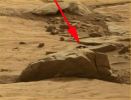
SOL0198-MR1007052000E1_DXXX-2-GB-LXTT-IPF-3.jpgExtremely unusually-looking Surface Feature on the Floor of Gale Crater: "The Mushroom" - Sol 198 (EDM - Enhanced Natural Colors; Credits: Dr Gianluigi Barca/LXTT/IPF)104 visitenessun commentoMareKromiumMar 08, 2013
|
|
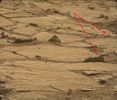
SOL0198-MR1007052000E1_DXXX-2-GB-LXTT-IPF-2.jpgExtremely unusually-looking Surface Features on the Floor of Gale Crater - Sol 198 (Calibrated Natural Colors; EDM: Absolute Natural Colors - Credits: Dr Gianluigi Barca/LXTT/IPF)108 visiteVi suggeriamo di focalizzare la Vostra attenzione sulla Feature situata più in basso rispetto al punto di osservazione di Curiosity.
L'apparenza, forse (e magari anche spesso), inganna... Ma il dettaglio scuro situato circa ad ore 3 del frame, a noi sembra un "Fungo" che si è piegato su se stesso (che si è "afflosciato" o "flesso", insomma). La texture ed il colore del dettaglio, comunque, mal si sposano con il macigno sul quale esso giace e le rocce che lo circondano e questa coppia di circostanze già ci dovrebbe spingere a pensar bene a quello che REALMENTE stiamo guardando.
Indicato dalla prima freccia, invece, una sorta di "Sauro" ma, in questo caso, visto frontalmente e che mostra occhi (simmetrici) e bocca. Per Onestà Intellettuale, riteniamo questo secondo particolare un possibile - e semplice - effetto ottico (un'illusione ottica, o pareidolia, in altre parole).
Ma sul "Fungo", sinceramente, noi riteniamo che bisognerebbe riflettere MOLTO BENE!...MareKromiumMar 08, 2013
|
|
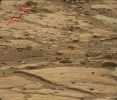
SOL0198-MR1007056000E1_DXXX-1-GB-LXTT-IPF-1.jpgExtremely unusually-looking Surface Features on the Floor of Gale Crater - Sol 198 (Calibrated Natural Colors; EDM: Absolute Natural Colors - Credits: Dr Gianluigi Barca/LXTT/IPF)108 visiteIndicate dalla freccia di color rosso, altre due straordinarie Features che "appaiono" sulla Superficie del Cratere Gale: la prima (quella più in alto), sembra (è) una sorte di "Proboscide" che sembra sbucare da una crepa o un foro; la seconda, ricorda tanto il corpo sinuoso di un Sauro, la cui "pelle" ha esattamente lo stesso colore della Superficie su cui giace. Ed anche in questo caso, un GRANDISSIMO COMPLIMENTO al nostro Vice-Presidente e Partner Storico, Dott. Gianluigi Barca (alisa Big "G"). Non possiamo "spiegare", perchè non ne abbiamo i mezzi. Possiamo solo invitarVi a GUARDARE e, se ci riuscite, a VEDERE...MareKromiumMar 08, 2013
|
|
| 25353 immagini su 2113 pagina(e) |
 |
|
|
|
|
80 | |
|
|
|
|
|
|





