| |
| Ultimi arrivi |

Janus-PIA14667-PCF-LXTT-IPF.jpgJanus, from far away... (Absolute Natural Colors; credits for the additional process. and color.: Dr Paolo C. Fienga/Lunar Explorer Italia/Italian Planetary Foundation)94 visiteIn this frame, we can see that the NASA - Cassini Spacecraft has recently caught a glimpse of Janus: an irregularly-shaped Minor Saturnian moon. Lacking sufficient gravity to pull itself into a round shape, Janus (which is approx. 111 miles - such as about 178,63 - across) has had its lumpy primordial shape only slightly modified by impacts since its formation. A huge Impact Crater can be seen on the upper left corner of the illuminated side of Janus, jointly with other barely visible Surface Details. Furthermore, if you look carefully (after bringing the image to its full size), a few more Surface Details that are found of that part of Janus that lies in the shadows, beyond the Terminator Line, can be (even though just barely) seen, jointly with the outline of the moon.
This view looks toward the Trailing Hemisphere of Janus. North on Janus is up and rotated 44° degrees to the left. The image was taken in Visible Light with the NASA - Cassini Spacecraft Narrow-Angle Camera on April 28, 2013; the view was obtained at a distance of approximately 780.000 miles (such as about 1.255.285 Million KiloMeters) from Janus and at a Sun-Janus-Cassini Spacecraft (or Phase), Angle of 77°. The mage scale is roughly 5 miles (such as 8,04 Km) per pixel.
This frame (which is an Original NASA - Cassini Spacecraft b/w frame published on the NASA - Planetary Photojournal with the ID n. PIA 14667) has been additionally processed, contrast enhanced, magnified and then colorized in Absolute Natural Colors (such as the colors that a human eye would actually perceive if someone were onboard the NASA - Cassini Spacecraft and then looked outside, towards the Saturnian moon Janus), by using an original technique created - and, in time, dramatically improved - by the Lunar Explorer Italia Team. Different colors, as well as different shades of the same color, mean, among others, the existence of different Elements present on the Surface of Janus, each having a different Albedo (---> Reflectivity) and Chemical Composition.MareKromiumLug 14, 2013
|
|

Janus-PIA14607-PCF-LXTT-IPF.jpgClosing-up on Janus (Absokute Natural Colors; credits for the additional process. and color.: Dr Paolo C. Fienga/Lunar Explorer Italia/Italian Planetary Foundation)90 visiteDark and deep Shadows were obscuring most part of Janus' cratered Surface, when the NASA - Cassini Spacecraft took a close look at this Saturnian moon during the Fly-By which occurred on March 27, 2012.
This view is centered on Terrain located at approx. at 13° South Latitude and 26° West Longitude. The image was taken in Visible Light with the NASA - Cassini Spacecraft Narrow-Angle Camera, at a distance of approximately 28.000 miles (such as about 45.061 Km) from Janus and at a Sun-Janus-Cassini Spacecraft , or Phase, Angle of 109°. Image scale is 892 feet (272 meters) per pixel.
This frame (which is an Original NASA - Cassini Spacecraft b/w frame published on the NASA - Planetary Photojournal with the ID n. PIA 14607) has been additionally processed, contrast enhanced, magnified and then colorized in Absolute Natural Colors (such as the colors that a human eye would actually perceive if someone were onboard the NASA - Cassini Spacecraft and then looked outside, towards the Saturnian moon Janus), by using an original technique created - and, in time, dramatically improved - by the Lunar Explorer Italia Team. Different colors, as well as different shades of the same color, mean, among others, the existence of different Elements present on the Surface of Janus, each having a different Albedo (---> Reflectivity) and Chemical Composition.MareKromiumLug 14, 2013
|
|

ZZ-Mercury-Craters-Unnamed_Crater-PIA17290-PCF-LXTT-IPF-0.jpgUnnamed and (relatively) Fresh Impact Crater (CTX Frame - Absolute Natural Colors; credits for the additional process. and color.: Dr Paolo C. Fienga/Lunar Explorer Italia/Italian Planetary Foundation)73 visiteThis Absolute Natural Color Image-Mosaic shows us a bright (and, of course, relatively speaking, "fresh") Impact Crater - approx. 33 Km (such as about 20,49 miles) in diameter - exhibiting possible evidence of a Pyroclastic Deposit on it's Eastern Side (---> Dx of the Crater for the Observer), as well as a series of Secondary Impact Craters which have unearthed some - still unknown - kind of Sub-Surface Material, barely visible (and lightly gray-colored) in the North-Eastern corner of the picture (---> upper right quadrant).
Date acquired: November, 6th, 2011
Images Mission Elapsed Time (MET): 229105596, 229105592, 229105588
Images ID: 980566, 980565, 980564
Instrument: Wide Angle Camera (WAC) of the Mercury Dual Imaging System (MDIS)
Center Latitude: 25,42° North
Center Longitude: 266,80° East
Solar Incidence Angle: 52,3° (meaning that the Sun, at the time that the picture was taken, was about 37,7° above the imaged Local Mercurian Horizon)
Emission Angle: 16,8°
Sun-Mercury-Messenger (or "Phase") Angle: 69,1°
This picture (which is an Original NASA - MESSENGER Spacecraft's false colors Map-Projected image-mosaic published on the NASA - Planetary Photojournal with the ID n. PIA 17290) has been additionally processed, contrast enhanced, magnified and then re-colorized in Absolute Natural Colors (such as the colors that a human eye would actually perceive if someone were onboard the NASA - MESSENGER Spacecraft and then looked down, towards the Surface of Mercury), by using an original technique created - and, in time, dramatically improved - by the Lunar Explorer Italia Team. Different colors, as well as different shades of the same color, mean, among other things, the existence of different Elements (Minerals) present on the Surface of Mercury, each having a different Albedo (---> Reflectivity) and Chemical Composition.MareKromiumLug 14, 2013
|
|
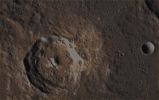
ZZ-Mercury-Craters-Unnamed_Crater-PIA17290-PCF-LXTT-IPF-1.jpgUnnamed and (relatively) Fresh Impact Crater (EDM - Absolute Natural Colors; credits for the additional process. and color.: Dr Paolo C. Fienga/Lunar Explorer Italia/Italian Planetary Foundation)69 visiteThis Absolute Natural Color Image-Mosaic shows us a bright (and, of course, relatively speaking, "fresh") Complex Mercurian Impact Crater - approx. 33 Km (such as about 20,49 miles) in diameter - that exhibits Terraced and Multi-Layered Inner Walls and Slopes - with some Collapse Feature (Mass-Wasting?) here and there -, an also quite Complex Central Peaks' System and, last but not least, the (more than just) possible evidence of a large Pyroclastic Deposit located on it's Eastern Side (---> Dx of the Crater for the Observer), and mostly concentrated in the Region going from about 1 to 4 o'clock of its Outer Surroundings.
Date acquired: November, 6th, 2011
Images Mission Elapsed Time (MET): 229105596, 229105592, 229105588
Images ID: 980566, 980565, 980564
Instrument: Wide Angle Camera (WAC) of the Mercury Dual Imaging System (MDIS)
Center Latitude: 25,42° North
Center Longitude: 266,80° East
Solar Incidence Angle: 52,3° (meaning that the Sun, at the time that the picture was taken, was about 37,7° above the imaged Local Mercurian Horizon)
Emission Angle: 16,8°
Sun-Mercury-Messenger (or "Phase") Angle: 69,1°
This picture (which is a crop from an Original NASA - MESSENGER Spacecraft's false colors Map-Projected image-mosaic published on the NASA - Planetary Photojournal with the ID n. PIA 17290) has been additionally processed, contrast enhanced, magnified and then re-colorized in Absolute Natural Colors (such as the colors that a human eye would actually perceive if someone were onboard the NASA - MESSENGER Spacecraft and then looked down, towards the Surface of Mercury), by using an original technique created - and, in time, dramatically improved - by the Lunar Explorer Italia Team. Different colors, as well as different shades of the same color, mean, among other things, the existence of different Elements (Minerals) present on the Surface of Mercury, each having a different Albedo (---> Reflectivity) and Chemical Composition.MareKromiumLug 14, 2013
|
|

Meridiani_Planum-ESP_032098_1785-PCF-LXTT-IPF.jpgFeatures of Meridiani Planum (Absolute Natural Colors; credits for the additional process. and color.: Dr Paolo C. Fienga/Lunar Explorer Italia/Italian Planetary Foundation)87 visiteIn this frame, taken by the NASA - Mars Reconnaissance Orbiter on the date of June, 1st, 2013, we can see a few interesting (although very common) Surface Features which characterize the Meridiani Planum Region of Mars. In particular, we can see an old and (still) Unnamed Impact Crater - with the "usual" Dunefield on its Floor - that is located on the very upper portion of the frame and just below a (relatively) Sand-free section of Surface known as "Martian Paving". Afterwards, moving down towards the South (such as towards the lower portion of the frame), we can find an area where there are many Sand Ripples and a few small Impact Craters. Finally, on the very lowest portion of the picture, we can also see more Sand Ripples, a number of Sand Dunes, several very small Impact Craters and quite a few Rocky Outcrops.
However, the Martian Surface pictured here, in our opinion (as IPF), and contrary to the common idea of how the Meridiani Planum Region of Mars is - generally - characterized and known (such as an almost totally plain and reliefs-free Region), is really far from being flat at all: as a matter of fact, if you observe the picture carefully, you will be able to notice that the whole area which has been photographed by the NASA - Mars Reconnaissance Orbiter (and, particularly, the area visible in the central and lower portion of the frame - meaning the one located to the South of the main visible Feature, such as the Unnamed Impact Crater) appears to show several points of Subsidence, a few Ridges and some (most likely very short and small) Hillocks.
Mars Local Time: 14:09 (Early Afternoon)
Coord. (centered): 1,584° South Lat. and 3,132° East Long.
Spacecraft altitude: 268,9 Km (such as about 166,986 miles)
Original image scale range: 26,9 cm/pixel (with 1 x 1 binning) so objects ~ 81 cm across are resolved
Map projected scale: 25 cm/pixel
Map projection: EQUIRECTANGULAR
Emission Angle: 0,0°
Phase Angle: 34,0°
Solar Incidence Angle: 34° (meaning that the Sun was about 56° above the Local Horizon at the time the picture was taken)
Solar Longitude: 328,5° (Northern Winter - Southern Summer)
Credits: NASA/JPL/University of Arizona
Additional process. and coloring: Lunar Explorer Italia
This picturee (which is a NASA - Original Mars Reconnaissance Orbiter NON-Map Projected b/w frame identified by the serial n. ESP_032098_1785) has been additionally processed and then colorized in Absolute Natural Colors (such as the colors that a human eye would actually perceive if someone were onboard the NASA - Mars Reconnaissance Orbiter and then looked down, towards the Surface of Mars), by using an original technique created - and, in time, dramatically improved - by the Lunar Explorer Italia Team.MareKromiumLug 14, 2013
|
|

OPP-SOL3355-PIA17271-PCF-LXTT-IPF-2.jpgSouthward View (Absolute Natural Colors; credits for the additional process. and color.: Dr Paolo C. Fienga/Lunar Explorer Italia/Italian Planetary Foundation)61 visiteThis very suggestive picture shows us some of the Terrain that the NASA - Mars Exploration Rover (MER) Opportunity is crossing in a (always relatively speaking) flat area of Endeavour Crater, called "Botany Bay", and located on the way toward "Solander Point," which is visible on the horizon.
The NASA - Mars Exploration Rover (MER) Opportunity used its Rear Hazard-Identification Camera (or HazCam, for short) to record this Southward view at the end of a drive covering about 387 feet (such as a little less than 118 meters) and which took place on the 3.355th Martian Day (or Sol) of Opportunity's work on Mars (such as July, 2nd, 2013 on Earth). Rover planners have been driving Opportunity in reverse, with the aim of to mitigatating a little bit the normal wearand tear on the Front - and so-called - "Wheel Actuators". For scale, the distance between the two Rear Wheels visible in the foreground is about 3,3 feet (a little more than 1 meter). The underside of Opportunity's Deck is visible at the top of the image. The Surface that the Rover (MER) Opportunity is driving upon, while crossing Botany Bay, is a Mosaic Pavement of fractured, light-toned Bedrock (---> the so-called "Martian Paving" of Meridiani Planum). A mixture of dark-toned Basaltic Soil and small Spherules - nicknamed "Blueberries" - fills-up most of the Cracks existing between the Bedrock pieces and, here and there, also thinly covers some of the Bedrock itself.
This frame (which is an Original NASA - Mars Exploration Rover (MER) "Opportunity" b/w image published on the NASA - Planetary Photojournal and identified by the ID n. PIA 17271) has been additionally processed, magnified and then colorized in Absolute Natural Colors (such as the colors that a normal - meaning "in the average" - human eye would actually perceive if someone were on the Surface of Mars, near the NASA - Mars Exploration Rover (MER) Opportunity, and then looked ahead, towards the Horizon and Sky over Endeavour Crater), by using an original technique created - and, in time, dramatically improved - by the Lunar Explorer Italia Team.MareKromiumLug 14, 2013
|
|

OPP-SOL3355-PIA17271-PCF-LXTT-IPF.jpgSouthward View (White-Balanced Natural Colors; credits for the additional process. and color.: Dr Paolo C. Fienga/Lunar Explorer Italia/Italian Planetary Foundation)110 visiteThis very suggestive picture shows us some of the Terrain that the NASA - Mars Exploration Rover (MER) Opportunity is crossing in a (always relatively speaking) flat area of Endeavour Crater, called "Botany Bay", and located on the way toward "Solander Point," which is visible on the horizon.
The NASA - Mars Exploration Rover (MER) Opportunity used its Rear Hazard-Identification Camera (or HazCam, for short) to record this Southward view at the end of a drive covering about 387 feet (such as a little less than 118 meters) and which took place on the 3.355th Martian Day (or Sol) of Opportunity's work on Mars (such as July, 2nd, 2013 on Earth). Rover planners have been driving Opportunity in reverse, with the aim of to mitigatating a little bit the normal wearand tear on the Front - and so-called - "Wheel Actuators". For scale, the distance between the two Rear Wheels visible in the foreground is about 3,3 feet (a little more than 1 meter). The underside of Opportunity's Deck is visible at the top of the image. The Surface that the Rover (MER) Opportunity is driving upon, while crossing Botany Bay, is a Mosaic Pavement of fractured, light-toned Bedrock (---> the so-called "Martian Paving" of Meridiani Planum). A mixture of dark-toned Basaltic Soil and small Spherules - nicknamed "Blueberries" - fills-up most of the Cracks existing between the Bedrock pieces and, here and there, also thinly covers some of the Bedrock itself.
This frame (which is an Original NASA - Mars Exploration Rover (MER) "Opportunity" b/w image published on the NASA - Planetary Photojournal and identified by the ID n. PIA 17271) has been additionally processed, magnified and then colorized in White-Balanced Natural Colors (such as the colors that a normal - meaning "in the average" - human eye would actually perceive if someone were on the Surface of Mars, near the NASA - Mars Exploration Rover (MER) Opportunity, and then looked ahead, towards the Horizon and Sky over Endeavour Crater), by using an original technique created - and, in time, dramatically improved - by the Lunar Explorer Italia Team.MareKromiumLug 14, 2013
|
|

ESP_032097_1810-PCF-LXTT-IPF.jpgEquatorial Dunefield (Absolute Natural Colors; credits for the additional process. and color. Dr Paolo C. Fienga/Lunar Explorer Italia/Italian Planetary Foundation)120 visiteMars Local Time: 14:08 (Early Afternoon)
Coord. (centered): 1,068° North Lat. and 30,111° East Long.
Spacecraft altitude: 268,9 Km (such as about 166,986 miles)
Original image scale range: 53,8 cm/pixel (with 2 x 2 binning) so objects ~ 1 mt and 61 cm across are resolved
Map projected scale: 50 cm/pixel
Map projection: EQUIRECTANGULAR
Emission Angle: 0,0°
Phase Angle: 34,9°
Solar Incidence Angle: 35° (meaning that the Sun was about 55° above the Local Horizon at the time the picture was taken)
Solar Longitude: 328,5° (Northern Winter - Southern Summer)
Credits: NASA/JPL/University of Arizona
Additional process. and coloring: Lunar Explorer Italia
This picture (which is a NASA - Original Mars Reconnaissance Orbiter NON-Map Projected CTX b/w frame identified by the serial n. ESP_032097_1810) has been additionally processed and then colorized in Absolute Natural Colors (such as the colors that a human eye would actually perceive if someone were onboard the NASA - Mars Reconnaissance Orbiter and then looked down, towards the Surface of Mars), by using an original technique created - and, in time, dramatically improved - by the Lunar Explorer Italia Team.MareKromiumLug 14, 2013
|
|

Saturn-North_Pole-PIA14945-PCF-LXTT-IPF.jpgNorth Polar Spring (Absolute Natural Colors; credits for the additional process. and color.: Dr Paolo C. Fienga/Lunar Explorer Italia/Italian Planetary Foundation)69 visiteThe North Pole of the Gas-Giant Planet Saturn, now illuminated by the fresh lights of the incoming Spring, is finally revealed in this image taken by the NASA - Cassini Spacecraft on November 27, 2012. As you know, the North Pole of Saturn has been hiding for a long time from the gaze of the Cassini's Imaging Cameras, and that circumstance was due to the fact that it was still Wintertime in (and therefore a deep darkness all over) the Northern Hemisphere of the Ringed Planet when the Spacecraft arrived in the Saturnian System in the AD 2004.
A Hurricane-like Storm circling Saturn's North Pole at about 89° North Latitude is also well visible inside the famous "Hexagon" Feature, which scientists think is a wandering Jet-Stream that whips around the North Pole of Saturn at a relatively constant mean speed of about 220 miles per hour (such as a little more than 354 Km per hour). Such a Jet-Stream it is folded into a six-sided shape because the Hexagon is a Stationary Wave that guides the path of the Gases existing inside the Jet itself. The Hexagon borders occur at about 77° North Latitude and the Feature is wider than two (flat) Earths. Last, but not least, a little section of the Rings of Saturn can also be seen in the upper right corner of the image.
This frame was acquired with the NASA - Cassini Spacecraft Wide-Angle Camera at a distance of approximately 260.000 miles (such as a little more than 418.000 Km) from the top of the Saturnian Clouds and at a Sun-Saturn-Cassini Spacecraft, or Phase, Angle of 96°. Image scale is roughly 18 miles (such as 28,968 Km) per pixel. For another image of the Hexagon and the Hurricane-like Storm that encircles the North Pole of Saturn, please refer to the APOD of December, 29, 2012.
This frame (which is a NASA - CASSINI Spacecraft Original Natural Color frame published on the NASA - Planetary Photojournal and identified by the serial n. PIA 14945) has been additionally processed, magnified, contrast enhanced and then re-colorized, according to an educated guess carried out by Dr Paolo C. Fienga (LXTT-IPF), in Absolute Natural Colors (such as the colors that a human eye would actually perceive if someone were onboard the NASA - Cassini Spacecraft and then looked outside, towards the North Pole of Satun), by using an original technique created - and, in time, dramatically improved - by the Lunar Explorer Italia Team. Different colors, as well as different shades of the same color, mean, among others, the existence of different Elements in the Upper Atmosphere of Satun, each having a different Albedo (---> Reflectivity) and Chemical Composition.MareKromiumGiu 16, 2013
|
|

Chasmas-Coprates_Chasma-PIA17224-PCF-LXTT-IPF.jpgFeatures of Coprates Chasma (Absolute Natural Colors; credits for the additional process. and color.: Dr Paolo C. Fienga/Lunar Explorer Italia/Italian Planetary Foundation)70 visiteIn this VIS image, taken by the NASA - Mars Odyssey Orbiter on March, 11, 2013 and during its 49.862nd orbit around the Red Planet, we can see that a large Landslide Deposit fills a portion of the Floor of Coprates Chasma: a huge and extremely long Canyon located the Coprates Quadrangle of Mars, at 13,4° South Latitude and 61,4° West Longitude. Coprates Chasma (---> the Abyss of Coprates) is part of the enormous Valles Marineris Canyon System and its length is of approx. 966 Km (such as about 599,88 miles).
Latitude (centered): 12,850° South
Longitude (centered): 293,254° East
Instrument: VIS
This frame (which is an Original Mars Odyssey Orbiter b/w frame published on the NASA - Planetary Photojournal with the ID n. PIA 17224) has been additionally processed, magnified, contrast enhanced and then colorized in Absolute Natural Colors (such as the colors that a human eye would actually perceive if someone were onboard the NASA - Mars Odyssey Orbiter and then looked down, towards the Surface of Mars), by using an original technique created - and, in time, dramatically improved - by the Lunar Explorer Italia Team.MareKromiumGiu 16, 2013
|
|

ZZ-Mercury-Terminator-PIA17229-PCF-LXTT-IPF.jpgSouthern Terminator (Absolute Natural Colors; credits for the additional process. and color.: Dr Paolo C. Fienga/Lunar Explorer Italia/Italian Planetary Foundation)110 visiteThis image-mosaic was created by combining two frames that were taken only 96 seconds apart from each other. It is obvious that the NASA - MESSENGER Spacecraft has to be farther away from the Planet Mercury (and, precisely, it must be in the Southern portion of its orbit) to acquire views like these. Mercury's heavily Cratered Surface is very well and really dramatically highlighted here - particularly in the Regions near the Terminator (such as the Boundary Line existing between the Sunlit Dayside and the Dark Nightside of the Planet) -, thus reflecting its, in a way, "violent" history; an history which saw this always mysterious and fascinating Celestial Body being impacted by thousands and thousands of objects (i.e.: Meteors, Comets and, probably, even a few small Asteroids), through the ages.
Date acquired: May 7th, 2013
Images Mission Elapsed Time (MET): 10234404, 10234500
Images ID: 4021801, 4021802
Instrument: Wide Angle Camera (WAC) of the Mercury Dual Imaging System (MDIS)
Center Latitude: 60,00° South
Center Longitude: 260,00° East
This picture (which is an Original NASA - MESSENGER Spacecraft's b/w Map-Projected frame published on the NASA - Planetary Photojournal with the ID n. PIA 17229) has been additionally processed, contrast enhanced, magnified and then colorized in Absolute Natural Colors (such as the colors that a human eye would actually perceive if someone were onboard the NASA - MESSENGER Spacecraft and then looked down, towards the Surface of Mercury), by using an original technique created - and, in time, dramatically improved - by the Lunar Explorer Italia Team. Different colors, as well as different shades of the same color, mean, among other things, the existence of different Elements (Minerals) present on the Surface of Mercury, each having a different Albedo (---> Reflectivity) and Chemical Composition.MareKromiumGiu 16, 2013
|
|

ZZ-Mercury-Craters-Tolstoj_Basin-PIA16663-PCF-LXTT-IPF.jpgTolstoj Basin and Surroundings (Absolute Natural Colors; credits for the additional process. and color.: Dr Paolo C. Fienga/Lunar Explorer Italia/Italian Planetary Foundation)63 visiteThis image of the Limb of the Planet Mercury shows, among other fascinating Surface Features, the location of the Impact Basin Tolstoj (approximately 350 Km - such as about 217,35 miles - in diameter). The interior of Tolstoj is filled with smooth Plains while the exterior is largely made of the so-called Low Reflectivity Material (or LRO, for short). Just to give to our Readers an idea of the real dimensions and proportions of what is visible on this part of Mercury, you have to consider that today's frame is approx. 2770 Km (such as about 1720,17 miles) across.
Date acquired: February 12th, 2013
Image Mission Elapsed Time (MET): 212797716
Image ID: 202274
Instrument: Wide Angle Camera (WAC) of the Mercury Dual Imaging System (MDIS)
Center Latitude: 8,04° South
Center Longitude: 200,07° East
Solar Incidence Angle: 60,1° (meaning that the Sun, at the time that the picture was taken, was about 29,9° above the imaged Local Mercurian Horizon)
Emission Angle: 48,1°
Sun-Mercury-Messenger (or "Phase") Angle: 96,8°
This picture (which is an Original NASA - MESSENGER Spacecraft's b/w Map-Projected frame published on the NASA - Planetary Photojournal with the ID n. PIA 16663) has been additionally processed, contrast enhanced, magnified and then colorized in Absolute Natural Colors (such as the colors that a human eye would actually perceive if someone were onboard the NASA - MESSENGER Spacecraft and then looked down, towards the Surface of Mercury), by using an original technique created - and, in time, dramatically improved - by the Lunar Explorer Italia Team. Different colors, as well as different shades of the same color, mean, among other things, the existence of different Elements (Minerals) present on the Surface of Mercury, each having a different Albedo (---> Reflectivity) and Chemical Composition.MareKromiumGiu 16, 2013
|
|
| 25353 immagini su 2113 pagina(e) |
 |
|
|
|
|
74 | |
|
|
|
|
|
|





