| |
| Ultimi arrivi |

The_Face_on_Mars_-_2-PCF-LXTT-IPF.jpgThe "Face" of Cydonia Mensae (CTX View - Absolute Natural Colors; credits for the additional process. and color.: Dr Paolo C. Fienga/Lunar Explorer Italia/Italian Planetary Foundation)114 visitenessun commentoMareKromiumOtt 23, 2013
|
|

The_Face_on_Mars_-_3-PCF-LXTT-IPF.jpgThe "Face" of Cydonia Mensae (EDM - Absolute Natural Colors; credits for the additional process. and color.: Dr Paolo C. Fienga/Lunar Explorer Italia/Italian Planetary Foundation)122 visitenessun commentoMareKromiumOtt 23, 2013
|
|

The_Pyramid_and_the_Castle-1-RAW_Frame.jpgThe "Pyramids" and the "Fort" (RAW Frame)147 visitenessun commentoMareKromiumOtt 23, 2013
|
|

The_Pyramid_and_the_Castle-2-Processed_and_colorized_Frame.jpgThe "Pyramids" and the "Fort" (Absolute Natural Colors; credits for the additional process. and color.: Dr Paolo C. Fienga/Lunar Explorer Italia/Italian Planetary Foundation)108 visitenessun commentoMareKromiumOtt 23, 2013
|
|

ZZ-Mercury-Craters-Neruda_Crater-PIA17515-PCF-LXTT-IPF-1.jpgNeruda Crater (EDM - Absolute Natural Colors; credits for the additional process. and color.: Dr Paolo C. Fienga/Lunar Explorer Italia/Italian Planetary Foundation)73 visiteThis frame is an Extra Detail Magnification (or "EDM", for short) featuring the Central Peaks' System of the Mercurian Impact Crater named "Neruda", after the Chilean poet Pablo Neruda (born on July, 12, 1904 in Parral - Chile - and died on September, 23, 1973 in the Chilean State's Capital, Santiago). As you can see, this Impact Crater (whose diameter is approx. 112 Km - such as about 69,55 miles) exhibits several Central Peaks punctuated by a few more recent, small Craters, resulting in a rugged Surface mostly made of ups and downs (and now think how difficult it would be if one hypothetical Astronaut decided - or just needed - to traverse the whole Crater's highly irregular Floor...). Similarly, the Crater's namesake Pablo Neruda experienced a number of ups and downs in his life, from success as a poet, through poverty, war and ultimately alleged poisoning.
Date acquired: July, 24th, 2012
Image Mission Elapsed Time (MET): 251577944
Image ID: 2256593
Instrument: Narrow Angle Camera (NAC) of the Mercury Dual Imaging System (MDIS)
Center Latitude: 52,20° South
Center Longitude: 125,30° East
Solar Incidence Angle: 80,4° (meaning that the Sun, at the time that the picture was taken, was about 9,6° above the imaged Local Mercurian Horizon)
Emission Angle: 2,4°
Sun-Mercury-Messenger (or "Phase") Angle: 78,0°
This picture (which is a crop taken from an Original NASA - MESSENGER Spacecraft's b/w and Map-Projected image published on the NASA - Planetary Photojournal with the ID n. PIA 17515) has been additionally processed, contrast enhanced, magnified to aid the visibility of the details and then colorized in Absolute Natural Colors (such as the colors that a human eye would actually perceive if someone were onboard the NASA - MESSENGER Spacecraft and then looked down, towards the Surface of Mercury), by using an original technique created - and, in time, dramatically improved - by the Lunar Explorer Italia Team. Different colors, as well as different shades of the same color, mean, among other things, the existence of different Elements (Minerals) present on the Surface of Mercury, each having a different Albedo (---> Reflectivity) and Chemical Composition.MareKromiumOtt 20, 2013
|
|

ZZ-Mercury-Craters-Neruda_Crater-PIA17515-PCF-LXTT-IPF-0.jpgNeruda Crater (CTX Frame - Absolute Natural Colors; credits for the additional process. and color.: Dr Paolo C. Fienga/Lunar Explorer Italia/Italian Planetary Foundation)70 visiteThis frame features the Mercurian Impact Crater named "Neruda", after the Chilean poet Pablo Neruda (born on July, 12, 1904 in Parral - Chile - and died on September, 23, 1973 in the Chilean State's Capital, Santiago). As you can see, this Impact Crater (whose diameter is approx. 112 Km - such as about 69,55 miles) exhibits several Central Peaks punctuated by a few more recent, small Craters, resulting in a rugged Surface mostly made of ups and downs (and now think how difficult it would be if one hypothetical Astronaut decided - or just needed - to traverse the whole Crater's highly irregular Floor...). Similarly, the Crater's namesake Pablo Neruda experienced a number of ups and downs in his life, from success as a poet, through poverty, war and ultimately alleged poisoning.
Date acquired: July, 24th, 2012
Image Mission Elapsed Time (MET): 251577944
Image ID: 2256593
Instrument: Narrow Angle Camera (NAC) of the Mercury Dual Imaging System (MDIS)
Center Latitude: 52,20° South
Center Longitude: 125,30° East
Solar Incidence Angle: 80,4° (meaning that the Sun, at the time that the picture was taken, was about 9,6° above the imaged Local Mercurian Horizon)
Emission Angle: 2,4°
Sun-Mercury-Messenger (or "Phase") Angle: 78,0°
This picture (which is an Original NASA - MESSENGER Spacecraft's b/w and Map-Projected image published on the NASA - Planetary Photojournal with the ID n. PIA 17515) has been additionally processed, contrast enhanced, magnified and then colorized in Absolute Natural Colors (such as the colors that a human eye would actually perceive if someone were onboard the NASA - MESSENGER Spacecraft and then looked down, towards the Surface of Mercury), by using an original technique created - and, in time, dramatically improved - by the Lunar Explorer Italia Team. Different colors, as well as different shades of the same color, mean, among other things, the existence of different Elements (Minerals) present on the Surface of Mercury, each having a different Albedo (---> Reflectivity) and Chemical Composition.MareKromiumOtt 20, 2013
|
|

Coprates_Chasma-PIA17517-PCF-LXTT-IPF.jpgFeatures of Coprates Chasma (Absolute Natural Colors; credits for the additional process. and color.: Dr Paolo C. Fienga/Lunar Explorer Italia/Italian Planetary Foundation)62 visiteIn this VIS image, taken by the NASA - Mars Odyssey Orbiter on August 12th, 2013, and during its 51.735th orbit around the Red Planet, we can see part of the Floor of Coprates Chasma, including a large Sand Sheet and a few smaller Dunes.
Latitude (centered): 13,967° South
Longitude (centered): 296,942° East
Instrument: VIS
This frame (taken from an Original Mars Odyssey Orbiter b/w and Map-Projected frame published on the NASA - Planetary Photojournal with the ID n. PIA 17517) has been additionally processed, magnified, contrast enhanced, Gamma corrected and then colorized in Absolute Natural Colors (such as the colors that a human eye would actually perceive if someone were onboard the NASA - Mars Odyssey Orbiter and then looked down, towards the Surface of Mars), by using an original technique created - and, in time, dramatically improved - by the Lunar Explorer Italia Team.MareKromiumOtt 20, 2013
|
|

Craters-Proctor_Crater-PIA17421-PCF-LXTT-IPF.jpgProctor Crater's Dunefield (Absolute Natural Colors; credits for the additional process. and color.: Dr Paolo C. Fienga/Lunar Explorer Italia/IPF)64 visiteIn this VIS image, taken by the NASA - Mars Odyssey Orbiter on July 4th, 2013, and during its 51.257th orbit around the Red Planet, we can see part of the very large Dunefield that is located located on the Floor of Proctor Crater (a large Impact Crater found in the Noachis Quadrangle of Mars, at about 48° South Latitude and 330,5° West Longitude).
Proctor Crater is approx. 168 Km (such as about 104,3 miles) in diameter and it was so named after Dr Richard A. Proctor, a British Astronomer (who was born in Chelsea - London, UK, on March, 23rd, 1837 and died in New York - USA - on September, 12th, 1888). Proctor Crater contains an approx. 35 x 65 Km (such as about 21,7 x 40,36 miles) Dark Dunefield that was one of the first Sand Dunefields ever recognized on Mars - note: this discovery was based on the NASA - Mariner 9 Spacecraft's images. Just out of curiosity, Proctor's Dunes are still being monitored by several Spacecrafts now orbiting the Red Planet (including the NASA- Mars Reconnaissance Orbiter) with the aim of identifying the changes (if any) which might have occurred - over time - in the shape of the Dunefield itself.
Latitude (centered): 47,4158° South
Longitude (centered): 30,9423° East
Instrument: VIS
This frame (taken from an Original Mars Odyssey Orbiter b/w and Map-Projected frame published on the NASA - Planetary Photojournal with the ID n. PIA 17421) has been additionally processed, magnified, contrast enhanced, Gamma corrected and then colorized in Absolute Natural Colors (such as the colors that a human eye would actually perceive if someone were onboard the NASA - Mars Odyssey Orbiter and then looked down, towards the Surface of Mars), by using an original technique created - and, in time, dramatically improved - by the Lunar Explorer Italia Team.MareKromiumOtt 20, 2013
|
|

Craters-Unnamed_Crater-NT-PIA17420-PCF-LXTT-IPF.jpgUnnamed Crater with Dunefield (Absolute Natural Colors; credits for the additional process. and color.: Dr Paolo C. Fienga/Lunar Explorer Italia/Italian Planetary Foundation)63 visiteIn this VIS image, taken by the NASA - Mars Odyssey Orbiter on July 2nd, 2013, and during its 51.232nd orbit around the Red Planet, we can see a relatively large, dark and, probably, "Migrating" Dunefield that is found on the Floor of an old and Unnamed Impact Crater located in the Martian Southern Region known as Noachis Terra.
Even this Dunefield (just like the one found on the Floor of Proctor Crater - please, refer to yesterday's APOD if you want to know more -, as well as many others, located on both Martian Hemispheres) is being monitored by several Spacecrafts now orbiting the Red Planet (including the NASA- Mars Reconnaissance Orbiter) with the aim of identifying the movements (---> shifting, if any) of the Dunefield and the changes (again, if any) which might have occurred - over time - in the shape of the Dunefield itself.
Latitude (centered): 52,1373° South
Longitude (centered): 30,6046° East
Instrument: VIS
This frame (taken from an Original Mars Odyssey Orbiter b/w and Map-Projected frame published on the NASA - Planetary Photojournal with the ID n. PIA 17420) has been additionally processed, magnified, contrast enhanced, Gamma corrected and then colorized in Absolute Natural Colors (such as the colors that a human eye would actually perceive if someone were onboard the NASA - Mars Odyssey Orbiter and then looked down, towards the Surface of Mars), by using an original technique created - and, in time, dramatically improved - by the Lunar Explorer Italia Team.MareKromiumOtt 20, 2013
|
|

SOL297-IT-01.jpgAnomalous Surface Features - Sol 297 (EDM n. 1 - by Ivana Tognoloni - Lunexit Team)125 visitenessun commentoMareKromiumOtt 20, 2013
|
|

SOL297-IT-02.jpgAnomalous Surface Features - Sol 297 (EDM n. 2 - by Ivana Tognoloni - Lunexit Team)84 visitenessun commentoMareKromiumOtt 20, 2013
|
|
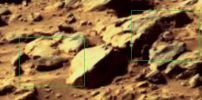
SOL297-IT-00.jpgAnomalous Surface Features - Sol 297 (CTX Frame - by Ivana Tognoloni - Lunexit Team)113 visiteDalla nostra Amica e Partner (di lunga data), Ivana Tognoloni, due rilievi - decisamente - "anomali" (o "peculiari, così qualche ignoto idiota la smetterà di chiamarci "Complottisti") ripresi dal Rover Spirit, durante il suo 297mo Sol di Esplorazione del Cratere Gusev. In questo Context Frame, i due rilievi potrebbero sfuggire ad un occhio non abituato, ma le successive magnificazioni, chiariranno le nostre perplessità. Si tratta di Rocce dalla forma "Unica"? Sono "Pseudo-Rocce"? Sono "Fossili"? Sono "Illusioni Ottiche"? NESSUNO può essere certo di nulla, dato che gli Amici di Pasadena (ed i loro accoliti), su queste problematiche, non hanno mai speso una parola. Sarà, forse, perché è "inutile", come dicono "quelli che sanno tutto" (i soliti anonimi codardi da Forum che, forse, spendono tutti i loro week-ends su Marte....), o forse sarà perché è "scomodo" tentare di interpretare l'ininterpretabile (come sosteniamo noi). La Verità? Quella, come sempre, decidetela Voi. Noi Vi diamo il materiale su cui riflettere.
Il resto, fatelo Voi: possibilmente usando Prudenza ed Educazione. Un GRANDE Ringraziamento ad Ivana, come sempre.MareKromiumOtt 20, 2013
|
|
| 25353 immagini su 2113 pagina(e) |
 |
|
|
|
|
72 | |
|
|
|
|
|
|





