| |
| Ultimi arrivi |

ZZ-Mercury-Craters-Mena_Crater-PIA15202-PCF-LXTT-IPF-00.jpgMena Crater, in context (Possible Absolute Natural Colors; credits for the additional process. and color.: Dr Paolo C. Fienga/Lunar Explorer Italia/Italian Planetary Foundation)60 visiteThe (relatively) young Rays of Mena Crater (approx. 15 Km - such as about 9,315 miles - in diameter) contrast brightly against the surrounding Mercurian Surface, though these beautiful and colorful Rays will gradually fade, and disappear, with time (Eons, in fact).
Furthermore, the asymmetric pattern of the Rays themselves, with an obvious gap in their South-Western direction, may be due to the angle at which the Impact that formed the Crater occurred or, maybe, it can also be due to the circumstance that Mena Crater formed on a very uneven Surface, such as just right on top of the Outer Rim of a larger, pre-existing, Impact Crater, as it can well be seen in this contextual image-mosaic. We, as IPF, believe that the second scenario which was mentioned herebefore is quite more plausible than the first one (even though a combination of the two scenarios/factors cannot be excluded).
Date acquired: November, 12th, 2011
Images Mission Elapsed Time (MET): 229581348, 229581352, 229581356
Images ID: 1003074, 1003075, 1003076
Instrument: Wide Angle Camera (WAC) of the Mercury Dual Imaging System (MDIS)
Center Latitude: 0,97° South
Center Longitude: 234,00° East
Solar Incidence Angle: 29,7° (meaning that the Sun, at the time that the picture was taken, was about 60,3° above the imaged Local Mercurian Horizon)
Emission Angle: 16,3°
Sun-Mercury-Messenger (or "Phase") Angle: 46,0°
This frame (which is an Original NASA - MESSENGER Spacecraft's false colors and Map-Projected image-mosaic published on the NASA - Planetary Photojournal with the ID n. PIA 15202) has been additionally processed, contrast enhanced, magnified to aid the visibility of the details, Gamma corrected and then re-colorized in Absolute Natural Colors (such as the colors that a human eye would actually perceive if someone were onboard the NASA - MESSENGER Spacecraft and then looked down, towards the Western Edge of the Mercurian Impact Crater "Mena"), by using an original technique created - and, in time, dramatically improved - by the Lunar Explorer Italia Team. Different colors, as well as different shades of the same color, mean, among other things, the existence of different Elements (Minerals) present on the Surface of Mercury, each having a different Albedo (---> Reflectivity) and Chemical Composition.MareKromiumDic 26, 2013
|
|

ZZ-Mercury-Craters-Damer_Crater-PIA17812-PCF-LXTT-IPF.jpgThe Walls of Damer (Absolute Natural Colors; credits for the additional process. and color. Dr Paolo C. Fienga/Lunar Explorer Italia/Italian Planetary Foundation)58 visiteThe (relatively) steep Walls of the Impact Crater named Damer are well highlighted in today's APOD. Named after the English sculptor, Anne Seymour Damer (née Conway, she was born in Sevenoaks - UK - on November, 8, 1749 and died in London on May, 28, 1828) earlier this year by the International Astronomical Union (or "IAU", for short), this approx. 60-Km diameter (such as about 37,26 miles) Impact Crater is distinguished by a massive and complex Central Peak that is almost completely covered with Hollows.
Date acquired: November, 13th, 2013
Images Mission Elapsed Time (MET): 26687033
Images ID: 5191249
Instrument: Narrow Angle Camera (NAC) of the Mercury Dual Imaging System (MDIS)
Center Latitude: 36,25° North
Center Longitude: 243,40° East
Solar Incidence Angle: 68,3° (meaning that the Sun, at the time that the picture was taken, was about 21,7° above the imaged Local Mercurian Horizon)
Emission Angle: 3,0°
Sun-Mercury-Messenger (or "Phase") Angle: 65,3°
This frame (which is an Original NASA - MESSENGER Spacecraft's b/w and NON Map-Projected image-mosaic published on the NASA - Planetary Photojournal with the ID n. PIA 17812) has been additionally processed, contrast enhanced, magnified to aid the visibility of the details, Gamma corrected and then colorized in Absolute Natural Colors (such as the colors that a human eye would actually perceive if someone were onboard the NASA - MESSENGER Spacecraft and then looked down, towards the Western Edge of the Mercurian Impact Crater "Damer"), by using an original technique created - and, in time, dramatically improved - by the Lunar Explorer Italia Team. Different colors, as well as different shades of the same color, mean, among other things, the existence of different Elements (Minerals) present on the Surface of Mercury, each having a different Albedo (---> Reflectivity) and Chemical Composition.MareKromiumDic 26, 2013
|
|

Aeolian_Features-Windstreaks-SMP-PIA17683-PCF-LXTT-IPF.jpgWindstreaks in Syrtis Major Planum (EDM - Absolute Natural Colors; credits for the additional process. and color.: Dr Paolo C. Fienga/Lunar Explorer Italia/Italian Planetary Foundation)84 visiteIn this VIS image, taken by the NASA - Mars Odyssey Orbiter on September, 24th, 2013, and during its 52.254th orbit around the Red Planet, we can see (an count) a series of at least 8 (eight) Windstreaks (probably the most common Aeolian - meaning Wind-caused/related - Surface Feature found on Mars), which are located in the (VERY dark, as far as its Albedo - Reflectivity - is concerned) Region known as Syrtis Major Planum.
Syrtis Major Planum - when observed through a telescope - looks like a "Dark Spot" (---> Albedo Feature) located at the Boundary between the Northern Lowlands and Southern Highlands of Mars, just West of the large Impact Basin known as Isidis Planitia. In fact, Syrtis Major Planum was discovered, on the base of data collected by the NASA - Mars Global Surveyor Orbiter, to be a low-relief Shield Volcano, when it was formerly believed to be just a Plain (and it was then known as Syrtis Major Planitia). The very dark color of its Surface comes - most likely - from the Basaltic Volcanic Rocks that form (---> are found all over) the Region and a corresponding (and relative) relative lack of the Red/Orange Dust that covers most of the Red Planet.
Latitude (centered): 5,90248° North
Longitude (centered): 69,73730° East
Instrument: VIS
This image (which is an Original Mars Odyssey Orbiter b/w and Map-Projected frame published on the NASA - Planetary Photojournal with the ID n. PIA 17683) has been additionally processed, magnified, contrast enhanced, Gamma corrected and then colorized in Absolute Natural Colors (such as the colors that a human eye would actually perceive if someone were onboard the NASA - Mars Odyssey Orbiter and then looked down, towards the Surface of Mars), by using an original technique created - and, in time, dramatically improved - by the Lunar Explorer Italia Team.MareKromiumNov 25, 2013
|
|

OPP-SOL3466-PIA17585-PCF-LXTT-IPF.jpgOn the Outer Rim of Endeavour Crater (Image-Mosaic - Absolute Natural Colors; credits for the additional process. and color. Dr Paolo C. Fienga/Lunar Explorer Italia/Italian Planetary Foundation)97 visiteThis is an image-mosaic that shows us the lower reaches of an area of Meridiani Planum (please, remember that we are now very close to the Outer Rim of the large Endeavour Crater) that is informally known as "Murray Ridge". The individual images that were used to create this mosaic were all acquired during the 3466th Sol (such as October, 24, 2013 on Earth) of exploration of the Martian peri-Equatorial Region of Meridiani Planum, by using the Navigation Camera (or "NavCam", for short) that is onboard the NASA - Mars Exploration Rover (MER) - "Opportunity".
This Ridge, as we mentioned herebefore, is part of the Outer Rim of Endeavour Crater and it has been identified by the Opportunity's Science Team as an important Site for scientific exploration. The Ridge has been (so far) informally named "Murray Ridge" to honor the late Dr Bruce Murray, who made fundamental advances in Mars Science and who led the NASA's Jet Propulsion Laboratory through a period of great challenges and achievements.
This frame (which is an Original NASA - Mars Exploration Rover (MER) - "Opportunity" Original b/w image published on the NASA - Planetary Photojournal and identified by the ID n. PIA 17585) has been additionally processed (where the additional processing has been based on the assumption that the Atmospheric Opacity - "TAU" - of the pictured area was LOW), Gamma corrected and then colorized in Absolute Natural Colors (such as the colors that a normal - meaning "in the average" - human eye would actually perceive if someone were on the Surface of Mars, near the NASA - Mars Exploration Rover (MER) - Opportunity, and then looked ahead, towards the Surface, Horizon and Sky over Endeavour Crater), by using an original technique created - and, in time, dramatically improved - by the Lunar Explorer Italia Team.
Note: please consider that the Martian Sky (as it has been colored and represented in this picture) appears extremely dark because quite a few of the frames used to make the mosaic were taken during the hours of the Martian Middle/Late Afternoon, such as during that period of the day when the luminosity of the Martian Sky itself (better yetç: that porton of it which is not near, around and/or right above the Sun's disk) drops rapidly and dramatically.MareKromiumNov 25, 2013
|
|

ZZ-Mercury-Craters-Unnamed_Craters-CB-PIA17692-PCF-LXTT-IPF-1.jpgOn the Edge of Caloris Basin (EDM - Possible Absolute Natural Colors; credits for the additional process. and color. Dr Paolo C. Fienga/Lunar Explorer Italia/Italian Planetary Foundation)65 visiteThis picture, which is an Extra Detail Magnification (or "EDM" for short) of a crop taken from an image-mosaic made of 3 (three) frames obtained by the NASA - MESSENGER Spacecraft on October, 24, 2013, features, in particular, two Unnamed Impact Craters (being the larger one, visible at the top of the image, approximately 54 Km - such as about 33,53 miles - in diameter) that are located in the proximities of the Eastern Edge of the Giant Caloris Basin. These two large Unnamed Impact Craters have excavated (at the time of their formation, and according to NASA's Scientists) "Low Reflectance Material", and they both show extrenmly bright Hollows (which, in fact, caused an oversaturation of the picture in the areas where thay are present) within their relatively flat Floors.
The Orange/Reddish Deposits visible in the North/Eastern Quadrant (---> upper right corner) of the scene, exhibit a so-called "Spectral Signature" that is similar to the one usually left by Pyroclastic Deposits, and this circumstance suggests that this Region (just like way many others on Mercury) might have, once, been the Site of Explosive Volcanism.
Date acquired: October, 24th, 2013
Images Mission Elapsed Time (MET): 24470528, 24960452, 24470516
Images ID: 5033545, 5068359, 5033542
Instrument: Wide Angle Camera (WAC) of the Mercury Dual Imaging System (MDIS)
Center Latitude: 23,72° North
Center Longitude: 179,10° East
Solar Incidence Angle: 24,8° (meaning that the Sun, at the time that the picture was taken, was about 65,2° above the imaged Local Mercurian Horizon)
Emission Angle: 8,4°
Sun-Mercury-Messenger (or "Phase") Angle: 33,2°
This frame (which is an an Extra Detail Magnification (or "EDM" for short) of a crop taken from an Original NASA - MESSENGER Spacecraft's False Colors and Map-Projected image-mosaic published on the NASA - Planetary Photojournal with the ID n. PIA 17692) has been additionally processed, contrast enhanced, magnified to aid the visibility of the smaller details, Gamma corrected and then re-colorized in Absolute Natural Colors (such as the colors that a human eye would actually perceive if someone were onboard the NASA - MESSENGER Spacecraft and then looked down, towards the Surface of Mercury), by using an original technique created - and, in time, dramatically improved - by the Lunar Explorer Italia Team. Different colors, as well as different shades of the same color, mean, among other things, the existence of different Elements (Minerals) present on the Surface of Mercury, each having a different Albedo (---> Reflectivity) and Chemical Composition.MareKromiumNov 25, 2013
|
|

ZZ-Mercury-Craters-Unnamed_Craters-CB-PIA17692-PCF-LXTT-IPF-0.jpgOn the Edge of Caloris Basin (CTX Frame - Possible Absolute Natural Colors; credits for the additional process. and color. Dr Paolo C. Fienga/Lunar Explorer Italia/Italian Planetary Foundation)83 visiteThis picture, which is an image-mosaic made of 3 (three) frames taken by the NASA - MESSENGER Spacecraft on October, 24, 2013, features several Unnamed Impact Craters (being the larger one, visible near the top of the image, approximately 54 Km - such as about 33,53 miles - in diameter) that are all located in the proximities of the Eastern Edge of the Giant Caloris Basin. The two larger Unnamed Impact Craters seen here have excavated (obviously, at the time of their formation, and according to NASA's Scientists) "Low Reflectance Material", and they both show extrenmly bright Hollows (which, in fact, caused an oversaturation of the picture in the areas where thay are present) within their relatively flat Floors.
The Orange/Reddish Deposits visible in the North/Eastern Quadrant (---> center and upper right corner) of the scene, exhibit a so-called "Spectral Signature" that is similar to the one usually left by Pyroclastic Deposits, and this circumstance suggests that this Region (just like way many others on Mercury) might have, once, been the Site of Explosive Volcanism.
Date acquired: October, 24th, 2013
Images Mission Elapsed Time (MET): 24470528, 24960452, 24470516
Images ID: 5033545, 5068359, 5033542
Instrument: Wide Angle Camera (WAC) of the Mercury Dual Imaging System (MDIS)
Center Latitude: 23,72° North
Center Longitude: 179,10° East
Solar Incidence Angle: 24,8° (meaning that the Sun, at the time that the picture was taken, was about 65,2° above the imaged Local Mercurian Horizon)
Emission Angle: 8,4°
Sun-Mercury-Messenger (or "Phase") Angle: 33,2°
This frame (which is an Original NASA - MESSENGER Spacecraft's False Colors and Map-Projected image-mosaic published on the NASA - Planetary Photojournal with the ID n. PIA 17692) has been additionally processed, contrast enhanced, magnified to aid the visibility of the details, Gamma corrected and then re-colorized in Absolute Natural Colors (such as the colors that a human eye would actually perceive if someone were onboard the NASA - MESSENGER Spacecraft and then looked down, towards the Surface of Mercury), by using an original technique created - and, in time, dramatically improved - by the Lunar Explorer Italia Team. Different colors, as well as different shades of the same color, mean, among other things, the existence of different Elements (Minerals) present on the Surface of Mercury, each having a different Albedo (---> Reflectivity) and Chemical Composition.MareKromiumNov 25, 2013
|
|

Chasma-Ophir_Chasma-PIA17702-PCF-LXTT-IPF.jpgFeatures of Ophir Chasma (EDM - Absolute Natural Colors; credits for the additional process. and color.: Dr Paolo C. Fienga/Lunar Explorer Italia/Italian Planetary Foundation)72 visiteThe really huge Landslides existing along the Walls of Ophir Chasma (which is nothing else but a deep Canyon located in the Coprates Quadrangle of Mars, at about 4° South Latitude and 72,5° West Longitude. It is approx. 317 km long and it was so named after a "Classical Albedo Feature") host a variety of Geologic Surfaces and Mineralogies.
Some of them possess a variety of Hydrated Sulfate Minerals that formed, eons ago, in the presence of Partially Acidic Liquid Water. This NASA - Mars Reconnaissance Orbiter's Contextual (or "CTX", for short) Image, which is representing an ancient (possibly and approximately 3 Billion Years-old) Landslide, shows us the presence, within it, of 2 (two) very distinct Surface Albedoes, which, in fact, mark a Transition Zone from one Sulfate Mineralogy to another (a circumstance that proves beyod doubts the occurrence, in a far and distant past, of some remarkable variations in the evolution of the visible Surface).
The Upper Slopes (such as the ones located towards the North) are light-toned, and this fact is due to the concurrent abundance of Hydrated Sulfate Minerals and Bright Surface Dust. On the other hand, the Surfaces that make up the Southern Portion of the Landslide, are darker in tone, and this is due to the greater abundance of Dark Sediment that, in time, formed "Strings of Sand Drifts" (extremely well visible in this Extra Detail Magnification). In addition to the above, the underlying Units of Bedrock consist of Darker Minerals that received a lesser hydration then the Northern ones, and this further circumstance implies the occurrence of a strong (and, perhaps, sudden) change in the Ancient Aqueous Environments that formed them.
Mars Local Time: 14:52 (Early Afternoon)
Coord. (centered): 4,328° South Lat. and 288,657° East Long.
Spacecraft altitude: 271,0 Km (such as about 168,291 miles)
Original image scale range: 27,1 cm/pixel (with 1 x 1 binning) so objects ~ 81 cm across are resolved
Map projected scale: 25 cm/pixel
Map projection: EQUIRECTANGULAR
Emission Angle: 6,3°
Phase Angle: 52,7°
Solar Incidence Angle: 47° (meaning that the Sun was about 43° above the Local Horizon at the time the picture was taken)
Solar Longitude: 27,0° (Northern Spring - Southern Fall)
Credits: NASA/JPL/University of Arizona
Additional process. and coloring: Lunar Explorer Italia
This picture (which is an Original NASA - Original Mars Reconnaissance Orbiter - False Colors and NON-Map Projected sub-frame identified by the serial n. PSP_007535_1755-1) has been additionally processed, magnified, contrast enhanced, Gamma corrected, and then re-colorized in Absolute Natural Colors (such as the colors that a human eye would actually perceive if someone were onboard the NASA - Mars Reconnaissance Orbiter and then looked down, towards the Surface of Mars), by using an original technique created - and, in time, dramatically improved - by the Lunar Explorer Italia Team.MareKromiumNov 25, 2013
|
|

Chasma-Ophir_Chasma-PSP_007535_1755-PCF-LXTT-IPF.jpgFeatures of Ophir Chasma (CTX Frame - Absolute Natural Colors; credits for the additional process. and color.: Dr Paolo C. Fienga/Lunar Explorer Italia/Italian Planetary Foundation)64 visiteThe really huge Landslides existing along the Walls of Ophir Chasma (which is nothing else but a deep Canyon located in the Coprates Quadrangle of Mars, at about 4° South Latitude and 72,5° West Longitude. It is approx. 317 km long and it was so named after a "Classical Albedo Feature") host a variety of Geologic Surfaces and Mineralogies.
Some of them possess a variety of Hydrated Sulfate Minerals that formed, eons ago, in the presence of Partially Acidic Liquid Water. This NASA - Mars Reconnaissance Orbiter's Contextual (or "CTX", for short) Image, which is representing an ancient (possibly and approximately 3 Billion Years-old) Landslide, shows us the presence, within it, of 2 (two) very distinct Surface Albedoes, which, in fact, mark a Transition Zone from one Sulfate Mineralogy to another (a circumstance that proves beyod doubts the occurrence, in a far and distant past, of some remarkable variations in the evolution of the visible Surface).
The Upper Slopes (such as the ones located towards the North) are light-toned, and this fact is due to the concurrent abundance of Hydrated Sulfate Minerals and Bright Surface Dust. On the other hand, the Surfaces that make up the Southern Portion of the Landslide, are darker in tone, and this is due to the greater abundance of Dark Sediment that, in time, formed "Strings of Sand Drifts". In addition to the above, the underlying Units of Bedrock consist of Darker Minerals that received a lesser hydration then the Northern ones, and this further circumstance implies the occurrence of a strong (and, perhaps, sudden) change in the Ancient Aqueous Environments that formed them.
Mars Local Time: 14:52 (Early Afternoon)
Coord. (centered): 4,328° South Lat. and 288,657° East Long.
Spacecraft altitude: 271,0 Km (such as about 168,291 miles)
Original image scale range: 27,1 cm/pixel (with 1 x 1 binning) so objects ~ 81 cm across are resolved
Map projected scale: 25 cm/pixel
Map projection: EQUIRECTANGULAR
Emission Angle: 6,3°
Phase Angle: 52,7°
Solar Incidence Angle: 47° (meaning that the Sun was about 43° above the Local Horizon at the time the picture was taken)
Solar Longitude: 27,0° (Northern Spring - Southern Fall)
Credits: NASA/JPL/University of Arizona
Additional process. and coloring: Lunar Explorer Italia
This picture (which is a NASA - Original Mars Reconnaissance Orbiter b/w and NON-Map Projected frame identified by the serial n. PSP_007535_1755) has been additionally processed, magnified, contrast enhanced, Gamma corrected, and then colorized in Absolute Natural Colors (such as the colors that a human eye would actually perceive if someone were onboard the NASA - Mars Reconnaissance Orbiter and then looked down, towards the Surface of Mars), by using an original technique created - and, in time, dramatically improved - by the Lunar Explorer Italia Team.MareKromiumNov 25, 2013
|
|

Chasma-Echus_Chasma-Fractures-ESP_033591_1805-PCF-LXTT-IPF.jpgFeatures of Echus Chasma (CTX Frame - Absolute Natural Colors; credits for the additional process. and color.: Dr Paolo C. Fienga/Lunar Explorer Italia/Italian Planetary Foundation)71 visiteIn this image, we can see a so-called "Intersection Area" created by a number of Fractures (or, perhaps, Fissures and/or Water or Lava-carved narrow Channels) which are all located on the Floor of Echus Chasma (an Equatorial Chasma found in the Lunae Planum High Plateau Region of Mars, slightly to the North of the gigantic Valles Marineris Canyon System, and approx. 100 Km long and 10 Km wide).
Echus Chasma contains several Valleys which range - as far as their depth is concerned - from about 1 to 4 Km, and it is now considered, by Planetary Scientists, to be the Water Source Region that allowed the formation and then the (relevant) water-supply of the Kasei Valles Outflow Channel: a large Valley that extends for thousands of kilometers towards the North of the Red Planet.
Mars Local Time: 14:36 (Early Afternoon)
Coord. (centered): 0,377° North Lat. and 279,483° East Long.
Spacecraft altitude: 269,1 Km (such as about 161,111 miles)
Original image scale range: 53,8 cm/pixel (with 2 x 2 binning) so objects ~ 1 mt and 62 cm across are resolved
Map projected scale: 50 cm/pixel
Map projection: EQUIRECTANGULAR
Emission Angle: 7,7°
Phase Angle: 47,6°
Solar Incidence Angle: 40° (meaning that the Sun was about 50° above the Local Horizon at the time the picture was taken)
Solar Longitude: 27,0° (Northern Spring - Southern Fall)
Credits: NASA/JPL/University of Arizona
Additional process. and coloring: Lunar Explorer Italia
This picture (which is a NASA - Original Mars Reconnaissance Orbiter b/w and NON-Map Projected frame identified by the serial n. ESP_033591_1805) has been additionally processed, magnified, contrast enhanced, Gamma corrected, and then colorized in Absolute Natural Colors (such as the colors that a human eye would actually perceive if someone were onboard the NASA - Mars Reconnaissance Orbiter and then looked down, towards the Surface of Mars), by using an original technique created - and, in time, dramatically improved - by the Lunar Explorer Italia Team.MareKromiumNov 25, 2013
|
|

Chasma-Echus_Chasma-Fractures-PIA17704-PCF-LXTT-IPF.jpgFeatures of Echus Chasma (EDM - Absolute Natural Colors; credits for the additional process. and color.: Dr Paolo C. Fienga/Lunar Explorer Italia/Italian Planetary Foundation)99 visiteIn this Extra Detail Magnification (or "EDM" for short) - taken from an Original NASA - Mars Reconnaissance Orbiter's False Colors and NON-Map Projected sub-frame -, we can see, with a really great detail, a so-called "Intersection Area" existing between two Fractures (or, perhaps, Fissures and/or Water or Lava-carved narrow Channels) which are both located on the Floor of Echus Chasma (an Equatorial Chasma found in the Lunae Planum High Plateau Region of Mars, slightly to the North of the gigantic Valles Marineris Canyon System, and approx. 100 Km long and 10 Km wide).
Echus Chasma contains several Valleys which range - as far as their depth is concerned - from about 1 to 4 Km, and it is now considered, by Planetary Scientists, to be the Water Source Region that allowed the formation and then the (relevant) water-supply of the Kasei Valles Outflow Channel: a large Valley that extends for thousands of kilometers towards the North of the Red Planet.
Mars Local Time: 14:36 (Early Afternoon)
Coord. (centered): 0,377° North Lat. and 279,483° East Long.
Spacecraft altitude: 269,1 Km (such as about 161,111 miles)
Original image scale range: 53,8 cm/pixel (with 2 x 2 binning) so objects ~ 1 mt and 62 cm across are resolved
Map projected scale: 50 cm/pixel
Map projection: EQUIRECTANGULAR
Emission Angle: 7,7°
Phase Angle: 47,6°
Solar Incidence Angle: 40° (meaning that the Sun was about 50° above the Local Horizon at the time the picture was taken)
Solar Longitude: 27,0° (Northern Spring - Southern Fall)
Credits: NASA/JPL/University of Arizona
Additional process. and coloring: Lunar Explorer Italia
This picture (which is a crop taken from a NASA - Original Mars Reconnaissance Orbiter False Colors and NON-Map Projected sub-frame identified by the serial n. ESP_033591_1805-1) has been additionally processed, magnified, contrast enhanced, Gamma corrected, and then re-colorized in Absolute Natural Colors (such as the colors that a human eye would actually perceive if someone were onboard the NASA - Mars Reconnaissance Orbiter and then looked down, towards the Surface of Mars), by using an original technique created - and, in time, dramatically improved - by the Lunar Explorer Italia Team.MareKromiumNov 25, 2013
|
|

The_Face_on_Mars_-_0-RAW_Frame.gifThe "Face" of Cydonia Mensae (CTX View - RAW Frame n. V1-035A72)128 visitenessun commentoMareKromiumOtt 23, 2013
|
|
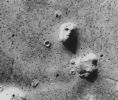
The_Face_on_Mars_-_1-RAW_Frame.jpgThe "Face" of Cydonia Mensae (EDM - RAW Frame n. V1-035A72)154 visitenessun commentoMareKromiumOtt 23, 2013
|
|
| 25353 immagini su 2113 pagina(e) |
 |
|
|
|
|
71 | |
|
|
|
|
|
|





