| |
| Ultimi arrivi |

MERCURY SKY.jpgMercury from Earth152 visitenessun commentoLug 08, 2004
|
|
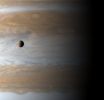
IO 2.jpgIo & Jupiter (from Cassini)68 visiteL'immenso Giove ed il piccolo (ma affascinante e VIVO, geologicamente parlando) Io, in un transito immortalato dalla Sonda Cassini, in transito accanto al Signore degli Dei ed in viaggio verso il Sistema di Saturno.Lug 08, 2004
|
|

IO 4.jpgIo (Flying over a volcanic eruption and a sea of sulphur - Tvashtar Catena)106 visiteAn active volcanic eruption on Jupiter's moon Io was captured in this image taken on February 22, 2000 by NASA's Galileo spacecraft. Tvashtar Catena, a chain of giant volcanic calderas centered at 60 degrees north, 120 degrees west, was the location of an energetic eruption caught in action in November 1999. A dark, "L"-shaped lava flow to the left of the center in this more recent image marks the location of the November eruption. White and orange areas on the left side of the picture show newly erupted hot lava, seen in this false color image because of infrared emission. The two small bright spots are sites where molten rock is exposed to the surface at the toes of lava flows. The larger orange and yellow ribbon is a cooling lava flow that is more than more than 60 kilometers (37 miles) long. Dark, diffuse deposits surrounding the active lava flows were not there during the November 1999 flyby of Io.
This color mosaic was created by combining images taken in the near-infrared, clear, and violet filters from Galileo's camera. The range of wavelengths is slightly more than that of the human eye. The mosaic has been processed to enhance subtle color variations. The bright orange, yellow, and white areas at the left of the mosaic use images in two more infrared filters to show temperature variations, orange being the coolest and white the hottest material. This picture is about 250 kilometers (about 155 miles) across. North is toward the top and illumination from the Sun is from the west (left).
Lug 08, 2004
|
|

IO 5.jpgZal Patera, Io, in color75 visiteThe Zal Patera region of Jupiter's volcanic moon Io is shown in this combination of high-resolution black and white images taken by NASA's Galileo spacecraft on November 25, 1999 and lower resolution color images taken by Galileo on July 3, 1999. By combining both types of images, Galileo scientists can better understand the relationships between the different surface materials and the underlying geologic structures. For example, in the center toward the top of the picture, the edge of the caldera, or volcanic crater, is marked by the black flows, and it coincides with the edge of a plateau. Also, the red material(just above and to the right of the center of the image) is typically associated with regions where lava is erupting onto the surface. Here the red material follows the base of a mountain, which may indicate that sulfurous gases are escaping along a fault associated with the formation of the mountain.
Scientists can use the lengths of the shadows cast to estimate the height of the mountains. They estimate that the northernmost plateau, which bounds the western edge of Zal Patera, rises up to approximately 2 kilometers (6,600 feet) high. The mountain to the south of the caldera has peaks up to approximately 4.6 kilometers (15,000 feet) high, while the small peak at the bottom of the picture is approximately 4.2 kilometers (14,000 feet) high.
North is to the top of the image, which is centered at 33.7 degrees north latitude and 81.9 degrees west longitude. The higher resolution images have a sharpness of about 260 meters (or yards) per picture element, and they are illuminated from the left. These images were taken on November 25, 1999 at a range of 26,000 kilometers (16,000 miles). The color images are illuminated from almost directly behind the Galileo spacecraft. The resolution of the color images is 1.3 kilometers (0.8 miles) per picture element. They were taken on July 3, 1999 at a distance of about 130,000 kilometers (81,000 miles).
Lug 08, 2004
|
|

IO 6.jpgIo (On top of the erupting volcano)120 visiteForse l'immagine più famosa di un vulcano attivo su "Io". Essa è stata usata non solo in tanti documentari, ma anche - come fondale - per l'effettuazione del film "2010 - Odissea 2", in una sequenza in cui due Astronauti (un Russo ed un Americano) si spostano dall'Astronave Leonov alla Discovery, sospesa in quello che tecnicamente si chiama "Punto Lagrangiano" - o di equilibrio gravitazionale - fra Giove ed Io.
This color picture of Io, Jupiter's innermost Galilean satellite, was taken by Voyager 1 on the morning of March 5, 1979 at a range of 128,500 kilometers (77,100 miles). It is centered at 8 south latitude and 317 longitude. The width of the picture is about 1000 kilometers (600 miles). The diffuse reddish and orangish colorations are probably surface deposits of sulfur compounds, salts and possibly other volcanic sublimates. The dark spot with the irregular radiating pattern near the bottom of the picture may be a volcanic crater with radiating lava flows.
Lug 08, 2004
|
|

IO 7.jpgIo & Jupiter (from Voyager 2)74 visiteUn'immagine da guardare in parallelo ad un altro "transito" di Io davanti a Giove: questo è un frame (eccezionale!) Voyager 2; il precedente, come ricorderete, era un frame Cassini. Tecnologicamente parlando, c'è un "abisso" tra la Sonda Voyager e la Sonda Cassini ma, alla prova delle immagini, i risultati "visivi" ottenuti sono sostanzialmente analoghi. E questa è un'altra ragione della nostra diffidenza nei confronti della NASA (e dell'ESA): se negli Anni '70 ed '80 eravamo già capaci di simili risultati, come mai oggi, AD 2005, non siamo neppure in grado di dire quali sìano i veri colori e le vere (da un punto di vista dell'occhio umano) "sfumature" di Marte, Giove e Saturno? Eravamo bravissimi 25 anni fa e "stupidi" adesso, oppure non avevamo capito niente 25 anni fa mentre ora tutto e chiaro (si fa per dire)? O forse NON c'è stata reale "evoluzione" da un punto di vista tecnologico? O magari la "Verità" è così incredibile che divulgarla è ritenuto periglioso?
Domande: sempre domande...Lug 08, 2004
|
|

IO 8.jpgIo from 8,3 MKM!77 visiteThis photo of Jupiter's satellite Io was taken by Voyager 1 about 4:30 p.m. (PST) March 2, 1979. The spacecraft was about 5 million miles (8.3 million kilometers away). Voyager 1 was mapping Jupiter with the cameras and infrared instrument at the time the picture was taken. The hemisphere seen here is the one that always faces away from Jupiter. This photo shows details on Io never before seen. The smallest features are about 38 miles (70 kilometers) across. Near the center and slightly to the right can be seen several round features with dark centers and bright rims. They may be the first craters ever observed on Io. At this resolution scientists still cannot tell much about the origin of the features, which could be impact craters or of internal (volcanic) origin. No ray or ejecta patterns are obvious at this resolution.
Lug 08, 2004
|
|

URANUS.jpgUranus from European Southern Obs.100 visiteCome avete potuto vedere Voi stessi nel frame precedente, Urano assomiglia tantissimo ad una biglia di alluminio: un disco completamente liscio e privo di qualsiasi punto di riferimento.
In realtà le foto più spettacolari del Pianeta sono state scattate dall'HST e dal Southern European Observatory, ma la scoperta del suo sistema di anelli avvenne nel 1977, senza l'impiego di sonde o di telescopi orbitali o di telescopi terrestri raffinatissimi ed ultramoderni.
Per quanto attiene la composizione di questi anelli, possiamo solo avanzare delle ipotesi.Lug 08, 2004
|
|

TRITON2.jpgTriton from Voyager 2 (enhanced real colors)80 visiteUn dettaglio della superficie di Tritone, sempre ripresa dal Voyager 2 (da notare che le gradazioni di colore e, conseguentemente, la qualità del dettaglio e dei particolari, sono state artificiosamente accentuate/i).
Una curiosità: a quanto è stato possibile accertare sino ad ora, le caratteristiche morfologiche superficiali di Tritone sembrano davvero molto simili a quelle di Plutone. Due mondi simili (due KBOs?) con un comune passato remoto e che, magari, sono destinati ad un comune lontano futuro...Lug 08, 2004
|
|

TRITON.jpgTriton from Voyager 2 (enhanced real colors)103 visiteLa superficie di Tritone, come ripresa dal Voyager 2, in colori reali ma con esaltazione dei contrasti.
Canali, crepacci, montagne e grandi crateri da impatto sono facilmente visibili, al pari di una strana distesa semi-pianeggiante che interrompe nettamente e bruscamente il paesaggio del pianeta, facendolo passare dall'estremamente accidentato e montuoso al (relativamente) liscio e pianeggiante. Forse questo paesaggio così affascinante ed "alieno" è il prodotto di eventi sismici aventi carattere planetario e risalenti alla "gioventù" del corpo celeste.Lug 08, 2004
|
|

UMBRIEL.jpgUmbriel from Voyager 297 visiteLa quinta Luna Maggiore di Urano: Umbriel.
La caratteristica superficiale che rende unico questo Satellite è data dalla curiosa "aureola bianca" che sembra essere "poggiata" sul suo Polo Nord. In un certo senso un'aureola di questo tipo è visibile anche al Polo Nord di Titania, ma la nitidezza e la definizione possedute da quella di Umbriel sono davvero uniche.
Si tratta di ghiacciai antichissimi?
O magari di una formazione montuosa "circolare" e leggermente infossata?
Non lo sa nessuno: ogni ipotesi è valida e quindi - ovviamente - nessuna, in fondo, lo è...Lug 08, 2004
|
|

MIRANDA.jpgMiranda from Voyager 2117 visiteIn questo nuovo frame potete apprezzare il fatto che Miranda ha più la forma di un uovo che quella di una sfera. Le fotografie che possediamo di questo corpo celeste ci fanno vedere un mondo profondamente segnato da impatti: impatti che hanno provocato profondissime "cicatrici" le quali, come si diceva in sede di commento all'immagine precedente, sono ancora ben visibili.
La enorme depressione a cui avevamo già accennato è ora visibile con maggiore chiarezza, sulla Vostra Sn. A giudicare dalle sue fattezze possiamo supporre che si sia (forse) trattato di un "urto radente", ossìa il corpo celeste che ha impattato Miranda avrebbe dovuto avere, al momento del contatto, un angolo di incidenza, rispetto al piano dell'orizzonte di Miranda stessa, molto basso (inferiore ai 35°?). Ed è forse per questo motivo che, nonostante la catastrofica collisione, Miranda è, si, rimasta profondamente segnata, ma NON si è completamente disintegrata...Lug 08, 2004
|
|
| 25353 immagini su 2113 pagina(e) |
 |
|
|
|
|
2043 | |
|
|
|
|
|
|





