| Ultimi arrivi |

SOL227-2N146514832EFF8542P1554L0M1.jpgLooking at the sky of Mars...55 visiteAgo 24, 2004
|
|

SOU-SOL024-Sunset-PIA00920_modest~0.jpgSunset on Mars - Sol 24 (True Colors; credits: NASA/JPL)231 visiteCaption NASA:"This is a close-up of the Sunset on Sol 24 as seen by the Imager for Mars Pathfinder. The red sky in the background and the blue around the Sun are approximately as they would appear to the human eye. The color of the Sun itself is not correct - the Sun was overexposed in each of the 3 color images that were used to make this picture. The true color of the Sun itself may be near white or slightly bluish".Ago 23, 2004
|
|

ZA-Uranus-LP-PIA00143.jpgFarewell Uranus... (2)89 visiteCaption NASA originale:"This view of Uranus was recorded by Voyager 2 on Jan 25, 1986, as the spacecraft left the planet behind and set forth on the cruise to Neptune. Voyager was 1 MKM (about 600.000 miles) from Uranus when it acquired this wide-angle view. The picture - a color composite of blue, green and orange frames - has a resolution of 140 Km (90 mi) per pixel". Ago 23, 2004
|
|

SOU-SOL016-PIA00784.jpgPre-Dawn Clouds on Mars - Sol 16 (True Colors; credits: NASA/JPL)178 visiteCaption NASA:"Pink Stratus Clouds are coming from the North/East at about 15 miles per hour (6,7 meters/second) at an approximate height of 10 miles (about 16 Km) above the Surface. The clouds consist of water ice condensed on reddish dust particles suspended in the Atmosphere. Clouds on Mars are sometimes localized and can sometimes cover entire Regions, but have not yet been observed to cover the entire Planet. The image was taken by the Imager for Mars Pathfinder (IMP) on Sol 16 about forty minutes before Sunrise showing areas of the Eastern Martian Local Horizon".Ago 23, 2004
|
|

SOU-SOL016-Clouds-PIA00785.jpg"Cloudy Sky" on Mars - Sol 16188 visiteCaption NASA:"This is the first image ever taken from the Surface of Mars of an overcast sky. Featured are stratus clouds coming from the North/East at about 15 miles per hour (6,7 meters/second) at an approximate height of 10 miles (about 16 Km) above the Surface. The "you are here" notation marks where Earth was situated in the sky at the time the image was taken. Scientists had hoped to see Earth in this image, but the cloudy conditions prevented a clear viewing. Similar images will be taken in the future with the hope of capturing a view of Earth. From Mars, Earth would appear as a tiny blue dot as a star would appear to an Earthbound observer. Pathfinder's imaging system will not be able to resolve Earth's moon.
The clouds consist of water ice condensed on reddish dust particles suspended in the Atmosphere. Clouds on Mars are sometimes localized and can sometimes cover entire regions, but have not yet been observed to cover the entire Planet. The image was taken about an hour and forty minutes before sunrise by the Imager for Mars Pathfinder (IMP) on Sol 16 at about 10° up from the Eastern Martian Local Horizon".Ago 23, 2004
|
|

SOU-SOL006-backshell-03-PIA00790_modest.jpgThe "Backshell" - Sol 6305 visiteCaption NASA:"During the Entry, Descent and Landing phase of the mission, the final step is the separation of the Lander and it's surrounding Airbags from the Backshell. The conical Backshell above the Lander contains 3 solid rocketmotors each providing about a ton of force for over 2". They are activated by the computer in the Lander. Electrical wires that run up the bridle close relays in the Backshell which ignite the 3 rockets at the same instant. The brief firing of the solid rocketmotors at an altitude of 80-100 meters is intended to essentially bring the downward movement of the Lander to a halt some 12 meters above the Surface. The bridle separating the Lander and Heat-Shield is then cut in the Lander, resulting in the Backshell driving up and into the Parachute under the residual impulse of the rockets, while the Lander, encased in airbags, falls to the Surface. The Backshell is to the S/E of the Lander, and in front and to the left of "Big Crater".Ago 23, 2004
|
|

SOU-SOL033-Landscape-PIA01120.jpgMartian Landscape - Sol 33 (Enhanced True Colors; credits: NASA/JPL)185 visiteCaption NASA:"The Sojourner Rover deploys the Proton X-Ray Spectrometer" onto the rock named "Moe" within the "Rock Garden" in this 75- image, color-enhanced mosaic taken by the imager on the Lander. Image of the Rover in the "Rock Garden" was taken on a different day than the terrain image. The view is to the South/West, with the Carl Sagan Memorial Station in the foreground and South Twin Peak on the horizon about 1 km from the Lander".
[Image processed at Jet Propulsion Laboratory, Pasadena, CA]Ago 23, 2004
|
|

SOU-SOL010-Twin_Peaks-TC-PIA01546_modest.jpgTwin Peaks - Sol 10 (True Colors; credits: NASA/JPL)221 visiteCaption NASA:"The True Colors of Mars based upon three filters with the sky set to aluminance of 60. The color of the Pathfinder Landing Site is yellowish brown with only subtle variations. These colors are identical to the measured colors of the Viking Landing Sites reported by Huck et al. [1977]. This image was taken near local noon (12:00 M.L.T.) on Sol 10. A description of the techniques used to generate this color image from IMP data can be found in Maki et al., 1999".Ago 23, 2004
|
|

SOU-SOL024-PIA01547.jpgSunset on Mars from Pathfinder and...A Star-Like Object! - Sol 24 (True Colors; credits: NASA/JPL)430 visiteCaption NASA:"The brownish gray sky as it would be seen by an observer on Mars in this four-frame, True Color mosaic taken on sol 24 (at approximately 16:10 M.L.T.). The Twin Peaks can be seen on the horizon. The sky near the sun is a pale blue color. Azimuth extent is 60° and elevation extent is approximately 12°. A description of the techniques used to generate this color image from IMP data can be found in Maki et al., 1999.Ago 23, 2004
|
|

SOU-SOL039-5-SunrisePthf-PIA01548_modest.jpgSunrise on Mars from Pathfinder - Sol 39 (True Colors; credits: NASA/JPL)168 visiteCaption NASA:"Sunrise, Sol 39. This true color, pre-sunrise image (approximately 05:30 MLT) is composed of six images extending 30 ° in azimuth and 45 ° in elevation and shows the brownish gray predawn sky. A description of the techniques used to generate this color image from IMP data can be found in Maki et al., 1999. Note: a calibrated output device is required accurately reproduce the correct colors.
Mars Pathfinder is the second in NASA's Discovery program of low-cost spacecraft with highly focused science goals. The Jet Propulsion Laboratory, Pasadena, CA, developed and manages the Mars Pathfinder mission for NASA's Office of Space Science, Washington, D.C. JPL is an operating division of the California Institute of Technology (Caltech). The IMP was developed by the University of Arizona Lunar and Planetary Laboratory under contract to JPL. Peter Smith is the Principal investigator".Ago 23, 2004
|
|

vl2-PIA00576_modest.jpgMartian Sunrise from Viking Lander 2 (Approximate True Colors; credits: NASA/JPL)210 visiteL'alba su Marte, così come vista dalla Sonda Viking 2. E' un vero peccato che, delle migliaia di immagini scattate da questa Sonda, la NASA ne ha rese disponibili (a quanto ci è dato sapere) solo poche decine. Se Voi sapete qualcosa per indirizzarci meglio a trovare gli archivi Viking 2 completi, non mancate di farcelo sapere! Grazie...Ago 23, 2004
|
|
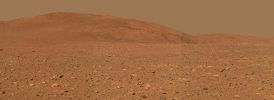
SOL149-The_Hills-PIA06045_modest.jpgThe Hills and the "Red Desert" - Sol 149 (Approx. True Colors; credits: NASA/JPL/Cornell)205 visiteCaption NASA:"This view from where NASA's Mars Exploration Rover Spirit stood on the Rover's 149th Martian Day, or Sol (such as June, 3, 2004), shows Terrain the MER has crossed since then. Spirit is currently headed East, traversing the flanks of the Hills en route to an overlook above a steep valley that is out of view from this perspective. Scientists hope to find more layered rocks that will tell a story of ancient water on Mars. Spirit has traveled 498 meters (more than one-quarter of a mile) and ascended 20 meters (66 feet) above the Plains since arriving at the "Columbia Hills" on sol 156 (June 11, 2004). It covered much of that distance driving on only five of its six wheels.
The images used to make this approximately true-color mosaic were taken with Spirit's panoramic camera from about 300 meters (984 feet) away from the base of the hills, using filters centered at wavelengths of 600, 530 and 480 nanometers". Ago 23, 2004
|
|
| 25353 immagini su 2113 pagina(e) |
 |
|
|
|
|
2002 | |
|
|
|
|





