| Ultimi arrivi |
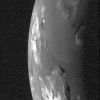
Io-PIA03530-1.jpgIo: the Loki Volcano from Galileo (RAW-HR and b/w Original NASA-Galileo Spacecraft Frame)66 visiteCaption NASA:"Light from the setting Sun falls across the Loki Volcanic Region on Jupiter's moon Io in this image taken by NASA's Galileo Spacecraft taken on October, 16, 2001.
The image was taken to examine the relative depths and heights of the major Surface Features existing in the Region. The Sun illuminates the surface from the right. Galileo's camera caught the large Volcanic Crater, or "Patera" of Loki near the Terminator (such as the boundary line between night and day). The image also shows several smaller craters plus shadows cast by the high peaks of several mountains.
Shadows cast by the low Sun should reveal any topography associated with Loki, such as a plateau in the center of the Patera or high Patera Walls. The near absence of shadows in this Region surprised Galileo scientists, as they had expected much more pronounced topography near Loki.
Another surprising aspect of this image is that features that have been black in previous Voyager and Galileo images of Loki, such as the dark Lava Flows visible inside the Patera, are here brighter than their surroundings. The best explanation is that the shiny, glassy surfaces of chilled Lava Flows look extremely dark when the Sun is directly overhead, but they reflect the Sun's light comparatively well when it shines at a low angle, in a similar manner to the reflective surfaces of bodies of water.
Other Volcanic Paterae in this image show the same unusual reflectance as seen at Loki. Some of them are being viewed at such an angle that these reflections from Lava Flows are the brightest features in the image. This image tells us that Lava Flows on Io chill quickly and form glassy surfaces, not unlike recently cooled lava flows in Hawaii.
The image has a resolution of about 1,1 Km (approx. 0,7 miles) per picture element. North is to the top of the picture".Ago 25, 2004
|
|
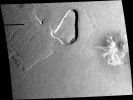
Io-Volcanic_Depression-PIA03532_modest1.jpgVolcanic Depression near the Equator (Original NASA/Galileo b/w Frame)61 visiteThis image taken by NASA's Galileo spacecraft on Oct. 16, 2001, near the equator of Jupiter's moon Io shows the contrast in volcanism styles found on Io.
The central feature is a large patera, or volcanic depression, almost 100 kilometers (60 miles) long. It may have formed after eruptions of lava emptied a subsurface magma chamber and left an empty space into which the crust collapsed. Evidence of lava flows associated with this patera, however, is difficult to find. Either the flows have been buried, or perhaps they never erupted and simply drained back deep into the crust.
On the right of the image is a small shield volcano, similar to volcanoes in Hawaii. It is rare for lavas on Io to be thick enough to pile up into shields around vents. They usually run out in thin, long flows instead. This shield abuts some very pale lava flows that emerged from a small vent to the west. These flows could be made of sulfur, like flows at Io's Emakong Patera. The vent is also surrounded by dark, diffuse material, which may be the result of lava erupted in an explosive, gas-rich eruption, similar to the 1980 eruption of Mount Saint Helens in Washington.
North is to the top of the image and the illumination is from the right. The image has a resolution of 330 meters (1,080 feet) per picture element and is 340 (211 miles) kilometers across.
Ago 25, 2004
|
|

ZC-Jupiter from Mars-PIA04532_modest.jpgJupiter and 3 Galilean Moons from Mars84 visiteCi siamo chiesti tante volte, guardando Giove dalla Terra, come lo si vedrebbe da Marte. Ebbene, abbiamo trovato la risposta (grazie all'aiuto del Mars Global Surveyor Orbiter): in questo frame davvero eccezionale, Giove e 3 dei suoi 4 Satelliti Galileiani, così come li vedremmo da Marte! Un'immagine bellissima da guardare e su cui occorre riflettere molto. Perchè? Perchè conquistare lo Spazio, alle volte, vuol dire anche ampliare i confini dell'Immaginazione...Ago 25, 2004
|
|
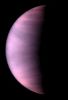
5-Venus.jpgVenus from 70.600.000 Km134 visiteUna splendida fotografia di Venere (crescente) ripresa dall'Hubble Space Telescope nel 1995. Diciamo che questa immagine, seppur bellissima, fa comunque parte di quella che noi chiamiamo "La Galleria Fotografica Nascosta", ossia quel complesso (smisurato) di immagini dello Spazio che, se non si sa esattamente dove mettere le mani (o se non si è fortunati), si rischia di non trovare mai.
Questa foto, comunque, se volete andare a vederla alla "fonte", proviene dal "Planetary Photojournal - Images of Venus"Ago 25, 2004
|
|

OPP-SOL207-1N146561132EFF35B8P0643L0M1.jpgA global view of Endurance Crater and its Dunes (3)61 visitenessun commentoAgo 25, 2004
|
|

OPP-SOL207-1N146560956EFF35B8P0643L0M1.jpgA global view of Endurance Crater and its Dunes (2)69 visitenessun commentoAgo 25, 2004
|
|

OPP-SOL207-1N146560905EFF35B8P0643L0M1.jpgA global view of Endurance Crater and its Dunes (1) - Sol 20770 visitenessun commentoAgo 25, 2004
|
|

SOL228-2N146606286EFF8600P0770L0M1.jpgThis is Mars!68 visiteAgo 25, 2004
|
|

SOL228-2N146606236EFF8600P0770L0M1.jpgColumbia Hills' landscape and the "Martian Mound"55 visiteAgo 25, 2004
|
|
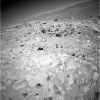
SOL228-2N146606200EFF8600P0770R0M1.jpgColumbia Hills' landscape and a possible Anomaly (2)80 visite...dell'immagine ma, sulla base di quella che è la nostra specifica conoscenza ed esperienza al riguardo, diremmo di no. Diremmo che si tratta, piuttosto, di un riflesso dei raggi del Sole su qualcosa che non è certamente pietra. Purtroppo il bagliore scompare subito e quindi gli elementi in nostro possesso ci permettono solo di esprimere (ancora una volta) dei dubbi.
Certo è che si tratta di un fenomeno strano, almeno a nostro parere...Ago 25, 2004
|
|

SOL228-2N146606200EFF8600P0770L0M1.jpgColumbia Hills' landscape and a possible Anomaly (1)68 visiteUna prova tangibile del fatto che bisogna stare sempre attenti ed analizzare TUTTE le immagini che vengono messe a disposizione: a prima vista sembrava un paesaggio come tanti altri ma, se guardate attentamente, scoprirete qualcosa di interessante. In primo luogo espandete il frame sino a full-size e poi guardate alla Vostra Sn - Dx della collina che si trova sullo sfondo -: c'è un punto bianco che, a nostro parere, merita una certa attenzione. Certo, potrebbe essere un difetto...Ago 25, 2004
|
|

SOL228-2N146606164EFF8600P0770L0M1.jpgColumbia Hills' landscape55 visiteAgo 25, 2004
|
|
| 25353 immagini su 2113 pagina(e) |
 |
|
|
|
|
2000 | |
|
|
|
|





