| Ultimi arrivi |

SOU-SOL004-Deimos_from_Pathfinder-PIA00996_modest.jpgDeimos, from Pathfinder - Sol 4180 visiteCaption NASA originale: "Mars' outermost natural satellite, Deimos, is seen from the Planet's surface in this Pathfinder image taken at night on Sol 4. This picture was acquired by the Imager for Mars Pathfinder (IMP) camera. Using IMP images of Deimos and its companion moon, Phobos, the spectral characteristics of the satellites and properties of the Martian atmosphere are determined".Ago 26, 2004
|
|
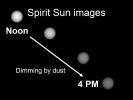
SOL010-THE_SUN_FROM_MARS-01.jpgThe Sun from Mars - Sol 1058 visiteCaption originale NASA: "This image shows the Sun as it appears on Mars throughout the day. Scientists monitor the dimming of the setting Sun to assess how much dust is in the martian atmosphere. The pictures were taken by the Mars Exploration Rover Spirit's panoramic camera". Ago 26, 2004
|
|

Sun-PIA03149_modest.jpgSolar Flares from Soho86 visiteCaption NASA originale:"Extreme Ultraviolet Imaging Telescope (EIT) image of a huge, handle-shaped prominence taken on Sept. 14,1999 taken in the 304 angstrom wavelength - Prominences are huge clouds of relatively cool dense plasma suspended in the Sun's hot, thin corona. At times, they can erupt, escaping the Sun's atmosphere. Emission in this spectral line shows the upper chromosphere at a temperature of about 60,000 degrees K. Every feature in the image traces magnetic field structure. The hottest areas appear almost white, while the darker red areas indicate cooler temperatures".Ago 26, 2004
|
|

Neptune-PIA01539_modest.jpgFarewell Neptune: a "bright smile" for the Earthlings...64 visiteCaption NASA originale:"Voyager 2's post-encounter view of Neptune's South Pole as the spacecraft sped away on a southward trajectory".
E con la Sonda Voyager 2 che sfiorava Nettuno e poi si dirigeva verso i più estremi confini del Sistema Solare - perdendosi per sempre nello spazio interstellare - quest'ultimo frame ci mostra (passateci il termine) il "sorriso" di Nettuno per noi Terrestri.
Un "luminoso sorriso" che a noi piace pensare sia il suo modo di dire "Arrivederci"...Ago 26, 2004
|
|

ZC-Neptune_s Rings-PIA01493_modest.jpgThe Rings of Neptune59 visiteCaption NASA originale:"In Neptune's outermost ring, 39.000 miles out, material mysteriously clumps into 3 arcs.
Voyager 2 acquired this image as it encountered Neptune in August 1989".Ago 26, 2004
|
|

ZB-Neptune_s Partial Rings-PIA02200_modest.jpgNeptune's "Partial Rings" (or "Ring Arcs")59 visiteCaption NASA originale:"One of two new ring arcs, or partial rings, discovered by NASA's Voyager 2 spacecraft, is faintly visible here just outside the orbit of the Neptunian moon 1989N4, also discovered by Voyager 2.
The 155 second exposure taken by Voyager's narrow-angle camera shows the glare of an overexposed Neptune to the right of the moon and ring arc.
The two bright streaks below the moon and ring arc are stars.
The ring arc is approximately 50.000 Km (or 30.000 miles) long".Ago 26, 2004
|
|

ZA-Neptune_s Rings-PIA01996_modest.jpgThe Rings of Neptune (closest approach)61 visiteCaption NASA originale:"The Voyager 2 spacecraft took this picture after closest approach to Neptune on Aug. 25 1989, using the clear filter of the wide-angle camera with an exposure time of 255 seconds. The view back towards Neptune at a phase angle of 135° found the 2 known rings to be 5 to 10 times brighter than seen in backscattering during Voyager approach at much lower phase angle. This brightness increase implies a large percentage of microscopic particles within the rings". Ago 26, 2004
|
|

ZA-Neptune_s Rings-PIA01997_modest.jpgThe Rings of Neptune (full system) 165 visiteCaption NASA originale:"These two 591-second exposures of the rings of Neptune were taken with the clear filter by the Voyager 2 wide-angle camera on Aug. 26, 1989 from a distance of 280.000 Km (175.000 miles). The 2 main rings are clearly visible and appear complete over the region imaged. The time between exposures was 1 hour and 27 minutes. [During this period the bright ring arcs in the outer bright ring were not visible in either picture (they were unfortunately on the opposite side of the planet for each exposure).] Also visible in this image is the inner faint ring at about 42.000 km (25.000 miles) from the center of Neptune and the faint band which extends smoothly from the 53.000 Km (33.000 miles) ring to roughly halfway between the 2 bright rings". Ago 26, 2004
|
|

ZA-Neptune_s Rings-PIA02202_modest.jpgThe Rings of Neptune (full system) 258 visiteCaption NASA originale:"This pair of Voyager 2 images (FDS 11446.21 and 11448.10), two 591-s exposures obtained through the clear filter of the wide angle camera, show the full ring system with the highest sensitivity. Visible in this figure are the bright, narrow N53 and N63 rings, the diffuse N42 ring, and (faintly) the plateau outside of the N53 ring (with its slight brightening near 57.500 Km)". Ago 26, 2004
|
|

Triton-PIA02214_modest.jpgTriton from Voyager 2 (false colors)70 visiteCaption NASA originale:"This false color image of Triton is a composite of images taken through the violet, green and ultraviolet filters. The image was taken early on Aug. 25, 1989 when Voyager 2 was about 190.000 Km (118.000 miles) from Triton's surface. The smallest visible features are about 4 Km(2,5 miles) across. The image shows a geologic boundary between completely dark materials and patchy light/dark materials. A layer of pinkish material stretches across the center of the image. The pinkish layer must be thin because underlying albedo patterns show through. Several features appear to be affected by the thin atmosphere; the elongated dark streaks may represent particulate materials blown in the same direction by prevailing winds and the white material may be frost deposits". Ago 26, 2004
|
|

Triton-PIA02213_modest.jpgThe limb of Triton (natural colors - elab. NASA)57 visiteCaption NASA originale:"This natural color image of the limb of Triton was taken early in the morning of Aug. 25, 1989, when the Voyager 2 spacecraft was at a distance of about 210.000 Km (128.000 miles) from the icy satellite. The largest surface features visible area about 3 miles across. The picture is a composite of images taken through the violet, green and clear filters.
The image shows a geologic boundary between a rough, pitted surface to the right and a smoother surface to the left". Ago 26, 2004
|
|

Neptune-PIA02245.jpgNeptune from 16.000.000 Km56 visiteCaption NASA originale:"This color image, produced from a distance of about 16 MKM, shows several complex and puzzling atmospheric features. The Great Dark Spot (GDS) seen at the center is about 13.000 Km by 6.600 km in size - as large along its longer dimension as the Earth. The bright, wispy "cirrus-type" clouds seen hovering in the vicinity of the GDS are higher in altitude than the dark material of unknown origin which defines its boundaries". Ago 26, 2004
|
|
| 25353 immagini su 2113 pagina(e) |
 |
|
|
|
|
1994 | |
|
|
|
|





