| Ultimi arrivi |

SOL230-2P146787745EFF8600P2575L7M1.jpgMartian Landscape - Sol 23058 visitenessun commentoAgo 27, 2004
|
|
SOL230-2N146783320EFF8600P0343L0M1.jpgThe sky over the Columbia Hills (4)56 visitenessun commentoAgo 27, 2004
|
|
SOL230-2N146783320EFF8600P0343R0M1.jpgThe sky over the Columbia Hills (5)56 visitenessun commentoAgo 27, 2004
|
|

SOL230-2N146783235EFF8600P0343R0M1.jpgThe sky over the Columbia Hills (2)58 visitenessun commentoAgo 27, 2004
|
|
SOL230-2N146783285EFF8600P0343L0M1.jpgThe sky over the Columbia Hills (3)55 visitenessun commentoAgo 27, 2004
|
|

SOL230-2N146783235EFF8600P0343L0M1.jpgThe sky over the Columbia Hills (1)55 visitenessun commentoAgo 27, 2004
|
|
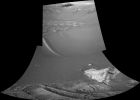
OPP-SOL206-mer_b_sol206_ncam_puffin_cyl-B209R1_br2.jpgNear the dunes of Endurance Crater85 visiteOpportunity non si addentrerà verso le stranissime dune che giacciono sul fondo di Endurance Crater: c'è il rischio, infatti, che le sabbie siano troppo molli e non consentano trazione alle ruote del Rover il quale finirebbe con l'impantanarsi. A nostro avviso, questa considerazione sulla possibile "eccessiva morbidezza" delle sabbie deve farci dubitare, ancora una volta, sui dati relativi all'accuratezza delle temperature di Marte al suolo. Ma non dovrebbe essere tutto ghiacciato e compatto?Ago 27, 2004
|
|

Sedna-06.jpgSedna and other celestial bodies197 visiteGli astronomi A. Morbidelli ed H. Levison pensano che Sedna non si sia formato laddove attualmente si trova, nè che la sua posizione dipenda da interazioni con altri corpi celesti. Costoro ritengono che Sedna sia "figlio" di un Sistema Solare diverso dal nostro. Forse si tratta di un pianetino strappato ad un altro Sistema in transito accanto al nostro, oppure esso è il frutto dell'aggregazione di detriti cosmici rubati dal Sole ad una stella molto più piccola che gli è passata troppo vicina.
Siamo nel campo delle ipotesi più "spinte" e delle speculazioni scientifiche vere e proprie, come ovvio.
La risposta? Chissà...Ago 27, 2004
|
|

Callisto-Chain of craters-PIA00514_modest.jpgA chain of craters on Callisto102 visiteCaption NASA originale:"A portion of a chain of impact craters on Jupiter's moon Callisto is seen in this image taken by the Galileo spacecraft on November 4, 1996. This crater chain on Callisto is believed to result from the impact of a split object, similar to the fragments of Comet Shoemaker-Levy 9 which smashed into Jupiter's atmosphere in July of 1994". Ago 26, 2004
|
|

Callisto-V1-PIA00362_modest.jpgCallisto from 1.200.000 Km (Voyager 1)59 visiteCaption NASA originale:"This color photo of Jupiter's satellite Callisto was made from three black-and-white images taken March 5 from a distance of 746.000 miles (1,2 MKMs).
It shows the entire hemisphere of Callisto that was photographed at HR by Voyager 1 during the close encounter with the satellite. Visible near the upper left limb is the large basin-like structure discovered by Voyager 1. The central region of the basin is much brighter than the average surface of the satellite. Near the south polar region are two bright areas associated with smaller basin-like structures. These bright areas are believed to contain more clean ice than the rest of Callisto's generally 'dirty-ice' surface".Ago 26, 2004
|
|

Callisto-V1-PIA02277_modest.jpgCallisto's basin from Voyager 162 visiteCaption NASA originale:"This picture of a multi=ring basin on Callisto was taken the morning of March 6, 1979, from a distance of about 200.000 Km. The complicated circular structure seen at left center is similar to the large circular impact basins that dominate the surface of the Earth's moon and also the planet Mercury. The inner parts of these basins are generally surrounded by radially lineated ejecta and several concentric mountainous ring structures that are thought to form during the impact event. This multi-ring basin on Callisto consists of light floored central basin some 300 k m in diameter surrounded by at least eight to ten discontinuous rhythmically spaced ridges. No radially lineated ejecta can be seen. The ring structures on Moon and Mercury have been likened to ripples produced on a pond by a rock striking the water. The great number of rings observed around this basin on Callisto is consistent with its low planetary density and probable low internal strength".Ago 26, 2004
|
|

Callisto-full disk-PIA03456_modest.jpgCallisto from Galileo95 visiteCaption NASA originale:"Bright scars on a darker surface testify to a long history of impacts on Jupiter's moon Callisto in this image of Callisto from NASA's Galileo spacecraft.
The picture, taken in May 2001, is the only complete global color image of Callisto obtained by Galileo, which has been orbiting Jupiter since December 1995. Of Jupiter's four largest moons, Callisto orbits farthest from the giant planet.
Callisto's surface is uniformly cratered but is not uniform in color or brightness. Scientists believe the brighter areas are mainly ice and the darker areas are highly eroded, ice-poor material".Ago 26, 2004
|
|
| 25353 immagini su 2113 pagina(e) |
 |
|
|
|
|
1993 | |
|
|
|
|





