| Ultimi arrivi |

Saturn-HST-Oct1997-PIA03159_modest.jpgSaturn from Hubble Space Telescope (Oct. 1997)59 visitenessun commentoAgo 29, 2004
|
|

Saturn-HST-Oct1998-PIA03160_modest.jpgSaturn from Hubble Space Telescope (Oct. 1998)57 visitenessun commentoAgo 29, 2004
|
|

Saturn-HST-Oct1999-PIA03161_modest.jpgSaturn from Hubble Space Telescope (Oct. 1999)58 visitenessun commentoAgo 29, 2004
|
|

Saturn-HST-Oct.2000-PIA03162_modest.jpgSaturn from Hubble Space Telescope (Oct. 2000)60 visitenessun commentoAgo 29, 2004
|
|

Saturn-HST-PIA05982_modest.jpgSaturn from Hubble Space Telescope61 visiteCaption NASA originale:"...The subtle pastel colors of ammonia-methane clouds trace a variety of atmospheric dynamics. Saturn displays its familiar banded structure, with haze and clouds at various altitudes. Like Jupiter, all bands are parallel to Saturn's equator. The magnificent rings, at nearly their maximum tilt toward Earth, show subtle hues which indicate the trace chemical differences in their icy composition..."Ago 29, 2004
|
|

Callisto-Asgard emi.-Gal-PIA00562_modest.jpgThe "Asgard" hemisphere of Callisto (detail mgnf)66 visiteCaption NASA originale:"...Dominating the scene is the impact structure, Asgard, centered on the smooth, bright region near the middle of the picture and surrounded by concentric rings up to 1.700 kilometers in diameter. A second ringed structure with a diameter of about 500 kilometers can be seen to the north of Asgard, partially obscured by the more recent, bright-rayed crater, Burr. The icy materials excavated by the younger craters contrast sharply with the darker and redder coatings on older surfaces of this Moon..."Ago 29, 2004
|
|

Callisto-Asgard emisph.-Gal-PIA01100_modest.jpgThe "Asgard" hemisphere of Callisto61 visiteCaption NASA originale:"False color view of a portion of the leading hemisphere of Jupiter's moon Callisto as seen through the infrared filters of the Solid State Imaging (CCD) system aboard NASA's Galileo spacecraft. North is to the top of the picture and the sun illuminates the surface from the east. More recent impacts have excavated bright, relatively clean ice from beneath Callisto's battered surface. Callisto's dark mottled appearance may be due to contamination by non-ice components contributed by impactors or concentrated in a residue as ice is removed".Ago 29, 2004
|
|

OPP-SOL198-1M145775434EFF3505P2907M2M1.jpgA Martian stone, from VERY close! - Sol 198127 visiteLa roccia fotografata è, in sè, molto bella ed interessante, ma ancora più interessante è la "tessitura" del terreno cu cui essa poggia. Un terriccio soffice e per nulla polveroso, almeno in apparenza. Un terriccio che non assomiglia per nulla a quello che ci aspetteremmo di trovare sul fondo di un cratere, perso nel bel mezzo di un deserto e ad una temperatura media di oltre 40° C al di sotto dello zero...Ago 29, 2004
|
|
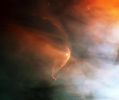
Bow-Shock on M42-HST-PIA04227_modest.jpgBow-shock in Orionis - HST1547 visiteNamed for the crescent-shaped wave a ship makes as it moves through water, a "bow-shock" can form in space when two gas streams collide. In this case, the young star, LL Orionis, emits a vigorous wind, a stream of charged particles moving rapidly outward from the star. Our own Sun has a less energetic version of this wind that is responsible for auroral displays on the Earth. The material spewed from LL Ori collides with slow-moving gas evaporating away from the center of the Orion nebula, located to the lower right of the image. The surface where the two winds collide is seen as the crescent-shaped bow shock. Unlike a water wave from a ship, this interstellar bow shock is three-dimensional. The filamentary emission has a distinct boundary on the side facing away from LL Ori, but is diffuse on the side closest to the star, a trait common to many bow shocks. Ago 28, 2004
|
|

Ant Nebula-HST-PIA04216_modest.jpgAnt Nebula - HST189 visite"...Nella necessità di codificare, classificare e schematizzare tutto quello che vediamo, c'è la nostra incapacità di vedere le cose per ciò che esse sono davvero..."
P.C. Floegers - "Conversations"Ago 28, 2004
|
|
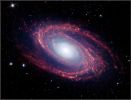
M-081-5.jpgM 81 - Spiral Galaxy (SST)86 visite"...God's Order is constant. Each time I reflect on Divine Order, I feel serene. My heart beats in a perfect rhythm and I breathe deeply and evenly. Immersed in Divine Order, I am restored: in my mind, in my body and in my soul..."Ago 28, 2004
|
|

Sharpless 140-SST-PIA05878_modest.jpgSharpless 140 Nebula - SST109 visite"...L'immaginazione non è infinita, tutt'altro. Noi, infatti, possiamo immaginare solo nei limiti costituiti e fissati dalla nostra capacità di elaborare dei "concetti" che sono, comunque, già in nostro possesso. Quando parlo di "concetti" indico, fra l'altro, forme e colori, tempi e distanze, semplici idee oppure oggetti fisici veri e propri. Mescolando i "concetti", possiamo creare, ma tutto ciò che creiamo, comunque, già esisteva, sia pure in una forma diversa, nei "concetti" usati in partenza..."
P.C. Floegers - "Conversations"Ago 28, 2004
|
|
| 25353 immagini su 2113 pagina(e) |
 |
|
|
|
|
1991 | |
|
|
|
|





