| Ultimi arrivi |

Jupiter-HW-PIA00360_modest.jpgHigh Winds on Jupiter (from appx. 4.000.000 Km)62 visiteCaption NASA originale:"A high resolution image of the Jovian mid-latitudes taken by Voyager 1 on March 2, 1979, shows distinctly differing characteristics of the planet's meteorology. The well defined pale orange line running from southwest to northeast (North is at the top) marks the high speed north temperate current with wind speeds of about 120 meters p/s. These high winds produce a cleaner flow pattern in the surrounding clouds whose average lifetime is of about 2 years".Ago 30, 2004
|
|

Jupiter-WO-PIA01513_modest.jpgWhite Ovals on Jupiter58 visiteCaption NASA originale:"This photo of Jupiter was taken by Voyager 1 on March 1st, 1979, from a distance of 4.300.000 Km. The region shown is just to the southeast of the Great Red Spot. A small section of the spot can be seen at upper left. One of the 40-year-old white ovals in Jupiter's atmosphere can also be seen at middle left, as well as a wealth of other atmospheric features, including the flow lines in and around the ovals.
The smallest details that can be seen in this photo are about 80 Km across".Ago 30, 2004
|
|

Jupiter-V1-PIA01518_modest.jpgThe "Plume"60 visiteCaption NASA originale:"Reconstruction of a plume on Jupiter, photographed on March 1st, 1979".
Nota: in questo frangente per "plume" si intende uno 'sbuffo' di nuvole bianche e vaporose le quali si distinguono nettamente dal resto del paesaggio circostante.
L'espressione "plume", di regola, viene invece impiegata per indicare il 'pennacchio' di fumo che caratterizza i vulcani in fase eruttiva (innumerevoli sono, infatti, le "plumes" che vediamo sul piccolo - ma attivissimo! - Io).Ago 30, 2004
|
|

Jupiter-V2-PIA01527_modest.jpgThe "Red Spot" of Jupiter59 visiteCaption NASA originale:"The region of white clouds now extends from east of the Red Spot and around its northern boundary, preventing small cloud vortices from circling the feature. The disturbed region west of the Red Spot has also changed since the equivalent Voyager 1 image. It shows more small scale structure and cloud vortices being formed out of the wave structures. The picture was taken on July 3, 1979, from about 6 MKM".Ago 30, 2004
|
|
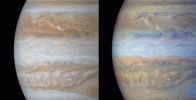
Jupiter-CH-PIA02877_modest.jpgReal Colors and False Colors of Jupiter60 visiteCaption NASA originale:"These color composite frames of the mid-section of Jupiter were of narrow angle images acquired on December 31, 2000, a day after Cassini's closest approach to the planet. The smallest features in these frames are roughly ~ 60 kilometers. The left is natural color, composited to yield the color that Jupiter would have if seen by the naked eye. The right frame is composed of 3 images: two were taken through narrow band filters centered on regions of the spectrum where the gaseous methane in Jupiter's atmosphere absorbs light, and the third was taken in a red continuum region of the spectrum, where Jupiter has no absorptions". Ago 30, 2004
|
|
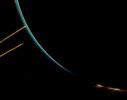
Jupiter_s Rings-PIA01529_modest.jpgColorful Jupiter's Rings834 visiteCaption NASA originale:"Jupiter's faint ring system is shown in this color composite as two light orange lines protruding from the left toward Jupiter's limb. This picture was taken in Jupiter's shadow through orange and violet filters. The colorful images of Jupiter's bright limb are evidence of the spacecraft motion during these long exposures. The Voyager 2 spacecraft was at a range of 1.450.000 kilometers about two degrees below the plane of the ring. The lower ring image was cut short by Jupiter's shadow on the ring itself".Ago 30, 2004
|
|

BH-Black-Hole_in_3D.jpgBlack-Hole in 3D144 visiteThis three-dimensional illustration shows how the rotating space around a black hole twists up the magnetic field in the plasma falling toward the black hole. The black sphere at the center of the figure is the black hole itself, and the yellow region around it represents the area where space is being twisted. The red tubes depict magnetic field lines threading this twisting space, while the green ones show magnetic field lines which have not yet entered that space. Ago 29, 2004
|
|

BH-Black-Hole.jpgComputer simulation of a Black-Hole from start to finish116 visitePlasma is falling slowly toward the black hole in a (at the upper left). The plasma has a magnetic field, shown by the white lines. It picks up speed as it falls toward the hole in b (at the upper right), c (lower left) and d (lower right). However, the rotating black hole twists up space itself (and the magnetic field lines) and ejects electromagnetic power along the north and south poles above the black hole. The red and white color shows the immense electromagnetic power output, which eventually will pick up particles and form squirting jets.Ago 29, 2004
|
|

He2-90-HST-PIA04214_modest.jpgHe2-90 - HST105 visite"...Se io fossi capace di vedere, oltre le Notti, ed oltre i Giorni, che fanno la Vita; Se fossi capace di sentire, le Grida del Passato ed i Sussurri dell'Avvenire, e le Parole del Presente; Se ci fosse un Cielo, grande abbastanza per coprirmi; Se ci fosse un Sole, rosso e caldo ad illuminarmi e se ci fosse un Angelo, grande e forte, pronto ad abbracciarmi; Volerei via con Lui, se ci fosse, volerei via con Lui..."
Alain J. Malheureux - "Prière du Matin"Ago 29, 2004
|
|

Saturn-Orbit-ins-PIA03883_modest.jpgCassini's Orbital Insertion78 visitenessun commentoAgo 29, 2004
|
|

Saturn-HST-1996upto2000-PIA03156_modest.jpgSaturn from Hubble Space Telescope (1996 - 2000)57 visiteCaption NASA originale:"...Looming like a giant flying saucer in our outer solar system, Saturn puts on a show as the planet and its magnificent ring system nod majestically over the course of its 29-year journey around the Sun. These Hubble Space Telescope images, captured from 1996 to 2000, show Saturn's rings open up from just past edge-on to nearly fully open as it moves from autumn towards winter in its Northern Hemisphere..."Ago 29, 2004
|
|

Saturn-HST-Oct1996-PIA03158_modest.jpgSaturn from Hubble Space Telescope (Oct. 1996)58 visitenessun commentoAgo 29, 2004
|
|
| 25353 immagini su 2113 pagina(e) |
 |
|
|
|
|
1990 | |
|
|
|
|





