| Ultimi arrivi |

Phobos-Phobos_Monolith-01.jpgThe "Phobos' Monolith" (EDM n.1)386 visiteComunque - e per concludere questo primo approccio con Phobos - l'idea di tentare un atterraggio su questo (e chissà poi perchè...) misterioso e, a quanto vediamo, enigmatico corpo celeste, non è venuta soltanto alla NASA.
Conoscete la storia della Sonda Russa "Phobos 2", del suo avvicinamento a Phobos e del relativo "incidente" che ne seguì?
No?!?
Ve ne parleremo più avanti, sempre, in questa Sezione...
Ago 30, 2004
|
|
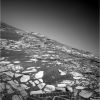
OPP-SOL163-1N142657958EFF3221P1971R0M1.jpgThe "Squared Stones" of Endurance Crater - Sol 16389 visitenessun commentoAgo 30, 2004
|
|
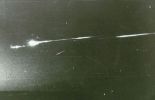
ZZ-UNKNOWN.jpgA "streak" in the sky446 visiteQuesta immagine deve essere vista in parallelo al frame che abbiamo intitolato "Another Spirit in the sky", il quale raffigurava una striscia nel Cielo Marziano che la NASA (e tanti altri Scienziati e Giornalisti, anche in Italia) hanno frettolosamente (ed erroneamente!) attribuito ad una vecchia Sonda (Viking 1?) che precipitava oppure ad una banalissima stella cadente.
Ebbene, ecco come appare (nel cielo della Terra) un Satellite che precipita.
Ma a Voi sembra che ci siano somiglianze fra le due tracce?!?Ago 30, 2004
|
|

ZQ-SPIRIT-JUNE02-04-JR-04-outcrop-A147R1.jpgThe "Martian Mound", from far (but not too far...) away470 visiteLa "prima" (forse...) occhiata del Rover Spirit a quello strano terrapieno che noi avremmo in seguito chiamato "Martian Mound" (vedi Sezione "Walking on Mars") e che gli Scienziati della NASA, invece, fanno rientrare in quella sterminata categoria di luoghi caratteristici della superficie di Marte (Mars Surface Features) denominati "outcrop" (geol. per "affioramenti").Ago 30, 2004
|
|
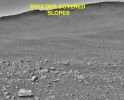
ZP-SPIRIT-JUNE02-03-JR-03-boulders-A147R1.jpgThe Columbia Hills261 visiteLa destinazione del Rover Spirit - dopo le peregrinazioni sulla pianura del landing e dopo la visita al Cratere Bonneville - agli "occhi" della PanCam.
Siamo nel Giugno 2004.Ago 30, 2004
|
|

ZE-SPIRIT PATH TO THE MOUNTAINS.jpgSpirit's path from Bonneville up to Columbia Hills224 visiteE, dal Cratere Bonneville, il prosieguo della marcia sino alle pendici delle Columbia Hills.Ago 30, 2004
|
|

ZA-Map2-09-RA-01-panondimes-A094R1.jpgMars Map 2 - Spirit/Bonneville Crater Area257 visiteUn'eccellente mappatura del percorso effettuato dal Rover Spirit sino al raggiungimento del Bonneville Crater.Ago 30, 2004
|
|

ZA-Map1-09-mg-02-moc-A020R1_br.jpgMars Map 1 - Spirit/Bonneville Crater Area379 visiteE' tramite questa mappa che ci è stato possibile localizzare lo Scudo Termico della Sonda Spirit (precipitato sul bordo del Cratere Bonneville) e giungere alla conclusione (meramente preliminare, ma - allo stato - accettabile) che l'Anomalia da noi chiamata "Silver Sphere" deve essere qualcosa di diverso dai rottami spaziali che sembravano essere i maggiori indiziati. Che cosa? Solo la NASA potrebbe rispondere...Ma non risponde!Ago 30, 2004
|
|

Jupiter_s limb-Gal-PIA00858_modest.jpgJupiter's limb and White Ovals, from Galileo58 visiteCaption NASA originale:"The oval shaped vortices in the upper half of the mosaic are two of the three long-lived White Ovals that formed to the south of the Red Spot in the 1930's and, like the Red Spot, rotate in a counterclockwise sense. The east to west dimension of the leftmost White Oval is 9000 Km. The White Ovals drift in longitude relative to one another, and are presently restricting the cyclonic structure. To the south, the smaller oval and its accompanying cyclonic system are moving eastward at about 0.4 degrees per day relative to the larger ovals. The interaction between these two cyclonic storm systems is producing high, thick cumulus-like clouds in the southern part of the more northerly trapped system".Ago 30, 2004
|
|

Jupiter_s limb-Gal-PIA00896_modest.jpgJupiter's limb, from Galileo72 visiteCaption NASA originale:"North is at the top. The images are projected on a sphere, with features being foreshortened towards the north. The planetary limb runs along the right edge of the mosaic. Cloud patterns appear foreshortened as they approach the limb. The smallest resolved features are tens of kilometers in size. These images were taken on April 3, 1997, at a range of 1.4 MKM by the Solid State Imaging system (CCD) on NASA's Galileo spacecraft".Ago 30, 2004
|
|

Jupiter-V2-PIA00343_modest.jpgJupiter in full detail, by Voyager 262 visiteCaption NASA originale:"The colors have been enhanced to bring out detail. Zones of light-colored, ascending clouds alternate with bands of dark, descending clouds. The clouds travel around the planet in alternating eastward and westward belts at speeds of up to 540 Km p/h. Tremendous storms as big as Earthly continents surge around the planet. The Great Red Spot is an enormous anticyclonic storm that drifts along its belt, eventually circling the entire planet". Ago 30, 2004
|
|

Jupiter-V1-PIA01324_modest.jpgCrescent Jupiter (from Voyager 1)60 visiteCaption NASA originale:"This crescent view of Jupiter was taken by Voyager 1 on March 24, 1979. This image was taken through three color filters and recombined to produce the color image. This photo was assembled from three black and white negatives by the Image Processing Lab at Jet Propulsion Laboratory".Ago 30, 2004
|
|
| 25353 immagini su 2113 pagina(e) |
 |
|
|
|
|
1989 | |
|
|
|
|





