| Ultimi arrivi |

Landing on Titan (2).jpgLanding on Titan (2)110 visiteThe Huygens probe descends through Titan's murky, brownish-orange atmosphere of nitrogen and carbon-based molecules, beaming its findings to the distant Cassini orbiter. The probe is equipped with a variety of scientific sensors to measure the physical properties of the moon's atmosphere; it also carries an imaging device to return pictures of Titan's possibly hydrocarbon-lake-dotted surface. Set 04, 2004
|
|

Landing on Titan.jpgLanding on Titan109 visiteBecause it's in a deep freeze state, Titan's atmosphere is thought to contain chemicals similar to those found on Earth's early days. Data from the Huygens probe combined with Cassini's measurements may offer clues about how life began on Earth. Set 04, 2004
|
|

Titan - artwork.jpgHuygens on Titan90 visiteThin methane clouds dot the horizon and a narrow methane spring or "methanefall" flows from the cliff at left and drifts mostly into vapor. Smooth ice features rise out of the methane/ethane lake, and crater walls can be seen far in the distance.Set 04, 2004
|
|

M-043-8.jpgM 43 - The "Horse-Head Nebula" (alias Barnard 33)95 visite"...Ed ora, giunto al limitare della mia Esistenza - trascorsa ad osservare le mutevoli espressioni del Cielo e cercando di comprenderne le Leggi -, mi chiedo se davvero esista un Dio e, con Esso, una Nuova Vita.
Se al quesito risponde la Speranza, allora non v'è dubbio: Dio c'è e mi sta aspettando.
Se invece risponde la mia Coscienza, sento su di me il gelido soffio del dubbio.
E se, infine, ascolto la voce della nostra Scienza, che ho fatto anche mia, capisco che è necessaria solo l'Idea di Dio, mentre è irrilevante che Egli esista o meno..."
P.C. Floegers - "Conversations"Set 04, 2004
|
|

BB-Out Of Dust-Planet_s Birth-PIA05988_modest.jpgBirth of a new planet around "Coku-Tau 4"238 visiteIn this artist's conception, a possible newfound planet spins through a clearing in a nearby star's dusty, planet-forming disc. This clearing was detected around the star CoKu Tau 4 by NASA's Spitzer Space Telescope. Astronomers believe that an orbiting massive body, like a planet, may have swept away the star's disc material, leaving a central hole. The possible planet is theorized to be at least as massive as Jupiter; a graceful ring, much like Saturn's, spins high above the planet's cloudy atmosphere.Set 04, 2004
|
|

ZZ-O-Landscape-PIA06850_modest.jpgA beautiful Martian Panorama95 visiteDominating the left side of this image, to the east, is the high point of the "West Spur" region of the "Columbia Hills," where Spirit has been exploring rock outcrops since June. On the right side, northwest of the rover's present location, are Spirit's tracks leading up the slope. Dark areas show wheel tracks created when Spirit slipped a bit while negotiating the outcrops. Beyond that, sand dunes on the floor of Gusaev Crater can be seen. Set 04, 2004
|
|

OPP-SOL217-1N147434125EFF35BGP1555L0M1.jpgSky over Endurance Crater - Sol 21756 visitenessun commentoSet 04, 2004
|
|

OPP-SOL217-1N147450646EFF35BGP0691L0M1.jpgBig boulders inside Endurance Crater62 visitenessun commentoSet 04, 2004
|
|
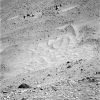
SOL236-2P147316153EFF8600P2584R1M1.jpgSands and Stones - Sol 23655 visitenessun commentoSet 04, 2004
|
|

SOL237-2N147401769EFF8600P1554L0M1.jpgMartian Sky - Sol 23757 visitenessun commentoSet 04, 2004
|
|
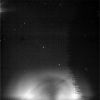
AV-Saturn-N00015958.jpgA "double glare" in the Space of Saturn80 visiteIl consueto riflesso che si accompagna alle rotazioni della Sonda quando essa si rivolge verso l'Anello "E", questa volta presenta una ulteriore curiosità. Guardate alla estrema Sn dell'immagine, in alto: potrete chiaramente vedere l'irraggiamento che proviene da un'altra sorgente luminosa, posizionata fuori obbiettivo. Dunque abbiamo un riflesso/irraggiamento in basso ed uno in alto a Sn. La domanda è ovvia: quali sono le cause di questi due fenomeni?Set 04, 2004
|
|
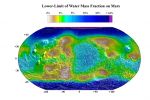
023-Mars_Water-3.jpgMap of Water on Mars97 visiteI raggi cosmici, dopo aver aver raggiunto il Pianeta, interagiscono rapidamente con gli elementi presenti negli strati superficiali del suolo Marziano. Da questo impatto e dalle conseguenti reazioni, scaturisce una (+ o - elevata) dispersione di neutroni. Sapendo che, per quanto maggiore è il quantitativo di H presente in detti strati, tanto minore è la dispersione di neutroni, misurando il loro > o < assorbimento, misuriamo anche il > o < quantitativo di H presente in essi.Sapendo che la forma più probabile in cui si può trovare H in prossimità della superficie di Marte è quella che lo vede aggregato all’O2, deduciamo che, laddove viene rilevata una maggiore presenza di H è altrettanto probabile che vi sia anche una maggiore presenza di H2O.Set 04, 2004
|
|
| 25353 immagini su 2113 pagina(e) |
 |
|
|
|
|
1983 | |
|
|
|
|





