| Ultimi arrivi |

Io-Emakong patera-PIA02598_modest.jpgThe "Emakong" Patera (HR)67 visiteCaption NASA originale:"Clues about how lava spreads great distances on Jupiter's volcanic moon Io come from HR views taken by NASA's Galileo spacecraft of a lava channel flowing out of Emakong Patera near Io's equator.
The lava channel is dark and runs to the right from the dark patera, or large depression, at the left of this mosaic. The 1999 images showed a dark channel though which molten material once fed a broad, bright lava flow that extended for hundreds of Km".
Set 08, 2004
|
|
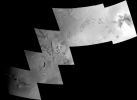
Io-Zamama Plume-PIA03531_modest.jpgThe "Zamama" flow field60 visiteThe source area of what had been a towering volcanic plume two months earlier lies in the far-right frame of this mosaic of images taken of Jupiter's moon Io by NASA's Galileo spacecraft on Oct. 16, 2001.
The region in the images includes the Zamama lava flow in Jupiter's northern hemisphere. The Zamama flow field emanates from the northernmost of two small volcanoes in the far left frame. These lava flows were not present in Voyager images of Io, so they formed some time between the Voyager 1 flyby in 1979 and the first Galileo observations of Io in 1996. Galileo also observed Zamama during Io encounters in 1999, and scientists identified narrow, long, dark lava flows thought to be similar to lava flows in Hawaii.
Moving northeast, the second and third frames of this mosaic contain lava flow fields and several unnamed volcanic depressions, called "paterae." It is unclear whether the broad, shield-like features or plateaus on which the paterae rest were created by eruptions from the paterae, or if they were preexisting features. Some fractures and dark lines suggest that the crust here is breaking up, creating cracks that magma can use to rise to the surface.
The far-right frame of this mosaic shows dark lava flows and bright spots. The bright spots are probably sulfur-bearing plume deposits, which are thought to be associated with the source of a plume eruption 500 kilometers (310 miles) high that was observed by the Galileo spacecraft in August, 2001. It was the largest plume eruption ever observed on Io.
Set 08, 2004
|
|

Io-Tohill Volcanoes-dtlmgnf-PIA03527_modest.jpgTohill Mons: Volcanoes and Craters60 visitenessun commentoSet 08, 2004
|
|
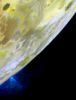
Io-Masubi plume-GAL-PIA02502_modest.jpgThe "Masubi" plume81 visiteA plume of gas and particles is ejected some 100 kilometers (about 60 miles) above the surface of Jupiter's volcanic moon Io in this color image, recently taken by NASA¹s Galileo spacecraft.
The plume is erupting from near the location of a plume first observed by the Voyager spacecraft in 1979 and named Masubi. However, during the course of the Galileo tour of Jupiter and its moons, a plume has appeared at different locations within the Masubi region.
This color image is the same as the previously released false color mosaic of Io, but with special processing to enhance the visibility of the plume. The plume appears blue because of the way small particles in the plume scatter light.
North is to the top of the picture, and the Sun illuminates the surface from almost directly behind the spacecraft. The resolution is 1.3 kilometers (0.8 miles) per picture element. The images were taken on July 3, 1999 at a distance of about 130,000 kilometers (81,000 miles) by the Galileo¹s camera.
Set 08, 2004
|
|

Io-Tohill Mons-PIA03600_modest.jpgTohill Mons63 visitenessun commentoSet 08, 2004
|
|

Io-Culann Tohill Patera-PIA03885_modest.jpgCulann-Tohill Patera61 visiteRepeated flybys of Io by NASA's Galileo spacecraft have allowed scientists to develop an understanding of Io's Tohil-Culann region of interconnected volcanoes and mountains.
An active volcano named Culann Patera (top center) is one of the most colorful volcanoes on Jupiter's innermost large moon (see PIA02535). It lies just north of an enigmatic mountain called Tohil Mons (see PIA03600). This mosaic image uses high-resolution Galileo images of Culann (200 meters or 660 feet per picture element) from the November 1999 flyby and high-resolution images of Tohil (165 meters or 540 feet per picture element) from the February 2000 flyby, and combines them with lower-resolution color images (1.4 kilometers or 0.9 mile per picture element) taken during the July 1999 flyby. Using the combined information, Galileo scientists have identified relationships among many colorful features in this complex.
The volcano Culann has produced both dark black and dark red lava flows, as well as diffuse, inner and outer rings of red and yellowish sulfur particles from explosive plumes (for example, PIA02502). Molten silicate rock inside Culann must occasionally mix with subsurface reservoirs of sulfur and sulfur dioxide to produce the plume deposits. The green color at the center of Culann and inside the older volcano Tohil Patera (center right) forms when red sulfur plume deposits land on dark black silicate lava flows and form a green veneer. The large white patch in southwestern Tohil Patera is rich in sulfur dioxide, and comparison with higher-resolution views (for example, PIA03527) suggests that this might be a region of cold sulfur dioxide flows. The small white patches on the mountain Tohil Mons might be deposits of sulfur dioxide snow that accumulate in grooves and at the bases of steep slopes in colder areas on the mountain. At upper right is a global view of Io showing the location of the mosaic.
Although Tohil Mons rises up to 6 kilometers (19,700 feet) above Io's plains, it is difficult to see in this image because the Sun was behind Galileo at the time it was taken. The topography of the mountainous region is clearer in a mosaic of images taken when the Sun was low in the sky, with illumination from the right (see figure below) The side-lit mosaic combines a high-resolution (330 meters or 1,100 feet per picture element) image from October 2001 with lower-resolution color images (1.4 kilometers or 0.9 mile per picture element) from July 1999.
Set 08, 2004
|
|

Io-Sulphur volcanism-PIA03887_modest.jpgPotential Source of Sulphur Flow on Io71 visiteA field of bright lava flows next to a shield volcano could be a source of recent sulfur volcanism on Io, as detected by instruments aboard NASA's Galileo spacecraft.
The mosaic at left combines higher-resolution images (330 meters or about 1080 feet per picture element) taken in October 2001 with lower-resolution color images (1.4 kilometers or 0.9 mile per picture element) taken in July 1999 by Galileo's solid-state imaging camera.
By comparing these images with a map of hot spots taken in February by Galileo's near-infrared mapping spectrometer (lower right), Galileo scientists noted that a new hot spot west of the active volcano Prometheus became bright in February 2000 and dimmed later. This hot spot appears to correspond with the bright flow field just west of a recently discovered shield volcano (see PIA03532), which is the only fresh volcanic material in the area.
The relatively low intensity of the February 2000 hot spot in the infrared data suggests a low-temperature eruption, consistent with sulfur lava rather than silicate lava as found elsewhere on Io and also on Earth. Sulfur lavas are thought to cool to a gray-yellow color on Io, as seen in the new flow field visible in the camera image. This bright flow field could be the best example of active sulfur lava flows deposited on Io during the Galileo mission. At upper right is a global view of Io showing the location of the more-detailed images.
The low temperature of this hot spot differs from many of Io's other active volcanoes, such as Pele, Tvashtar and Prometheus. Intense tidal flexing of Io helps keep the moon's interior molten, at some places producing silicate lavas hotter than any seen on Earth in billions of years. Io has the greatest known diversity of volcanic activity in the solar system.
North is to the top of all these images.
Set 08, 2004
|
|

Saturn_s South-Pole.jpgSaturn's South-Pole from approx. 8.900.000 Km57 visiteMacchie di nuvole bianche e svariate tempeste "scure" dominano le regioni polari dell'emisfero sud di Saturno in questa immagine ripresa il 18 Agosto 2004 da una distanza di circa 8.9 milioni di Km e con l'uso di un filtro sensibile alle lunghezze d'onda proprie della luce infrarossa. La scala dell'immagine è di 54 Km (33 miglia) per pixel.Set 08, 2004
|
|

NGC-4038_and_NGC-4039_(2).jpgNGC 4039 and NGS 4038 - The "Antennae" Colliding Galaxies75 visiteThe image was taken by Spitzer's infrared array camera and is a combination of infrared light ranging from 3.6 microns (shown in blue) to 8.0 microns (shown in red). The dust emission (red) is by far the strongest feature in this image. Starlight was systematically subtracted from the longer wavelength data (red) to enhance dust features. The two nuclei, or centers, of the merging galaxies show up as white areas, one above the other. The brightest clouds of forming stars lie in the overlap region.Set 08, 2004
|
|
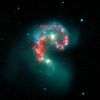
NGC-4038_and_NGC_4039-1.jpgNGC 4039 and NGS 4038 - The "Antennae" Colliding Galaxies70 visiteThis false-color image composite from NASA's Spitzer Space Telescope reveals hidden populations of newborn stars at the heart of the colliding "Antennae" galaxies. These 2 galaxies are located around 68 million light-years away and have been merging together for about the last 800 M years. The latest SST observations provide a snapshot of the tremendous burst of star formation triggered in the process of this collision, particularly at the site where the 2 galaxies overlap.Set 08, 2004
|
|

ZZ-ZZ-Z-APOLLO 15 AS 15-98-13302 MONOLITH.jpgThe "LUN-EX-IT Cuspid-pcf-04-04" from AS 15-98-13302186 visiteForse è un'altra Lunar Spire - sfuggita a Blair - o, magari, è solo un picco dalle fattezze davvero inusuali. O forse è quello che residua di una costruzione effettivamente artificiale, eretta migliaia o milioni di anni fa ed oggi totalmente in rovina? E' un "segno" che non siamo soli? Secondo noi le Cuspidi di Blair, quella di Phobos e la LUN-EX-IT Cuspid sono un invito a non fermarsi qui, sulla Terra, e "tornare lassù", a cercare risposte, segnali, tracce e, in fondo, frammenti della nostra stessa storia.Set 08, 2004
|
|

OPP-SOL220-1P147721288EFF35CCP2425R1M1.jpgInside Endurance Crater (close-up)56 visitenessun commentoSet 08, 2004
|
|
| 25353 immagini su 2113 pagina(e) |
 |
|
|
|
|
1979 | |
|
|
|
|





