| Ultimi arrivi |
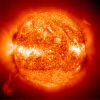
Sun-prom1743_eit_big.jpgAnother "Solar Prominence" from Soho85 visiteCaption NASA originale:"This large prominence is significant not only for its size, but also for its shape. The picture was taken early in the year 2000 by the Sun-orbiting SOHO satellite. Although large prominences and energetic Coronal Mass Ejections (CMEs) are relatively rare, they are occurred more frequently near Solar Maximum, such as the time of peak sunspot and solar activity in the 11 year solar cycle". Set 09, 2004
|
|

A-The Sun-Solar flare from Soho.jpgPowerful solar flare from Soho62 visiteCaption originale NASA: "Seen through the electromagnetic spectrum, the Sun briefly becomes over than 100 times brighter (in the X-rays wavelength) than normal. This is a so-called "Solar Flare" and, when it happens, energetic particles which are emitted from the Sun strike the Earth causing malfunctions in satellite communications or, in some specific areas, a very unusual (and yet very impressive) phoenomenon known as "Aurora Borealis".Set 09, 2004
|
|

The Sun from Soho.jpgA "Solar Prominence" from Soho68 visiteCaption NASA originale:"A 'Solar Prominence' is a cloud of solar gas held above the Sun's surface by the Sun's magnetic field. The Earth would easily fit under the hovering curtain of hot gas (like the one pictured above). A quiescent prominence typically lasts about one month, and may erupt in a Coronal Mass Ejection (CME) expelling hot gas into the Solar System. Although somehow related to the Sun's changing magnetic field, the energy mechanism that creates and sustains a Solar Prominence is still a mistery". Set 09, 2004
|
|

ZA-Green flash from the Sun.jpgAnother "green flash" from the Sun (Finland)137 visiteThe same phoenomenon represented by the previous picture.Set 09, 2004
|
|

ZA-Sunspot.jpgSunspot and Solar "granules" (detail mgnf)88 visiteCaption NASA originale:"Sometimes, small regions of the Sun appear unusually dark. Visible above is a close-up picture of a sunspot, a depression on the Sun's face that is slightly cooler and less luminous than the rest of the Sun. Sunspots can be larger than the Earth and usually last for only a few days. As you can see, the Sun's face is a bubbling sea of separate cells of hot gas. These cells are known as "granules" and a solar "granule" is about 1000 Km across and "lives" for + or - 10 minutes, then explodes".Set 09, 2004
|
|

Craters-Unnamed_Buried_Craters-MGS-PIA06855-00.jpgUnnamed Buried Craters in Utopia Planitia (Original NASA/MGS/MSSS b/w Frame)112 visiteCaption NASA:"This Mars Global Surveyor (MGS) Mars Orbiter Camera (MOC) image shows a cracked Plain in Western Utopia Planitia. The three circular crack patterns indicate the location of three buried Unnamed Impact Craters. These landforms are located near 41,9° North Lat. and 275,9° West Long. The image covers an area approximately 3 km (about 1,9 mi) across. Sunlight illuminates this scene from the lower left".Set 09, 2004
|
|

Sagittarius Region.jpgThe beautiful "Sagittarius Region" with NGC 6559, M 8 and M 20129 visite"And God shall wipe away all tears from their eyes; and there shall be no more death, neither sorrow, nor crying, neither shall there be any more pain: for the former things are passed away"
Revelation 21:4
Set 09, 2004
|
|

Io-sulphur_s role-PIA02547_modest.jpgThe Role of Sulphur in Io's Volcanoes74 visiteCaption NASA originale:"Sulphur gas, consisting of pairs of sulphur atoms (S2) - as detected above Io's volcano Pele by the HST in October 1999 - is ejected from the hot vents of Io's volcanoes (green arrow). Such sulphur gas lands on the cold surface where the sulphur atoms rearrange into molecules of 3 or 4 atoms (S3 and S4) which give the surface a reddish color. In time, the atoms rearrange into their most stable configuration (S8) that forms ordinary pale-yellow sulphur".Set 08, 2004
|
|

Io-Pele plume-PIA02546_modest.jpgThe "sulphuric plume" of Pele66 visiteThis image depicts the discovery of sulfur gas in the plume of the Pele volcano on Jupiter's moon Io, as seen by the Hubble Space Telescope in October 1999, during a flyby of Io by NASA's Galileo spacecraft. The main image shows Io passing in front of Jupiter as seen by Hubble's Wide-Field Planetary Camera (WFPC2) in near-ultraviolet light. The small inset shows that when a WFPC2 image at shorter ultraviolet wavelengths is included in a color composite with the near-ultraviolet image, Io's Pele plume appears as a dark smudge off the edge of Io's disk, silhouetted against Jupiter. The larger inset shows data from Hubble's Space Telescope Imaging Spectrograph, which mapped the composition of Pele's plume by analyzing the ultraviolet light from Jupiter which had passed through the plume. The regions shown in yellow were rich in sulfur gas, which was precisely centered over the Pele volcano, whose position is shown along with the edge of Io's disk.
Set 08, 2004
|
|
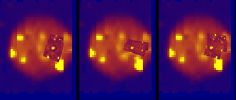
Io-active volcanoes-PIA02558_modest.jpgActive volcanoes on Io in 3 different months59 visiteCaption NASA originale:Changes in the volcanoes on Io can be seen in these 3 views, taken by NASA's Galileo spacecraft during its 3 flybys of Io in October and November 1999 and February 2000. All the images show the active volcanoes as bright yellow, corresponding to hot lava flows that appear glowing in infrared wavelengths. The 3 views were taken by the spacecraft's near-infrared mapping spectrometer and show the comparison of a typical low-resolution observation to the high-resolution views. The Prometheus volcano is seen near the middle of all three images. Before the recent flybys, only Prometheus and three other volcanoes were known to be active in this region. After these and other high-resolution observations, scientists were able to detect 14 volcanoes in the same area. The fainter volcanoes (hot spots) show some significant changes over intervals of 1 to 3 months. The area shown by all three observations put together is about 2 million square kilometers (about 770,000 square miles)".Set 08, 2004
|
|
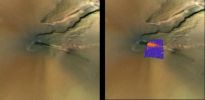
Io-Pele Volcano-PIA02560_modest.jpgThe "Pele" Volcano81 visitePele, one of Io's best-known volcanoes, was observed by the infrared spectrometer, an instrument onboard NASA's Galileo spacecraft, during the flyby of Jupiter's moon Io on February 22, 2000. The temperature map is shown here on the left in false color, superimposed on a visible color image of the Pele region obtained by the Voyager spacecraft in 1979. The red color represents the hottest lava flows. The purple colors are cooler materials. Preliminary results show that the temperatures of the hottest lava flows are at least 1,400 Kelvin (about 2,000 Fahrenheit), consistent with the temperatures of basaltic lava seen on the Kilauea volcano in Hawaii. It is possible that the eruption temperatures at Pele are even higher, as lava cools quickly once it starts to spread over the surface. The Voyager context image is 200 kilometers (124 miles) across.
Set 08, 2004
|
|

Io-hot spots-PIA02589_modest.jpgHot-spots on Io (at night) - edited68 visiteCaption NASA originale:"The left-hand frame shows the best view that Galileo has yet provided of Io's nighttime temperatures. For reference, the right hand frame, based on Galileo camera images, shows the same hemisphere of Io in visible light. The thin bright crescent indicates the only observable portion illuminated by sunlight during the temperature measurements. Several volcanoes are identified on both images: "L-K" is Lei-Kung Fluctus, "L" is Loki, "Pi" is Pillan, "M" is Marduk and "Pe" is Pele".Set 08, 2004
|
|
| 25353 immagini su 2113 pagina(e) |
 |
|
|
|
|
1978 | |
|
|
|
|





