| Ultimi arrivi |
M-069-1.jpgM 69 - Globular Star Cluster69 visite"A volte, quando guardiamo una Creatura che reputiamo essere a noi inferiore - magari per la posizione che occupa nella Scala Evolutiva, per esempio, o anche per la posizione in cui si trova in quella che chiamiamo "Gerarchia Sociale" -, ci scopriamo a chiederci "a che cosa serva", effettivamente, quella Creatura Inferiore e perchè, a quali scopi, Essa sia stata creata.
Io mi domando che effetto possa fare, a quella Creatura, sentirsi valutata in questi termini da esseri che, per semplice crudeltà, egoismo, vanagloria o cupidigia o lussuria o per altre similari motivazioni, non esitano a passare sopra i loro simili, calpestandone la Dignità, mutilandone la Speranza e poi, spesso, carpendone anche la Vita..."
P.C. Floegers - "Conversations"Set 16, 2004
|
|

SOU-SOL008.jpgMars Panorama from Pathfinder (Carl Sagan Station) - Soles 8, 9 and 10 (Enhanced Natural Colors - top image - and Natural Colors - bottom image -; credits: NASA/JPL-Caltech)102 visiteAncora un bel panorama di Marte, così come lo vedremmo se fossimo seduti accanto alla Sonda Soujourner. Le considerazioni da svolgere sono le solite. In questo caso Vi offriamo il commento originale al frame: "Each of these panoramic views is a controlled mosaic of approximately 300 IMP images covering 360° of azimuth and elevations from approximately 4° above the horizon to 45° below it. Simultaneous adjustment of orientations of all images has been performed to minimize discontinuities between images. Mosaics have been highpass-filtered and contrast-enhanced to improve discrimination of details without distorting relative colors overall.
TOP IMAGE: Enhanced true-color image created from the "Gallery Pan" sequence, acquired on Soles 8-10 so that Local Solar Time (LST) increases nearly continuously from about 10:00 (right edge) up to about 12:00 (left). BOTTOM IMAGE: Anaglyphic stereoimage created from the "Monster Pan" sequence, acquired in 4 sections between about 8:30 and 15:00 LST on Sol 3".Set 16, 2004
|
|

SOU-SOL050.jpgMars Panorama from Pathfinder (edited) - Sol 50 (Enhanced Natural Colors; credits: NASA/JPL/USGS)111 visiteUna bella veduta panoramica del Landing Site della Sonda Soujourner, corredata dall'indicazione di tutte le "aree di interesse", vicine e lontane. Da notarsi due cose: la prima attiene, come sempre, ai colori del paesaggio (incoerenti rispetto ad altre immagini simili o identiche); la seconda, i "nomi" dati dai Tecnici NASA alla maggior parte delle surface features oggetto di studio. Nomi che, come abbiamo detto in altra Sezione, sembrano essere stati estratti da giornali a fumetti per bambini. Semplificazione e volontà di rendere i dati accessibili a tutti o semplice tentativo di banalizzazione? Non è facile rispondere.
Voi cosa ne pensate?Set 16, 2004
|
|

Mars Express-PIA04802_modest.jpgMars Express89 visitenessun commentoSet 16, 2004
|
|

Saturn storms_-PIA06477_modest.jpgAn "oval" storm near Saturn's South Pole61 visiteCaption NASA originale:"The region near Saturn's south pole shows a great deal of fascinating detail in this view from Cassini. Near upper right, an oval-shaped storm is bordered to the north and south by bright streaks of cloud, and two dark storms hover in a brighter cloud lane near the center.
The image was taken with the Cassini spacecraft narrow angle camera on Aug. 7, 2004, at a distance of 8.4 million kilometers (5.2 million miles) from Saturn through a filter sensitive to wavelengths of infrared light. The image scale is 50 kilometers (31 miles) per pixel". Set 16, 2004
|
|

Microquasars.jpgMicro-Quasar in Cassiopeia and IC 180592 visiteMicroquasars (MQ), bizarre binary star systems, generating high-energy radiation and blasting out jets of particles at nearly the speed of light, live in our Milky Way galaxy. The energetic microquasar systems seem to consist of a very compact object, either a neutron star or a black hole, formed in a supernova explosion but still co-orbiting with an otherwise normal star. And now, using a very long array of radio telescopes, astronomers are reporting that at least 1 MQ (LSI+61 303) can be traced back to its probable birthplace, within a cluster of young stars in the constellation Cassiopeia. About 7.500 LY from Earth, the star cluster and surrounding nebulosity are shown in the deep sky image above. The cluster stars are identified by yellow boxes and circles.
A yellow arrow indicates the common apparent motion of the cluster stars; the green one shows the deduced motion of the microquasar system and the red arrow depicts the microquasar's motion relative to the star cluster itself.
Set 16, 2004
|
|

Fox Fur Nebula.jpgThe "Fox Fur" Nebula147 visite"...Miraturque nihil, nisi quod Libitina sacravit..."
(Orazio)
"Nulla viene ammirato (pur se meritevole), finchè Libitina non gli conferisce Dignità..."
*Libitina: Dea dei funerali, nel cui Tempio si prelevava l'occorrente per i servizi funebri e si custodivano i cosiddetti "Registri dei Morti"
(oggi diremmo: le persone non si apprezzano fintanto che non sono morte)
Set 15, 2004
|
|
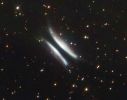
Gomez_s Hamburger - HST.jpgProtoplanetary Nebula - "Hamburger"136 visiteUn commento a questa immagine si impone: questa nebulosa protoplanetaria è stata chiamata "hamburger" - si, proprio come i panini di Mc Donald's... -. Un elevatissimo quantitativo di oggetti relativi allo spazio ed ai pianeti in generale ed a Marte in particolare viene quotidianamente battezzato usando una nomenclatura - quando va bene - "oscura" e, quando va male, "ridicola" sino ai limiti dell'offensivo. Ci siamo spesso chiesti il perchè di questo (per lo meno "curioso") approccio ai Misteri dell'Universo e, alla fine, ci siamo convinti che l'attribuzione di nomi ridicoli costituisca un modo di esorcizzare quello che non riusciamo a comprendere, in tutto o in parte, facendolo ricadere sotto una realtà che deve essere "nota" ed "innocua". Noi non sappiamo se questo modo di ragionare sia giusto o no, ma una cosa è certa: alle volte si esagera. La nebulosa "Hamburger", secondo noi, fa parte della casistica in cui si è esagerato nella semplificazione, ottenendo il risultato della "banalizzazione".
O no?!?..Set 15, 2004
|
|

Eta Carinae.jpgEta Carinae80 visite"...Black Hole: una stella collassata, per alcuni; un'anomalia del Cosmo, per altri. Una simpatica definizione diceva che il Buco Nero è una sorta di "Aspirapolvere Cosmico", capace di risucchiare ogni genere di corpo fisico al suo interno, incluso ciò che noi chiamiamo "Tempo". Nel complesso di definizioni, comunque - e nella loro diversità - è sempre emerso un punto comune, che è questo: NULLA, una volta afferrato, può sfuggire al Black Hole.
Ebbene io credo, con ciò creando un paradosso, che se un uomo venisse catturato da uno di questi oggetti, qualcosa potrebbe comunque riuscire a scappare all'immensa attrazione di un siffatto "Aspirapolvere Cosmico".
Cosa?
Ma è semplicissimo: esso non potrebbe mai trattenere un qualsiasi "pensiero" proveniente da questo ipotetico uomo, prigioniero del suo eterno ed invincibile abbraccio gravitazionale..."
P.C. Floegers - "In the Paradox"Set 15, 2004
|
|

Sun_Pillar_in_blue_and_violet.jpgSun Pillar from Lake Tahoe - Nevada State Park (USA)122 visiteCaption originale NASA: "Sometimes the unknown is beautiful. In 2000 February near Lake Tahoe, Nevada, two amateur photographers noticed an unusual red column of light rise mysteriously from a setting sun. During the next few minutes, they were able to capture the pillar and a photogenic sunset on film. Pictured above, the red column is seen above a serene Lake Tahoe and snow-capped mountains across from Lake Tahoe-Nevada State Park. The mysterious column, they learned later, is a Sun Pillar, a phenomenon where sunlight reflects off of distant falling ice crystals".Set 15, 2004
|
|

South_Polar_Regions-South_Pole.jpgThe South Pole of Mars (Natural Colors; credits: NASA/MGS/MSSS)200 visiteCaption NASA:"During Spring, the Ice Cap - predominantly formed by layers of frozen carbon dioxide (dry ice) plus some water ice - begins to shrink as the ices change directly from solid to gas (cosiddetta "sublimazione"). Hazy clouds of ice crystals and fog extend across the bottom of the picture and a darker, more defrosted area, is visible at the upper right, near the Red Planet's night side". Set 15, 2004
|
|

Fomalhaut.jpgFomalhaut Dust Disk Indicates Planets293 visiteFomalhaut, actually the 17th brightest star in the night sky, is a mere 22 LY away but only a fraction of the age of our Sun. Recent observations in far infrared light (...) indicate a dust disk surrounding Fomalhaut that has both a hole in the center and a warped edge. Now the hole in the center indicates that dust has fallen onto interior planets - possibly like the Earth - while the warp at the edge indicates the gravitational pull of a planet like Jupiter or Saturn. Set 15, 2004
|
|
| 25353 immagini su 2113 pagina(e) |
 |
|
|
|
|
1973 | |
|
|
|
|





