| |
| Ultimi arrivi |

NGC-1512.jpgNGC 151275 visite"...Lo vuoi davvero sapere qual'è il vero problema e qual'è il vero dilemma?
Ascolta, ecco il problema: pensa se tutto quello che fai nella tua Vita - di bene o di male, di giusto o di sbagliato, di importante o di non importante - non avesse comunque alcuna importanza. Zero.
Pensa che cosa sarebbe di te se tu sapessi che tutto quello che fai, che hai fatto e che farai è stato, è e sarà sempre ed in ogni caso completamente irrilevante.
Ora pensa, invece, che cosa resterebbe di te se tu sapessi che tutto quello che fai, hai fatto e farai nella tua Vita - di bene o di male, di giusto o di sbagliato, di importante o di non importante - è stato, è e sarà sempre e comunque rilevante. Decisivo.
Ogni azione od omissione che sia stata compiuta, che si compia e che si compierà, dalla più grandiosa alla più minuscola ed insignificante, è sempre fondamentale.
Questo è il problema.
E questo è il dilemma: quale delle due situazioni, secondo te, dovrebbe farci più paura?..."
P.C. Floegers - "Conversations"Set 17, 2004
|
|

Saturn_s Rings in color - PIA06114_modest.jpgSaturn's Rings in natural colors from Cassini-Huygens56 visiteCaption NASA originale:Saturn's faintly banded atmosphere is delicately colored and its threadbare rings cross their own shadows in this marvelous natural color view from Cassini.
The planet and its rings would nearly fill the space between Earth and the Moon. Yet, despite their great breadth, the rings are a few meters thick and in some places, very translucent. In this image, we can see through the C-Ring, which is closest to Saturn, and through the Cassini division, the 4.800-Km wide gap that arcs across the top of the image and separates the optically thick B-Ring from the A-Ring. The part of the atmosphere seen through the gap appears darker and more bluish due to scattering at blue wavelengths by the cloud-free upper atmosphere.
The different colors in Saturn's atmosphere are due to particles whose composition is yet to be determined.
The image was obtained with the Cassini spacecraft narrow angle camera on July 30, 2004, at a distance of 7.6 MKM from Saturn".Set 17, 2004
|
|

OPP-SOL116_(4).jpgEndurance Crater full Panorama193 visite...luccicanti.
E' molto importante risolvere "misteri" (reali o presunti) di questo tipo anche perchè la credibilità della NASA, a seconda della soluzione che riusciremo a trovare, potrebbe venir fuori fortificata (e ci sentiremmo, forse, tutti un pò più tranquilli) oppure ancora maggiormente ridotta (ed allora alcuni scenari, già adesso abbastanza foschi, comincerebbero a diventare anche inquietanti). In ogni caso, TUTTI quanti noi, Ricercatori, Appassionati e Curiosi, avremmo contribuito a rendere un buon servizio in favore di qualcosa che si chiama "Verità".
Il che, ne converrete, non è affatto cosa da poco...
Grazie per la collaborazione!Set 17, 2004
|
|
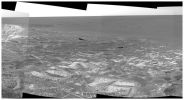
OPP-SOL116_(3).jpgEndurance Crater full Panorama230 visite...b) l'oggetto luccicante di cui sopra, come ripreso nella immagine a colori citata, non solo è troppo grande, ma inoltre ha EFFETTIVAMENTE attaccato a sè qualcosa e quindi NON può essere lo Scudo Termico, il quale è un pezzo piccolo, unico e solo c) accanto ad Endurance ci sono 2 rottami, dei quali uno è lo Scudo Termico e l'altro qualcosa che non riusciamo a definire. Noi non siamo, al momento, in condizione di risolvere questo piccolo enigma ma, a quanto ci ha scritto un Lettore, esiste un frame A COLORI dell'area prossima ad Endurance Crater dal quale SEMBRA effettivamente emergere che, accanto al Cratere ci siano 2 diversi oggetti, uno dei quali è certamente lo Scudo Termico e nessuno dei quali è la Backshell con Parachute. Molto interessante.
Però abbiamo bisogno di questa immagine (che pubblicheremmo subito) per risolvere, almeno in parte, una querelle i cui contorni cominciano a farsi confusi.
Aiutateci anche Voi: cercate di trovare questa immagine a colori di Endurance con accanto 2 oggetti...Set 17, 2004
|
|

OPP-SOL116_(2).jpgEndurance Crater full Panorama498 visiteIn accordo a quanto si vede nella Mappa predisposta dalla NASA stessa, i due rottami in questione - (1) backshell + parachute e (2) heatshield - dovrebbero giacere in posizioni profondamente differenti. In particolare: (2) dovrebbe trovarsi in prossimità di Endurance Crater. Nell'immagine a colori che riprende in campo lungo Endurance Crater (vedi Sez. "Mars in Colors") quando il Rover era ancora lontano, accanto ad Endurance si vede un oggetto metallico (NON piccolo!) al quale, per giunta, SEMBRA (cerchiamo di essere sempre più prudenti...) esserci attaccato qualcosa. Ora la componente (2), come saprete, non deve avere attaccato a sè assolutamente NULLA. Ciò premesso, gli scenari che emergono sono questi: a) l'immagine a colori che mostra qualcosa di luccicante accanto ad Endurance è stata da noi male interpretata e l'oggetto che ci sembrava avere attaccato qualcosa a sè è, invece, un corpo unico e solitario il quale è effettivamente lo Scudo Termico della Navicella...Set 17, 2004
|
|

OPP-SOL116_(1).jpgEndurance Crater and the "Sparkling Cube/Heatshield"293 visiteIl commento originale all'immagine: "This NavCam mosaic, created from images taken by NASA's Mars Exploration Rover Opportunity on Soles 115 and 116 (May 21 and 22, 2004) provides a dramatic view of "Endurance Crater." The Rover Engineering Team carefully plotted the safest path into the football field-sized crater, eventually easing the rover down the slopes around Sol 130 (June 12, 2004). To the upper left of the crater sits the Rover's protective heatshield, which sheltered Opportunity as it passed through the martian atmosphere".
E' dunque risolto il mistero del "cubo luccicante"? Sembra di si, ma se quel "cubo" è davvero lo "Scudo Termico", allora sapreste spiegarci perchè, in un'altra immagine (da noi pubblicata nella Sezione "Mars in Colors"), accanto ad Endurance Crater si vedono invece "backshell & parachute" (che la mappa prodotta dalla NASA, per altro, riporta in posizione diametralmente opposta rispetto ad Endurance Crater).
Forse abbiamo male interpretato le immagini? Vediamo un pò:...Set 17, 2004
|
|

IC-1805-4.jpgIC 1805 - The "Heart" Nebula123 visite"...Nelle chiese abbandonate
Si preparano rifugi,
E nuove astronavi,
Per viaggi interstellari...
In una vecchia miniera,
Distese di sale
E un ricordo di Te:
Come un incantesimo..."
F. Battiato - "I Treni di Tozeur"
Set 17, 2004
|
|

Jupiter-water cloud-GAL-PIA01639_modest.jpgWater clouds on Jupiter72 visiteThis false-color picture of a convective thunderstorm 10.000 Km(6.218 miles) northwest of Jupiter's Great Red Spot was obtained by NASA's Galileo spacecraft on June 26, 1996. The white cloud in the center is a tall, thick cloud about 1.000 Km (620 miles) across, standing 25 Km (15 miles) higher than most of the surrounding clouds. Its base extends off to the left and appears red in this representation. This red color indicates that the cloud base is very deep in the atmosphere, about 50 Km (30 miles) below the surrounding clouds. Most of the wisps and features in Jupiter's clouds are thick and thin ammonia clouds, forming at a pressure just less than Earth's sea level pressure. On Jupiter, water is the only substance to form a cloud at a depth where the pressure is about 5 times the Earth's sea level pressure. The red base of this thunderstorm is so deep that it can only be a water cloud. In 1979 NASA's Voyager spacecraft saw convective clouds of this type near the Great Red Spot. They erupted like this roughly once every 10 days and lasted a few days each. But Voyager's cameras could not allow the determination of the storms' altitude. It is thought that this storm is analogous to an Earth thunderstorm, with the cloud's high, bright, white portion comparable to the familiar anvil cloud on Earth. Whether any rain or snow is falling below this cloud is unknown, but there are indications that similar storms on Jupiter have lightning in them. Set 16, 2004
|
|

The Sun in Hydrogen-Alpha light (2).jpgThe Sun in Hydrogen-Alpha light64 visiteCaption NASA originale:"The above image, taken in a single color of light called Hydrogen Alpha, records a great amount of detail of the simmering surface of our parent star. The gradual darkening towards the Sun's edge, called limb darkening, is caused by increased absorption of relatively cool solar gas. Further over the edge, a giant prominence is visible, while a different prominence can be seen in silhouette as the dark streak near the image center. Two active areas of the Sun are marked by bright plages. The above amateur photograph of the Sun was taken just through a small telescope and a standard digital camera". Set 16, 2004
|
|

Martian_Mountains-MGS-00.jpgCharitum Montes (Natural Colors; credits: NASA/MGS/MSSS)205 visiteWhat causes the unusual white color on some Martian Mountains? The answer can be guessed by noticing that the bright areas disappear as springtime takes hold in the South of Mars: dry ice. Dry CO2 ice sublimates directly to gas from its frozen state. The frosty mountains, named "Charitum Montes", have been covered with CO2 ice over the Martian Winter. The serene scene pictured above is not a photograph, but rather a computationally constructed digital illusion resulting from the fusion of two color images from the Mars Orbital Camera and topographic data from the Mars Orbiter Laser Altimeter. Both instruments operate from the Mars Global Surveyor robot spacecraft currently orbiting Mars.Set 16, 2004
|
|

M-009-1.jpgM 9 - Globular Star Cluster69 visite"...Live as children of light - for the fruit of the light is found in all that is good and right and true..."
(Ephesians 5:8-9)Set 16, 2004
|
|

M-070-1.jpgM 70 - Globular Star Cluster81 visite"...Dubita pur che gli astri sian di foco,
Dubita pur che il sol si sposti in giro,
Che Verità, di noi, si prenda gioco,
Ma non ch'io ver' te, amante, ognor sospiro..."
(W. Shakesperare - "Hamlet" Atto II, scena II)Set 16, 2004
|
|
| 25353 immagini su 2113 pagina(e) |
 |
|
|
|
|
1972 | |
|
|
|
|
|
|





