| Ultimi arrivi |

M 42.jpgM 42 in different colors172 visiteUna suggestiva combinazione di immagini ottenute con 3 filtri distinti, ciascuno capace di registrare una diversa linea di emissione: Zolfo (S), Ossigeno (O2) e Idrogeno (H). A bassa densità (ovvero nelle condizioni esistenti all'interno della Grande Nebulosa di Orione), S ed H emettono luce rossa mentre l'O2 emette luce verde. Per distinguerli bene nell'immagine, tuttavia, allo Zolfo è stato - in sede di sviluppo finale - assegnato il rosso, all'Idrogeno il verde ed all'Ossigeno il blu.
Il risultato, sebbene la colorazione finale NON sia "realistica", appare comunque non solo utile a fini della ricerca e dell'esatta mappatura dei gas presenti nella Nebulosa, ma anche molto suggestivo.
Set 19, 2004
|
|

Star Forming Region DR21.jpgStar forming region "DR 21 - Cygni" - SST89 visiteDeep in the normally hidden recesses of giant molecular cloud DR 21, a stellar nursery has been found creating some of the most massive stars yet recorded. The orbiting Spitzer Space Telescope's Infrared Array Camera opened the window into the cloud in mid- infrared light. The cloud is opaque to visible light because of dense interstellar dust. Noticeable in the above representative color infrared Spitzer image are huge bubbles, a complex tapestry of dust and gas and very massive stars. The infrared filaments actually glow because of organic compounds known as "PAHs". The intricate patterns are caused by complex interactions between interstellar winds, radiation pressures, magnetic fields, and gravity. The pictured region spans about 75 LY and lies about 6.000 LY distant toward the constellation of Cygnus.Set 19, 2004
|
|

M-087.jpgM 87 - Elliptical Galaxy70 visiteElliptical galaxy M 87 is a type of galaxy that looks much different than our own Milky Way Galaxy. Even for an elliptical galaxy, though, M 87 is peculiar. M 87 is MUCH bigger than an average galaxy, appears near the center of a whole cluster of galaxies (known as the Virgo Cluster) and shows an unusually high number of globular clusters. These globular clusters are visible as faint spots surrounding the bright center of M 87. In general, elliptical galaxies contain similar numbers of stars as spiral galaxies, but are ellipsoidal in shape (spirals are mostly flat), have no spiral structure and little gas and dust.Set 19, 2004
|
|

AL-Streak Again-N00018570.jpgStreak again!77 visiteUna nuova "Striscia nel Cielo" - del 17/9/2004 - da guardare con estrema cura. Il motivo è questo: abbiamo svolto una semplice analisi sul frame scoprendo che la Striscia, stavolta, è costituita - ed è la 1ma volta che lo si vede con estrema chiarezza - da una sequenza di punti luminosi ravvicinatissimi i quali, per altro, non hanno tutti la stessa intensità luminosa. Un effetto similare (se non identico) lo si può ottenere, sulla Terra, riprendendo - con obbiettivo grandangolare o simile - una porzione di cielo notturno (con esposizione fra i 10 ed i 18/20") mentre un qualsiasi velivolo convenzionale si trovi in transito attraverso tale porzione di cielo. Effettuato lo sviluppo dell'immagine, noterete che il corpo del velivolo risulterà costituito da una serie ravvicinatissima di punti luminosi i quali diventeranno "più luminosi" in corrispondenza dei flash emessi dalle sue luci di posizione. Cosa implichiamo con questo discorso?
Che la Streak in the Sky di oggi NON E' CERTAMENTE un raggio cosmico!Set 19, 2004
|
|

At the edge of the Sun.jpgAt the edge of the Sun68 visiteCaption NASA originale: "Dramatic prominences can sometimes be seen looming just beyond the edge of the Sun. A Solar Prominence is a cloud of solar gas held just above the surface by the Sun's magnetic field. The Earth would easily fit below the prominence on the left. A quiescent prominence typically lasts about a month and may erupt in a Coronal Mass Ejection (CME) expelling hot gas into the Solar System. Although very hot, prominences typically appear dark when viewed against the Sun, since they are slightly cooler than the surface. The above image - in false color - was taken on June 1st, 2003, from Stuttgart, Germany, with a simple amateur telescope and camera".Set 18, 2004
|
|

ZB-Moon and Mars.jpgMoon and Mars311 visiteThe Clay Center Observatory expedition to Bonita Springs, Florida - USA - produced this evocative picture of Mars grazing the Moon's dark edge by digitally stacking and processing a series of telescopic images of the event. With the cratered Moon in the foreground, the bright planet Mars seems alarmingly close. Its global scale features and white south polar cap are easily visible. Set 18, 2004
|
|

SOL182 (4).jpgSol 182 - "Engineering Flats" Panorama - (4)56 visitenessun commentoSet 18, 2004
|
|
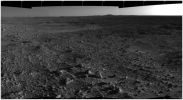
SOL182 (3).jpgSol 182 - "Engineering Flats" Panorama - (3)57 visitenessun commentoSet 18, 2004
|
|
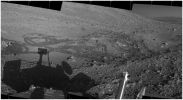
SOL182 (2).jpgSol 182 - "Engineering Flats" Panorama - (2)56 visitenessun commentoSet 18, 2004
|
|
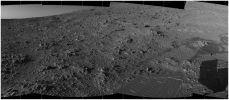
SOL182 (1).jpgSol 182 - "Engineering Flats" Panorama - (1)56 visitenessun commentoSet 18, 2004
|
|

M 55.jpgM 55 - Globular Star Cluster67 visiteM 55 is a large Globular Star Cluster of around 100.000 stars. Only 20.000 LY away in the constellation Sagittarius, M 55 appears to earth-bound observers to be nearly 2/3 the size of the full Moon. Globular star clusters like M 55 roam the halo of our Milky Way Galaxy as gravitationally bound populations of stars known to be much older than stellar groups found in the galactic disk. Astronomers who make detailed studies of globular cluster stars can accurately measure the cluster ages and distances. Their results ultimately constrain the age of the Universe and provide a fundamental rung on the astronomical distance ladder.Set 18, 2004
|
|

AI-Saturn-Streak in the Sky-N00018041.jpgA new "Bright Streak" in the Sky of Saturn88 visiteUna nuova "striscia luminosa" (bright streak) nel Cielo di Saturno, ripresa il giorno 14 Settembre 2004. Che dire? Secondo noi - anche se accettassimo acriticamente la teoria che spiega alcune (comunque brevi e piuttosto deboli) striature di luce che, spesso, appaiono nelle immagini scattate guardando verso lo spazio come "raggi cosmici" - questa specifica "striscia" sembra qualcosa di molto particolare. Qualcosa che non può essere semplicemente ricondotto all'emissione luminosa di una micro-particella che schizza nello spazio a velocità relativistica.
Secondo noi, questa striscia (come anche altre, riprese dalla superficie di Marte) è causata da qualcosa di diverso.
Cosa?
E se lo sapessimo...Set 17, 2004
|
|
| 25353 immagini su 2113 pagina(e) |
 |
|
|
|
|
1971 | |
|
|
|
|





