| Ultimi arrivi |

APOLLO 16 AS 16 112-18220.jpgAS 16-112-18220 - More "Star-like Objects"?131 visiteUna splendida formazione "a triangolo" di tre Star-like Objects. Uno dei tre - il più luminoso per l'esattezza - potrebbe essere il medesimo oggetto ripreso nel frame 18218...che si è spostato. Oppure potrebbe essere una stella molto luminosa. In ogni caso, si tratta di un fotogramma di grande mistero e, dunque, anche di grande valore.Set 23, 2004
|
|

APOLLO 16 AS 16 112-18217.jpgAS 16-112-18217 - Something is about to happen...122 visiteQuesto frame, in sè, non ci dice nulla. Ma è comunque importante considerarlo e tenerlo a mente, se andate a guardare i due che lo seguono...Set 23, 2004
|
|

APOLLO 16 AS 16 112-18219.jpgAS 16-112-18219 - More "Star-like Objects"?175 visiteIl fotogramma successivo ci dice che la sfera (?) luminosissima inquadrata in precedenza è sparita. In compenso si possono vedere molto chiaramente due distinti Star-like Objects che non apparivano nel frame 18218.
Da studiare.Set 23, 2004
|
|

APOLLO 16 AS 16 112-18218.jpgAS 16-112-18218 - What is that "bright thing"?187 visiteUna sfera bianca/argentea si libra ad un'altezza imprecisabile, ma (almeno apparentemente) in prossimità di un terrapieno o di una collinetta. E' forse un riflesso? Siamo in attesa di ricevere il frame originale uncompressed. Per ora possiamo dire che si tratta di qualcosa di realmente strano e di MOLTO luminoso. Qualora non si trattasse di uno dei difetti tipici dell'immagine derivanti dalla ipercompressione dei files associati (con cosiddetta creazione, sul positivo, di "artifacts"), possiamo subito dire "che cosa - quella luce - non è". Non è certo - almeno a nostro parere - la luce di una stella. Set 23, 2004
|
|

Sun - Coronal holes.jpgCoronal "Holes"63 visiteCaption NASA originale:"The ominous, dark shapes haunting the left side of the Sun are coronal holes - low density regions extending above the surface where the solar magnetic field opens freely into interplanetary space. Studied extensively from space since the 1960s in ultraviolet and x-ray light, coronal holes are known to be the source of the high-speed solar wind, atoms and electrons which flow outward along the open magnetic field lines. During periods of low activity, coronal holes typically cover regions just above the Sun's poles. These coronal holes, however, have just moved into view near the Sun's equator, and particles escaping them have already caused notable aurora here on Earth. Coronal holes like this one may last for a few solar rotations before the magnetic fields shift and change configurations. Shown in false-color, this picture of the Sun on March 9, 2003, was made in extreme ultraviolet light by the EIT instrument on board the space-based SOHO observatory".Set 23, 2004
|
|

Sun surface in 3D.jpgThe "bubbling" surface of the Sun in 3D100 visiteCaption NASA originale" How smooth is the Sun? The new Swedish 1-m Solar Telescope, deployed in the Canary Islands in 2002, allows imaging of objects less than 100-Km across on the Sun's surface. When pointed toward the Sun's edge, surface objects now begin to block each other, indicating true three-dimensional information. Close inspection of the image reveals much vertical information, including spectacular light-bridges rising nearly 500 Km above the floor of sunspots near the top of the image. Also visible in the above false-color image are hundreds of bubbling granules, each about 1000 Km across, and small bright regions known as "faculae".Set 23, 2004
|
|

OPP-SOL236-1P149143745ESF35CRP2587R1M1.jpgUnusual "drawing" in the sand618 visiteQuesta immagine - riferita al Sol 236 di Opportunity - ci ha lasciati davvero sorpresi. Si tratta, infatti, di una sorta di "disegno" tracciato sulla sabbia che si trova in prossimità del fondo del Cratere Endurance. A prima vista sembrerebbe un'impronta lasciata da uno degli "abrasori" di cui sono dotati i Rover ma questi strumenti, qualcuno ha correttamente eccepito, NON vengono usati per fare "disegni" sulla sabbia. E allora? Cos'è quella specie di "disco" che sembra "emergere" dalla sabbia? Attendiamo l'arrivo di nuove immagini per avanzare delle ipotesi più circostanziate: per ora ci limitiamo a dire che, qualora non si trattasse (o non si riuscisse a dimostrare che si tratta) di una impronta lasciata dal Rover Opportunity, allora ci troveremmo davanti ad un "segno" davvero inconfutabile che dimostra l'esistenza di attività meccaniche di origine "NON naturale" in corso (o trascorse) su Marte.
Osservate bene e fateci avere le Vostre opinioni...Set 23, 2004
|
|
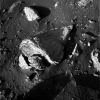
OPP-SOL235-1N149058214EFF35CRP1898L0M1.jpgClose encounter with Martian "stones" - Sol 235142 visiteRistabiliti i "contatti" con Marte, ecco che cominciano ad arrivare nuove immagini dopo 11 Soles di buio e silenzio. Questo frame si riferisce al Sol 235 di Opportunity e riguarda una gruppo di rocce che giacciono (quasi) sul fondo del Cratere Endurance. Se le osservate attentamente non potrete non notare la fortissima usura (probabilmente determinata dallo scorrere dell'acqua) che la roccia più grande sembra aver sofferto. Set 23, 2004
|
|

Neptune and Triton - PIA01491_modest.jpgNeptune and Triton56 visiteCaption NASA originale:"This image was returned by the Voyager 2 spacecraft on July 3, 1989, when it was 76 MKM from Neptune. The planet and its largest satellite, Triton, are captured in the field of view of Voyager's narrow-angle camera through violet, clear and orange filters. Triton appears in the lower right corner at about 5 o'clock relative to Neptune.
Recent measurements from Voyager images show Triton to be between 1.400 and 1.800 Km in radius with a surface that is about as bright as freshly fallen snow". Set 22, 2004
|
|

APOLLO 17 AS 17-140-21496.jpgAS 17-140-21496 - Boulder and Astronaut...148 visiteL'angolo di ripresa è cambiato, ma il macigno è lo stesso del frame precedente. Osservate le dimensioni della roccia in rapporto a quelle dell'astronauta...Set 22, 2004
|
|

APOLLO 17 AS 17-140-21436.jpgAS 17-140-21436 - Another "BIG" boulder135 visiteUn altro macigno "ostruisce" la strada al Moon Rover.
Si tratta di una roccia davvero bella ed imponente che verrà fotografata in lungo ed in largo.Set 22, 2004
|
|

APOLLO 17 AS 17-140-21386.jpgAS 17-140-21386 - Astronaut, Flag and Rover129 visiteUn classica "cartolina dalla Luna": la foto è molto bella ma non ci dice nulla di particolare...Set 22, 2004
|
|
| 25353 immagini su 2113 pagina(e) |
 |
|
|
|
|
1963 | |
|
|
|
|





