| Ultimi arrivi |

IC-3568.jpgIC 3568102 visite"Everything that moves, serves to interest and amuses a cat..."
F.A. Paradis De MoncrofOtt 08, 2004
|
|
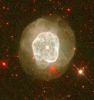
NGC-6578-02.jpgNGC 657863 visite"...There are many bridges between our World and Worlds beyond the one we know..."
(anonimo)Ott 08, 2004
|
|

Hellas_Planitia.jpgHellas Planitia in Winter (Natural Colors; credits: NASA/MGS/MSSS)128 visite"This picture captures two dust storms, each large enough to cover Arizona or New Mexico. One is located near the lower left, the other at the lower right. Taken on April 8, 2001 (Mid-Southern Winter), this is a mosaic of six MOC daily global images centered around Hellas Planitia in the Martian Southern Hemisphere. Hellas Planitia is the dominant elliptical feature just below the center of the picture. The bright, nearly white surfaces along the lower (southern) edge of the picture are covered by wintertime frost. The strong temperature difference between the winter frost and the warmer air just off the edge of this Polar Cap generates winds that - at this time of year - are often strong enough to lift Dust into large, reddish-brown, billowy clouds".Ott 07, 2004
|
|

Valles_Marineris-MGS.jpgPortion of the Valles Marineris Canyon System (Natural Colors; credits: NASA/MGS/MSSS)93 visitenessun commentoOtt 07, 2004
|
|

Souhern_Emisphere.jpgThe Southern Hemisphere of Mars (Natural Colors; credits: NASA/MGS/MSSS)107 visiteCaption NASA:"The wide angle camera view of Mars shown here was obtained by the Mars Global Surveyor Mars Orbiter Camera in late July 1999, about 1 week before the start of southern Spring. The frosty, retreating south polar cap (white) is seen in the lower quarter of the image and wisps of dust storm clouds (grayish-orange in this view) occur just above the cap at the lower left. The southernmost of the large Tharsis volcanoes, Arsia Mons, is seen at the upper left. Arsia Mons is about 350 Km across".
Ott 07, 2004
|
|

Volcanoes-Olympus_Mons_and_Tharsis_Region.jpgTharsis Region (Natural Colors; credits: NASA/MGS/MSSS)136 visite"Mars Global Surveyor's camera, MOC, provided this hemispheric view of the northern Tharsis region on June 1, 1998. This picture shows the giant volcano, Olympus Mons, and one of the Tharsis Montes volcanoes, Ascraeus Mons. Another volcano, Alba Patera, is lurking under the haze and clouds at the top of the image. Olympus Mons is about 550 Km wide. The terminator - such as the line that divides night and day - was located west of Olympus Mons (left part of the image). It is Winter in the northern hemisphere of Mars and the high latitudes (i.e.: north of Olympus Mons in this picture) exhibit clouds and haze. These clouds most likely contain water ice".
Non possiamo non notare l'enfasi che viene spesso posta, in sede di commento originale alle immagini, sul fatto che le nuvole Marziane "MOLTO PROBABILMENTE" (ossìa "QUASI CERTAMENTE") contengono ACQUA. E allora noi rivolgiamo alla NASA - ancora - la stessa domanda: ma siamo certi che su Marte non piove da qualche milione di anni?
Risposta? Silenzio totale.Ott 07, 2004
|
|

Phobos_from_Mgs-011.jpgMartian Limb and Phobos (Natural Colors; credits: NASA/MGS/MSSS)135 visiteUna spettacolare veduta del bordo ("limb") di Marte e della sua luna "misteriosa", Phobos, la quale costituisce anche uno degli oggetti più "bui" dell'intero Sistema Solare. Ecco il commento originale a questa immagine:
"Phobos is one of the darkest objects in the Solar System. Thus, 4 wide angle images were obtained to make the picture of Phobos over the martian limb: a pair of red and blue wide angle images was acquired for the limb and a pair of separate images were required to see Phobos. The wide angle images illustrate the fact that Phobos is mostly colorless (dark gray); the faint orange/red hue in the wide angle picture is a combination of slight differences in the focal lengths of the blue and red cameras and the orange/red illumination provided by reflection of sunlight off Mars. To a person standing on Phobos, the Red Planet would fill most of the sky". Ott 07, 2004
|
|

Craters-Gusev_Crater-R1300473_474.jpgGusev Crater Landscape from MGS (Extremely Enhanced Natural Colors; credits:NASA/JPL-MSSS)128 visiteSi tratta di un'immagine a colori ad HD semplicemente fantastica, ottenuta dalla Sonda Mars Global Surveyor e relativa (in parte) all'area di lavoro di Spirit. Abbiamo scelto di mostrarVi questo frame per almeno 3 buoni motivi: 1) perchè si tratta di un frame bellissimo; 2) perchè ci fa vedere bene i "colori di Marte" (che, dall'alto, sembrano diversi da quanto ci mostrano le Sonde che stazionano sulla superficie e 3) perchè ci aiuta a cogliere, usando i nostri occhi, la sensazione che proveremmo se ci trovassimo fisicamente su una nave spaziale, in orbita intorno a Marte.Ott 07, 2004
|
|

M-006-0.jpgM 6 - The "Butterfly" Open Star Cluster94 visite"A cat's eyes are windows enabling us to see into another World"
(Irish Legend)Ott 06, 2004
|
|
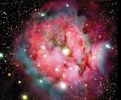
IC_5146.jpgIC 5146 - The "Cocoon Nebula"100 visite"Cats have always been associated with the Moon. Like the Moon they come to Life at night, escaping from Humanity and wandering over housetops with their eyes beaming out through the darkness"
Patricia Dale GreenOtt 06, 2004
|
|

Centaurus A.jpgCentaurus "A"86 visite"Our 'Perfect Companions' never have fewer than four feet"
ColetteOtt 06, 2004
|
|
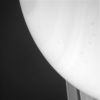
Saturn-N00020846.jpgSaturn and something else...57 visiteDi frames come questo, ogni giorno, ne giungono sulla Terra a decine, forse a centinaia. Noi cerchiamo di esaminarne il maggior quantitativo possibile (circa la metà di quelli che la NASA rende disponibili) e, di tanto in tanto, ci imbattiamo in qualche anomalia (o "stranezza", se Vi piace di più), come quella che Vi proponiamo ora. Dovete espandere l'immagine sino a full-size e poi guardare nel Cielo di Saturno, circa a mezza altezza dell'immagine. Sono visibili alcune stelle e poi una piccola traccia luminosa che sembra lasciarsi dietro una scia. Secondo noi non è un raggio cosmico (le loro tracce sono differenti); di certo non è un Satellite minore di Saturno (non c'è nel frame precedente nè in quello successivo) e non sembra una stella.
E allora cos'è?...Ott 06, 2004
|
|
| 25353 immagini su 2113 pagina(e) |
 |
|
|
|
|
1946 | |
|
|
|
|





