| Ultimi arrivi |

ZZ-Venus from Space.jpgVenus from the Earth's orbit127 visiteCaption NASA originale:"Venus can appear as a brilliant evening star. Besides the Sun and Moon, Venus is the brightest object visible in Earth's sky. Because it is closer to the Sun than Earth, Venus never strays far from the Sun in its apparent position and is seen during the year as either a bright morning or evening star. This beautiful sunset imaged from low earth orbit by the Atlantis space shuttle crew in May 1989 also reveals the planet Venus blazing above Earth's horizon. It is a fitting image for this mission and crew. It was recorded following the successful release of the robot Venus-explorer Magellan, the first planetary probe to be deployed from a space shuttle".Ott 16, 2004
|
|

Saturn-N00021916.jpgSaturn from about 4.000.000 Km58 visiteSaturno è sempre più vicino ed i dettagli che caratterizzano i suoi anelli si fanno sempre più chiari. Purtroppo non siamo in grado di dire se le sorgenti luminose puntiformi visibili in questa immagine sono degli oggetti reali o dei difetti emersi durante l'attività di processo dei dati. Si tratta comunque di "punti luminosi ripetitivi" (ossìa essi appaiono, più o meno allo stesso punto, in più frames) e questo ci fa propendere per l'ipotesi che si tratti di oggetti reali. La seconda domanda attiene la natura di questi oggetti: si tratta di corpi appartenenti al Sistema di Saturno o di stelle fisse che si vedono in campo lungo? La risposta, in questo caso - tenendo ferma la premessa secondo cui siamo davanti ad oggetti reali -, è relativamente semplice: si dovrebbe trattare di oggetti appartenenti al Sistema di Saturno. Le stelle, infatti (anche le più luminose), dovrebbero essere cancellate (washed-away) dalla elevata luminosità (glare) che promana dal disco stesso di Saturno.Ott 16, 2004
|
|

Black Sun.jpgBlack Sun86 visiteCaption NASA originale:"During a total solar eclipse, Earth's moon blocks the Sun - almost exactly. While the Sun is about 400 times wider than the Moon, it is also about 400 times farther away and each appears to be half a degree or so in diameter. On August 11, 1999 this remarkable coincidence in the apparent size of two vastly different celestial bodies produced tantalizing solar spectacles for denizens of Europe and Asia. For example, prominences along the Sun's limb peer around the Moon's dark edge in this dramatic picture of totality recorded as the lunar shadow swept across Hungary. Subtle structures in the Sun's inner corona are also visible streaming beyond the silhouetted Moon".Ott 16, 2004
|
|

Hungarian Eclypse.jpgMoments of the last Total Eclipse61 visiteCaption NASA originale:"Only in the fleeting darkness of a total solar eclipse is the light of the Solar Corona easily visible from Earth. Normally overwhelmed by the bright solar disk, the expansive corona, the Sun's outer atmosphere, is an alluring sight. But the subtle details and extreme ranges in the corona's brightness discernible to the eye are notoriously difficult to photograph. In this series of images recorded from Siofok, Hungary during the total phase of the August 11, 1999 eclipse, progressively longer exposures (top left to bottom center) have been used to more faithfully capture different regions of the elusive solar corona. The final image (at bottom right) shows light from the solar disk emerging from behind the moon's edge at the end of totality".Ott 16, 2004
|
|

Sun pillar.jpgAnother light Sun Pillar70 visitenessun commentoOtt 16, 2004
|
|

NGC-3079.jpgNGC 3079 - Spiral Galaxy (HST)86 visite"...So, can you tell me the reason why almost everything, in space, appears to be spherical?..."
"Because the sphere is the most efficient energy configuration".
(dal film "K-Pax")Ott 16, 2004
|
|

Sundogs.jpgThe "Sundogs", again140 visiteCaption NASA originale da "NASA - Picture of the Day" del 23 Agosto 1999 :"What if you woke up one morning and saw more than one Sun in the sky? Most probably, you would be seeing Sundogs, extra-images of the Sun created by falling ice-crystals in the Earth's atmosphere. As water freezes in the atmosphere, small, flat, six-sided, ice crystals might be formed. As these crystals flutter to the ground, much time is spent with their faces flat, parallel to the ground. An observer may pass through the same plane as many of the falling ice crystals near sunrise or sunset. During this alignment, each crystal can act like a miniature lens, refracting sunlight into our view and creating parhelia, the technical term for sundogs. Sundogs were photographed here in a cloudy sky above the Very Large Array of radio telescopes. A bright Sundog is visible on the far right, and a dim one on the far left. Ice-crystals can create other strange illusions of the Sun and Moon including halos and pillars".Ott 15, 2004
|
|

Mercury and the Sun.jpgA "Superior Conjunction" Of Mercury61 visiteCaption originale NASA dal "NASA - Picture of the Day" dell'8-9-1999: "In astronomical parlance, an interior planet is at "Superior Conjunction" when it is located on the opposite side of the Sun from Earth. Mercury, the solar system's innermost planet, zips past this point in its orbit today. In fact, in this picture (taken on September 1999) from a solar coronagraph on board the the space-based SOHO observatory, shows Mercury positioned very close to the Sun as seen from a near Earth vantage point. The coronagraph uses an internal occulting disk to block the intense solar glare which otherwise hides this sight from ground-based observers. The shadow of the occulting disk is at the center with the Sun's size and position indicated by the white circle. Mercury is the bright dot with a horizontal line (a digital artifact), while faint dots scattered throughout the field are stars. Bright regions of the sun's outer atmosphere are also visible".Ott 15, 2004
|
|

The Moon from Cassini-Huygens.jpgThe Moon from Cassini-Huygens - Lunar fly-by of Aug., 18, 1999103 visiteUna serie di tre fotogrammi montati in sequenza e relativi al passaggio ravvicinato ("fly-by") della Sonda Cassini-Huygens accanto alla Luna. Era il 18 Agosto 1999. Ed eccoVi la "original caption" relativa a questo evento, dal "NASA Picture of the Day" del 10 Settembre 1999: "...the Cassini spacecraft flew by the Earth and Moon, then continued on its way to the outer solar system. Near its closest approach to the Moon, a distance of about 377.000 Km, controllers tested Cassini's imaging systems on this most familiar celestial body. This composite picture shows three resulting lunar images from the green, blue, and ultraviolet regions of the spectrum (left to right). Prominant in the upper right of each image is the dark, round Mare Crisium (Sea of Crises) at the eastern edge of the Moon's near side. With its cameras clearly functioning well, Cassini's (...) expected to arrive at its final destination, the Saturnian system, in 2004".
La storia, come sapete, ha avuto un lieto finale.Ott 15, 2004
|
|
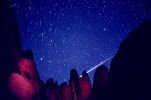
Polaris.jpgPolaris: the North Star80 visite"...Luce Polare, amica mia e sorella,
Umile Fiamma al vento, unica Stella,
Luce costante, candela di un Altare,
Unico faro, di questo immenso Mare..."
P.C. Floegers - "Poesie"
Ott 15, 2004
|
|

Gliese 623 b.jpgGliese 623 "a" and "b" - HST109 visite"...E' incredibile la velocità con cui siamo disposti ad accettare le costruzioni più fantastiche ed improbabili e le ipotesi più ridicole ed inverificabili allorchè queste si sposano, in qualsiasi maniera, anche con solo un minimo dei nostri interessi o convinzioni..."
P.C Floegers - "Conversations"Ott 15, 2004
|
|

SOL270-Layered_Outcrops-Sp-PIA06938_modest.jpgLayered Outcrops - Sol 270 (True Colors; credits: NASA/JPL)74 visitePer questa immagine abbiamo pensato di offrirVi anche la caption originale NASA. Si tratta, secondo noi, di un tentativo - così grossolano da risultare divertente - da parte della NASA stessa di far sembrare la definizione dei "true colors of Mars" come un'opera di "cesello matematico", estremamente complessa e meritevole di un Nobel. Eccola:"NASA's Mars Exploration Rover Spirit acquired the images that went into this color composite with its panoramic camera around 1:00 p.m. martian time on its 270th martian day (Oct. 5, 2004). The view represents the panoramic-camera team's best current attempt at generating a "true color" view of what this scene would look like if viewed by a human on Mars. It was generated from a mathematical combination of six calibrated images acquired through filters for wavelengths between 430 and 750 nanometers".
BRAVI! Ma ora chi gli va a dire che già 30 anni fa si scattavano fotografie favolose - ed a colori veri! - nello spazio, senza usare questa scienza da Star Trek???Ott 15, 2004
|
|
| 25353 immagini su 2113 pagina(e) |
 |
|
|
|
|
1937 | |
|
|
|
|





