| Ultimi arrivi |

EROS-PIA02951.jpgEros from above (1)68 visiteIn NEAR Shoemaker's long-awaited close-up images of Eros, the asteroid's small-scale features are revealing their fascinating diversity. This picture, taken July 8, 2000, from an orbital altitude of only 36 Km, shows a variety of differently shaped boulders. Some are nearly round, whereas others are elongated or even blade-shaped. Such varied shapes might arise from differences in the strength and fracturing of preexisting rock. The whole scene is about 1.4 Km across.Ott 16, 2004
|
|
Phi Persei.jpgPhi Persei77 visite"...Come fiori colorati, esotici, dalle forme curiose ed affascinanti, sono le Galassie;
E splendidamente opalescenti sono le nuvole di Orione e di Pegaso, che ci rammentano che ogni cosa ha una fine;
Anche le Stelle, magnifiche Entità di Luce, la cui Vita rasenta i margini dell'Infinito...
In questo Giardino Incantato, che si chiama Universo, osservo crescere nuove piante;
I semi gettati, dall'alba del Tempo, continuano a crescere ed a germogliare;
E nuove meraviglie ci attendono, se avremo coraggio, oltre le Porte dell'Alba, ai margini dell'Infinito..."
P.C. Floegers - "Poesie"Ott 16, 2004
|
|

IDA-PIA00138.jpgAsteroid Ida's limb (HR)71 visiteThe Galileo imaging system captured this picture of the limb of the asteroid 243 Ida about 46 seconds after its closest approach on August 28, 1993, from a range of only 2480 Km. It is the highest-resolution image of an asteroid's surface ever captured and shows detail at a scale of about 25 meters per pixel. This image is one frame of a mosaic of 15 frames shuttered near Galileo's closest approach to Ida. Since the exact location of Ida in space was not well-known prior to the Galileo flyby, this mosaic was estimated to have only about a 50 percent chance of capturing Ida. Fortunately, this single frame did successfully image a part of the sunlit side of Ida. The area seen in this frame shows some of the same territory seen in a slightly lower resolution full disk mosaic of Ida returned from the spacecraft in September, 1993, but from a different perspective. Prominent in this view is a 2 Km deep "valley" seen in profile on the limb.Ott 16, 2004
|
|

IDA-PIA00135.jpgAsteroid Ida (HR)60 visiteThis view of the asteroid 243 Ida is a mosaic of 5 image frames acquired by the Galileo spacecraft's solid-state imaging system at ranges of 3.057 to 3.821 Km on August 28, 1993, about 3-1/2 minutes before the spacecraft made its closest approach to the asteroid. Galileo flew about 2.400 Km from Ida at a relative velocity of 12.4 km/sec (28,000 mph). Asteroid and spacecraft were 441 million Km from the Sun. Ida is the second asteroid ever encountered by a spacecraft. It appears to be about 52 Km in length, more than twice as large as Gaspra, the first asteroid observed by Galileo in October 1991. Ida is an irregularly shaped asteroid placed by scientists in the S class (believed to be like stony or stony iron meteorites). It is a member of the Koronis family, presumed fragments left from the breakup of a precursor asteroid in a catastrophic collision. This view shows numerous craters, including many degraded craters larger than any seen on Gaspra.Ott 16, 2004
|
|

IDA&DACTYL-PIA00333.jpgIda and Dactyl in "natural colors"71 visiteThis color picture is made from images taken by the imaging system on the Galileo spacecraft about 14 minutes before its closest approach to asteroid 243 Ida on August 28, 1993. The range from the spacecraft was about 10,500 kilometers (6,500 miles). The images used are from the sequence in which Ida's moon was originally discovered; the moon is visible to the right of the asteroid. This picture is made from images through the 4100-angstrom (violet), 7560 A (infrared) and 9680 A (infrared) filters. The color is 'enhanced' in the sense that the CCD camera is sensitive to near infrared wavelengths of light beyond human vision; a 'natural' color picture of this asteroid would appear mostly gray. Shadings in the image indicate changes in illumination angle on the many steep slopes of this irregular body as well as subtle color variations due to differences in the physical state and composition of the soil (regolith). Ott 16, 2004
|
|

GASPRA-PIA00119.jpgAsteroid Gaspra75 visiteThis picture of asteroid 951 Gaspra is a mosaic of 2 images taken by the Galileo spacecraft from a range of 5.300 Km, some 10 minutes before closest approach on October 29, 1991. The Sun is shining from the right; phase angle is 50 degrees. The resolution, about 54 meters/pixel, is the highest for the Gaspra encounter and is about three times better than that in the view released in November 1991. Additional images of Gaspra remain stored on Galileo's tape recorder, awaiting playback in November. Gaspra is an irregular body with dimensions about 19 x 12 x 11 Km. The portion illuminated in this view is about 18 Km from lower left to upper right. The north pole is located at upper left; Gaspra rotates counterclockwise every 7 hours. The large concavity on the lower right limb is about 6 Km across, the prominent crater on the terminator, center left, about 1.5 Km. A striking feature of Gaspra's surface is the abundance of small craters. More than 600 craters, 100-500 meters (330-1650 feet) in diameter are visible here. The number of such small craters compared to larger ones is much greater for Gaspra than for previously studied bodies of comparable size such as the satellites of Mars.Ott 16, 2004
|
|

EROS-PIA03129.jpgEros from above (2)68 visiteNEAR Shoemaker photographed this area of Eros on December 18, 2000, from an orbital altitude of 33 Km. This part of the asteroid's surface, like many others, appears vaguely "sculptured" due to its low, elongated ridges and depressions with seemingly consistent orientations. Some of the low spots also contain accumulations of smooth, pond-like materials. Neither the surface sculpturing nor the pond-like materials are well understood, and both will be investigated in detail using even higher-resolution images from NEAR Shoemaker's low passes over Eros in early 2001. The whole scene is about 1 Km across.Ott 16, 2004
|
|

EROS-PIA02927.jpgEros' Boulders127 visiteNEAR Shoemaker images have shown many large boulders on Eros' surface, but seldom are the boulders as big and as close as the ones in this image taken on June 20, 2000, from an altitude of 51 Km. Nestled within the 700-meter (2300-foot) diameter crater at the center of the picture are four particularly large rocks whose tops protrude out from the shadowed crater interior and into sunlight. The center boulder, the largest, is about 100 meters (330 feet) across. The whole scene is approximately 1.9 Km across.Ott 16, 2004
|
|

EROS-PIA02905-0.jpgEros (the BIG Pseudo-Anomaly)144 visiteThis image of Eros, taken from the NEAR Shoemaker spacecraft on May 1, 2000, is among the first to be returned from "low orbit." Between May and August, the spacecraft orbited at altitudes near 50 Km or less. This will be the prime period of activity for some of the spacecraft's science instruments. The X-ray / gamma-ray spectrometer will build up maps of chemical abundances, while the laser rangefinder measures the shape of Eros to within meters (a few feet). At the same time the magnetometer will watch for indications of Eros' magnetic field and the near-infrared spectrometer will map rock types. The imager will take pictures of the entire surface of Eros that capture features as small as 4 meters (13 feet) across. This particular image, taken from an orbital altitude of 53 Km, shows a scene about 1.8 Km across. Numerous craters and boulders as small as 8 meters (26 feet) across dot the landscape. The large, rectangular boulder at the upper right is about 45 meters across.Ott 16, 2004
|
|

EROS-PIA02492.jpgEros in true colors89 visiteAs the NEAR Shoemaker spacecraft descends into lower orbits around Eros, it continually returns higher spatial resolution images of the asteroid. The true color image at left was taken February 12, 2000, from a range of 1.748 Km and shows details only as small as 180 meters (590 feet) across. It was taken two days before orbit insertion, as part of an image sequence designed to provide moderate-resolution color mapping of Eros at a near-constant viewing geometry. The true color image inset at right was taken February 29 from a range of 283 Km and shows much smaller details only 27 meters (89 feet) across.Ott 16, 2004
|
|

DACTYL-PIA00298.jpgAsteroid Dactyl63 visiteWithin seconds of its closest approach to the asteroid 243 Ida on August 28, 1993, the Galileo spacecraft's Solid State Imaging camera caught this glimpse of Ida's previously unknown moon orbiting the asteroid. One frame of a 15-image set designed to capture a view of Ida at the highest possible resolution landed by chance with its edge right on the little moon. The range from the spacecraft was about 2.400 Km and each picture element spans about 24 meters (80 feet) on the surface of the moon. Only a small sliver of the sunlit crescent is visible at the edge of the frame (which was shifted inward toward the center in this frame). Dactyl is approximately egg-shaped, measuring about 1.2 x 1.4 x 1.6 Km (0.75 x 0.87 x 1 mile). At the time this image was shuttered, Ida was about 90 Km (56 miles) away from the moon, outside this frame to the left and slightly below center. The smoothly curving shape of the dark edge of Ida's moon can be seen on the left. The moon's observed darkside was just barely detectable.Ott 16, 2004
|
|
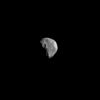
DACTYL-PIA00297.jpgAsteroid Dactyl63 visiteThis image is the most detailed picture of the recently discovered natural satellite of asteroid 243 Ida taken by the Galileo Solid-State Imaging camera during its encounter with the asteroid on August 28, 1993. Shuttered through the camera's broadband clear filter as part of a 30-frame mosaic designed to image the asteroid itself, this frame fortuitously captured the previously unknown moon at a range of about 3,900 kilometers (2,400 miles), just over 4 minutes before the spacecraft's closest approach to Ida. Each picture element spans about 39 meters (125 feet) on the surface of the moon. More than a dozen craters larger than 80 meters (250 feet) in diameter are clearly evident, indicating that the moon has suffered numerous collisions from smaller Solar System debris during its history. The larger crater on the terminator is about 300 meters (1,000 feet) across.Ott 16, 2004
|
|
| 25353 immagini su 2113 pagina(e) |
 |
|
|
|
|
1936 | |
|
|
|
|





