| Ultimi arrivi |

Eros from 250 mt - PIA03147_modest.jpgFalling down: Eros from 250 mt69 visiteCaption NASA:"...The image is 12 meters across. The cluster of rocks at the upper right measures 1.4 meters across...". Vale quanto già detto in precedenza: riuscite a vedere dei dettagli già presenti nel frame precedente?!?
NEAR, scendendo, fotografa "random"?Ott 28, 2004
|
|

Eros from 700 mt - PIA03146_modest.jpgFalling down: Eros from 700 mt62 visiteCaption NASA:"...The image is 33 meters across. The large, oblong rock casting a big shadow measures 7.4 meters across...".
Riuscite a distinguere in questo scorcio ulteriormente ravvicinato qualche dettaglio il quale - ora, ovviamente, ingrandito - fosse già presente nel frame precedente? Noi non ci siamo riusciti.Ott 28, 2004
|
|

Eros from 1150 mt - PIA03145_modest.jpgFalling down: Eros from 1150 mt62 visiteIn sequenza, le ultime (?) 4 immagini ricevute sulla Terra e relative alla discesa della Sonda NEAR sull'asteroide Eros. Purtroppo non siamo in grado di operare delle valutazioni precise sul contenuto di questi frames i quali, per svariati ordini di motivi, NON ci convincono. I particolari della superficie di Eros variano da frame a frame (come se la Sonda stesse precipitando, seguendo una traiettoria non lineare), ma la qualità (in termini di definizione e nitidezza dei dettagli ripresi) dei singoli frames, invece, lascia supporre un landing morbido ed una discesa "smooth".
La NASA, inoltre, dice che "...The image is 54 meters across. The large rock at lower left is 7.4 meters across..." ma questi dati non sembrano totalmente convincenti.
Vediamo gli altri 3 frames...Ott 28, 2004
|
|

Eros - impact site - PIA03144_modest.jpgEros: NEAR-Shoemaker's Probe landing site60 visiteThis map projection of NEAR Shoemaker images shows locations and sizes of landmarks surrounding the spacecraft's planned landing site. Diameters of craters are shown in red, and diameters of boulders are shown in yellow. Diameters are given in units of meters (1 meter is about 3.3 feet). Coordinates along the left side of the map are degrees south latitude and coordinates along the bottom are degrees west longitude.
The six yellow "footprint" boxes represent approximate image size at 500, 1.000, 1.500, 2.000, 2.500 and 3.000 meters above the surface during descent. The spacecraft will take pictures continuously between each spot. The arrow marks the estimated touchdown site.Ott 28, 2004
|
|

Comets-Borrelly_Comet-PIA03500_modest.jpgThe "Borrelly" Comet from Deep Space 161 visiteIn this highest resolution view of the icy, rocky nucleus of comet Borrelly, (about 45 meters or 150 feet per pixel) a variety of terrains and surface textures, mountains and fault structures, and darkened material are visible over the nucleus's surface. This was the final image of the nucleus of comet Borrelly, taken just 160 seconds before Deep Space1's closest approach to it. This image shows the 8-km (5-mile) long nucleus about 3417 kilometers (over 2,000 miles) away.
Smooth, rolling plains containing brighter regions are present in the middle of the nucleus and seem to be the source of dust jets seen in the coma. The rugged land found at both ends of the nucleus has many high ridges along the jagged line between day and night on the comet. This rough terrain contains very dark patches that appear to be elevated compared to surrounding areas. In some places the dark material accentuates grooves and apparent faults.Ott 28, 2004
|
|

Asteroids-Annefrank_Asteroid-PIA02885_modest.jpgAsteroid Annefrank from Stardust70 visiteAsteroid Annefrank is seen as irregularly shaped, cratered body in an image taken by NASA's Stardust spacecraft during a Nov. 2 flyby of the asteroid.
Stardust flew within about 3.300 Km (about 2.050 miles) of the asteroid as a rehearsal for the spacecraft's encounter with its primary target, comet Wild 2, in January 2004. The camera's resolution was sufficient to show that Annefrank is about 8 Km (5 miles) in length, twice the predicted size from Earth-based observations. The surface reflects about 0,1 to 0,2% of sunlight, slightly less than anticipated. A few craters that are hundreds of meters across can be seen. The straight edge in the right side of the image may be an artifact of processing.Ott 28, 2004
|
|
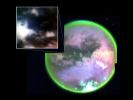
Titan-PIA06983_modest.jpgTitan (false colors) + the Huygens' probe landing site62 visiteCaption NASA originale:"This image taken by Cassini's visual and infrared mapping spectrometer clearly shows surface features on Titan. It is a composite of false-color images taken at three infrared wavelengths: 2 microns (blue); 2.7 microns (red); and 5 microns (green). A methane cloud can be seen at the south pole (top of image). This picture was obtained as Cassini flew by Titan at altitudes ranging from 100.000 to 140.000 Km (88.000 to 63.000 miles), less than two hours before the spacecraft's closest approach. The inset picture shows the landing site of Cassini's piggybacked Huygens probe".Ott 28, 2004
|
|

Titan-PIA06982_modest.jpgTitan from 1.200 Km59 visiteCaption NASA originale:"These images show the surface of Titan at two different infrared wavelengths. They were captured by the visual and infrared mapping spectrometer onboard Cassini as the spacecraft flew by at an altitude of 1200 Km - Cassini's closest approach yet to the Hazy Moon. The image on the left, taken at a wavelength of 2 microns, is the most detailed picture to date of the Titan's surface. It reveals complex landforms with sharp boundaries, which scientists are eager to further study. The image on the right was taken at a wavelength of 1 micron and shows approximately what a digital camera might see". Ad essere sinceri, da queste primissime immagini ravvicinate non riusciamo a distinguere praticamente nulla. Dobbiamo attendere che al Controllo Missione elaborino meglio le immagini giunte sino ad ora prima di lanciarci in nuove speculazioni relative alla configurazione effettiva della superficie di Titano. Abbiamo atteso anni, possiamo aspettare ancora qualche settimana...Ott 28, 2004
|
|

Titan-PIA06980_modest.jpgTitan: a "Secret Dream" for the Oil Companies"?58 visiteTitano, a quanto è emerso sino ad ora, potrebbe davvero essere (o diventare) un "sogno" per le grandi Multinazionali Petrolifere del nostro Pianeta. Perchè? Osservate il grafico e leggete le note originali NASA...:"This graph shows data acquired by Cassini as it flew by Titan at an altitude of 1.200 Km on Oct. 26, 2004 - its closest approach yet to the Hazy Moon. The data is from Cassini's ion and neutral mass spectrometer, which detects charged and neutral particles in the atmosphere. The graph reveals a diversity of hydrocarbons in the high atmosphere above Titan, including benzene and diacetylene". Ora, una delle tante (e neanche tanto nascoste...) verità che giacciono alle spalle dell'esplorazione spaziale, è nella ricerca di fonti energetiche significative e sfruttabili. Titano sembra proprio essere un Pianeta costituito - prevalentemente - da idrocarburi. La domanda è: premesso che un interesse commerciale può esistere, come fare a sfruttare le risorse di Titano in maniera economicamente vantaggiosa?Ott 28, 2004
|
|

Titan-PIA06138_modest.jpgTitan: the anomalous "circular" surface features are "camera artifacts"58 visiteCaption NASA originale from Planetary Photojournal:"The large, bottom image shows a complex interplay between dark and bright material on Titan's surface. This image was taken at a range of about 340.000 Km and the entire view is approximately 2.000 Km across. The surface appears to have been shaped by multiple geologic processes. Although a few "circular features" can be seen, there are no features that can be definitively identified as impact craters. The 3 smaller images show details of some of the features seen within the larger scene. The image on the upper right shows a scene approximately 500 Km across in which bright and dark bands of material span Et to Wt. The upper middle and upper right images show bright material surrounded by dark material in scenes approximately 300 Km across. The dark circular feature that appears at the top of each of the upper images is an artifact that was not removed by the preliminary image processing. There are no shadows or topographic shading visible in these images".Ott 28, 2004
|
|

Titan-Huygens_Landing_Site-08-PIA06136_modest.jpgHuygens' probe landing site59 visiteCaption originale NASA (dal "Planetary Photojournal"):"Shown here are two images of the expected landing site of Cassini's Huygen's probe (latitude 10.6 S, longitude 191 W). At right is a wide-angle image showing most of Titan's disc, with a scale of 10 Km (6.2 miles) per pixel. At left is a narrow-angle image of the landing site at a scale of 0.83 Km (0.5 miles) per pixel (location shown by black box at right). North is tilted about 45 degrees from the top of both images. The surface has bright and dark markings with a streamlined pattern consistent with motion from a fluid, such as the atmosphere, moving from west to east (upper left to lower right). The image at left is 400 Km (249 miles) wide. Both images were taken by Cassini's imaging science subsystem through near-infrared filters". Ott 28, 2004
|
|

Titan-PIA06139.jpgTitan (false colors)56 visiteDa "NASA - Picture of the Day" del 28.10.2004:"Normally hidden by a thick, hazy atmosphere, tantalizing features on Titan's surface appear in this false-color view. The image was recorded as the Cassini spacecraft approached its first close flyby of Saturn's smog-shrouded moon on October 26. Here, red and green colors represent specific infrared wavelengths absorbed by Titan's atmospheric methane while bright and dark surface areas are revealed in a more penetrating infrared band. Ultraviolet data showing the extensive upper atmosphere and haze layers is seen as blue. Sprawling across the 5.000 Km wide moon, the bright continent-sized feature known as "Xanadu" is near picture center, bordered at the left by contrasting dark terrain.
Saturn orbiter Cassini and Titan lander Huygens plan further explorations, but for now the origin and nature of Titan's surface features remain unknown".
...Unknown, per ora, diciamo noi...Ott 28, 2004
|
|
| 25353 immagini su 2113 pagina(e) |
 |
|
|
|
|
1928 | |
|
|
|
|





