| Ultimi arrivi |

ZZ-Z-Hadley Apennine-15-87-11717lbl.jpgThe Hadley-Apennine Region - Mission Overview273 visiteApollo 15 (CSM Endeavour and LM Falcon)
Saturn V
July 26-August 07, 1971
David R. Scott
James B. Irwin
Alfred M. Worden
12 days, 17 hours, 12 minutes
Landing site: Hadley-Apennine region near Apennine Mountains.
Landing Coordinates: 26.13224 degrees North, 3.63400 degrees East
(Source: National Space Science Data Center)
3 EVAs of 18 hours, 30 minutes plus 33-minute Stand-up EVA. Worden performed 38-minute transearth EVA. First mission to carry orbital sensors in service module of CSM. ALSEP deployed. Scientific payload landed on Moon doubled. Improved spacesuits gave increased mobility and stay-time. Lunar surface stay- time, 66.9 hours. Lunar Roving Vehicle (LRV), electric-powered, 4-wheel drive car, traversed total 27.9 km (17 mi). In lunar orbit 145 hours, with 74 orbits. Small subsatellite left in lunar orbit for first time. 76.6 kgs (169 lbs) of material gathered. Nov 15, 2004
|
|

ZZ-Z-Descartes Highlands-A16-18296-310.jpgDescartes Highlands - Mission Overview168 visiteApollo 16 (CSM Casper and LM Orion)
Saturn V
April 16-27, 1972
John W. Young
Thomas K. Mattingly II
Charles M. Duke, Jr.
11 days, 01 hour, 51 minutes
Landing site: Descartes Highlands.
Landing Coordinates: 8.97341 degrees South, 15.49859 degrees East
(Source: National Space Science Data Center)
First study of highlands area. Selected surface experiments deployed, ultraviolet camera/spectrograph used for first time on Moon, and LRV used for second time. LRV traversed 26.7 km. Three EVAs totaling 20 hours 14 minutes. 95.8 kg (213 lbs) of lunar samples collected. Lunar surface stay-time, 71 hours; in lunar orbit 126 hours, with 64 orbits. Subsatellite released in lunar orbit. Mattingly performed 1-hour trans-Earth EVA. Nov 15, 2004
|
|

ZZ-Z-Taurus Littrow.jpgTaurus Littrow - Mission Overview153 visiteApollo 17 (CSM America and LM Challenger)
Saturn V
December 07-19, 1972
Eugene A. Cernan
Ronald E. Evans
Harrison H. "Jack" Schmitt
12 days, 13 hours, 52 minutes
Last lunar landing mission.
Landing site:
Taurus-Littrow, highlands and valley area.
Landing Coordinates: 20.18809 degrees North, 30.77475 degrees East
(Source: National Space Science Data Center)
3 EVAs of 22 hours, 04 minutes. First scientist-astronaut to land on Moon, Schmitt. Sixth automated research station set up. LRV traverse total 30.5 km. 110.4 kg (243 lbs) of material gathered. Lunar surface stay-time, 75 hours. (CSM) in lunar orbit 148 hours. Evans performed trans-Earth EVA lasting 01 hour 06 minutes.
Nov 15, 2004
|
|

APOLLO 17 AS 17-139-21311.jpgAS 17-139-21311 - Moon from orbit129 visitenessun commentoNov 15, 2004
|
|

APOLLO 17 AS 17-139-21310.jpgAS 17-139-21310 - Moon from orbit134 visitenessun commentoNov 15, 2004
|
|

APOLLO 17 AS 17-139-21306.jpgAS 17-139-21306 - Moon from orbit153 visiteMentre sulla superficie Lunare si "andava in rover", l'Astronauta Ronald Evans se ne stava solo a bordo del CSM America e, fra un'orbita e l'altra, scattava qualche "istantanea della Luna". Ve ne proponiamo alcune, davvero bellissime...Nov 15, 2004
|
|

Phobos-Phobos_Monolith-00.jpgThe "Phobos' Monolith" (CTX Frame)297 visitenessun commentoNov 15, 2004
|
|

ZC-APOLLO 17-Crest and Shadow.jpgMore "cuspids" on the Moon?202 visiteUn'altra spettacolare immagine scattata dall'Apollo 17 mentre si trovava in orbita intorno alla Luna e da un'altezza oscillante fra i 280 ed i 300 Km.
Questa volta ci troviamo dvanti ad una serie di ombre "anomale" (?!?) le quali potrebbero essere il segno (inconfondibile) di una serie di "strutture a forma conica" o "piramidale". Nuove "cuspidi", dunque?
Diremmo di no.
Sicuramente ci troviamo davanti a delle montagne le cui sommità sembrano essere, tutto sommato, piuttosto aguzze (le ombre, da questo punto di vista, non mentono), ma ciò che caratterizza le "cuspidi di Blair" (o "Lunar Spires") e la "Lun-Ex-It Cuspid" è il fatto che si tratta (almeno in apparenza...) di vere e proprie strutture interamente "coniche" e/o "a colonna" e NON di semplici montagne i cui picchi risultano particolarmente appuntiti.
Si tratta, come potete agevolmente comprendere, di due concetti diversi. In ogni caso, anche questa fotografia è - semplicemente - meravigliosa e da gustarsi (e studiarsi) in versione "full size".Nov 15, 2004
|
|
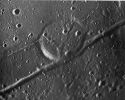
ZB-Apollo 17-Circle and Tangent.jpgCircle and tangent on the Moon188 visiteUn curioso "disegno" sulla Luna: da un'altezza di circa 280 Km si vede un cerchio (abbastanza accurato) ed una (quasi) tangente. Un cratere, ovviamente, ed il letto di un antico fiume di lava o, forse, un crepaccio generatosi allorchè la superficie della Luna si trovò a subire (al pari di tante altre lune di cui abbiamo visto le fotografie) fenomeni di "stretching", per esempio, a causa del suo raffreddamento globale (e cioè sia interno, sia esterno). Nov 15, 2004
|
|

Tycho Crater (detail mgnf) - Clem.jpgThe centre of "Tycho Crater" - from Clementine244 visiteUn altra area "famosa" della Luna: il Cratere Tycho, reso famoso anche dal romanzo "2001 - Odissea nello Spazio". Fu in quest'area, infatti, secondo il racconto dello scrittore Inglese Arthur C. Clarke, che venne dapprima registrata l'esistenza di un'anomalia magnetica (chiamata Tycho Anomaly) e quindi, in seguito alle indagini svolte, fu ritrovato il primo - e più piccolo - Monolito che avrebbe indicato agli Uomini la "Via delle Stelle".
Questa è la fantasia. La realtà, che pochi davvero conoscono, è che nell'area di Tycho, negli anni '70, venne effettivamente riscontrata un'anomalia magnetica relativamente alla quale, però, dopo la sua scoperta, non venne più divulgata alcuna informazione.
Si tratterà dunque di una storia vera o è solo una delle tante "Leggende Spaziali"?
Questa immagine, comunque, ci proviene dalla Sonda Clementine.Nov 15, 2004
|
|

Sedna-08.jpgSedna's position in the Sky (March-April 2004)184 visiteMa dove si trova, esattamente, Sedna?
A questa domanda risponde la mappa che Vi proponiamo e che si riferisce alla posizione di Sedna nel cielo dei mesi di Marzo-Aprile 2004. E' inteso che qualora riuscissimo a trovare delle mappe più recenti, non mancheremo di proporvele!
Ed eccoVi il commento originale: "This view shows where the newly discovered planet-like body, dubbed "Sedna," would lie in the evening skies at around 8:00 p.m. Pacific Standard Time. Currently it is located in the constellation of Cetus and forms a triangle with Mars and Venus in the direction of the setting Sun. Sedna is so faint, however, that it can not be seen with the naked eye, or with telescopes typically used by amateur astronomers". Nov 15, 2004
|
|
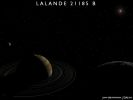
Lalande Solar System.jpgLalande 21185 and a possible extra-solar system153 visiteThe closest extrasolar planetary system could be made by the planets of the dim red dwarf star known as Lalande 21185: only 8 LY distant! This star is too faint to be seen by the naked eye and its planets have never been imaged directly but their presence is inferred by a long series of telescopic observations, tracking the star as it wiggles and wobbles in mutual gravitational response to the masses of its orbiting planets. University of Pitsburgh astronomer George Gatewood recently announced that much of Lalande 21185's wobble is most likely due to an unseen planet with approximately 90% of the mass of Jupiter and an orbital period of 5.8 years. His work also indicates that a second and possibly third planet of similar mass could well be present in the system. Nov 14, 2004
|
|
| 25353 immagini su 2113 pagina(e) |
 |
|
|
|
|
1916 | |
|
|
|
|





