| Ultimi arrivi |

Titan-Undefined_Surface_Features-Radar_View-PIA06995_modest.jpgAnother "radar view" from Titan: the "arrow"60 visiteOccorre la Caption NASA originale per tentare di capire qualcosa di questa "oscura" (da tutti i punti di vista) immagine radar di Titano: "...the (arrow-like) "feature" is approximately 30 Km across and it is formed from 2 straight lines that intersect. Looking more closely, one can distinguish other linear features that seem to follow the left side of the "arrow" and perhaps interact in some way with a dark spot. Straight lines may represent fractures or faults in the icy crust, or they may form from material that has flowed or has been shaped by wind, either recently or in the distant past.
The area shown is about 115 Km wide and 170 Km high and is located near 52° North latitude and 73° West longitude. This radar image is part of a larger strip of data acquired on Oct. 26, 2004, as Cassini passed Titan at a distance of 1.200 Km".
Secondo noi il rilievo che alla NASA chiamano "freccia" potrebbe essere una sorta di ciglio roccioso ma, come vedete Voi stessi, con un'immagine così...ogni ipotesi è buona!Dic 03, 2004
|
|
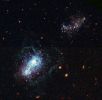
I Zwicky 18.jpgI Zwicky 1863 visite"...Bonae mentis soror est paupertas..."
(Petronio)
"...La miseria è (sempre) compagna (sorella) dell'intelligenza..."Dic 03, 2004
|
|

APOLLO 15 AS 15-87-11849-2-HD Detail Mgnf.jpgAS 15-87-11249 - Mount Hadley in colors (ORIGINAL-HD-detail mgnf)258 visiteSiamo giunti in possesso, grazie alla cortese collaborazione di uno dei Curatori dell'Istituto di Scienze Planetarie (RPIF), della versione originale, HD ed uncompressed del frame che ci aveva incuriosito a causa di una strana "roccia" grigia ed azzurra - o così ci sembrava... - visibile al centro dell'immagine a (stimiamo) una quarantina di metri (forse meno) dall'Astronauta che aveva effettuato la ripresa. Ebbene, con enorme stupore dobbiamo riscontrare che - forse - quella "cosa" che sembrava un macigno, è una vera e propria Anomalia di Superficie. Si tratta forse di un grande cristallo che riflette i raggi del Sole e brilla come un faro? E' qualcosa di "alieno"? Guardate l'immagine e giudicate Voi stessi: la particolare - ed elevatissima - sovraesposizione raggiunta dall'oggetto estraneo inquadrato ha, purtroppo, cancellato ogni suo possibile dettaglio superficiale. Abbiamo una sola (ma molto precisa) sensazione e la condividiamo con Voi: quell'oggetto sembra emanare luce propria...Dic 01, 2004
|
|
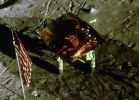
APOLLO 14 AS 14 66-9324-HD Detail Mgnf.jpgAS 14-66-9324 - A basket full of gold?!? (ORIGINAL-HD-detail mgnf)239 visiteUn'immagine davvero interessante e completamente inesplicabile, finalmente nella sua versione originale ed uncompressed: il cestello su ruote che doveva contenere i campioni di rocce Lunari e quant'altro gli astronauti avessero reperito sulla superficie della Luna che fosse risultato interessante e meritevole di essere riportato a Terra, è stato riempito. Già, ma con che cosa? Nonostante la eccezionale qualità del frame originale (di cui qui Vi proponiamo solo un dettaglio) non siamo comunque sicuri di aver capito che cosa sia quel materiale color oro che riempie il cestino. Sulla base di quanto eravamo riusciti a risolvere dell'immagine compressa avevamo ipotizzato che si trattasse di attrezzi speciali degli astronauti, oppure di pezzi di ricambio del LM o, forse, di rottami. Ora, dopo aver analizzato il frame originale, abbiamo ristretto le ipotesi a due. Secondo noi, infatti, sul carrello può essere stata appoggiata:
1) una lamina di metallo la quale, a giudicare dai riflessi, potrebbe essere...Dic 01, 2004
|
|

Mimas-PIA06142_modest.jpgMimas and Saturn in real colors67 visiteCaption NASA originale:"In a splendid portrait created by light and gravity, Saturn's lonely moon Mimas is seen against the cool, blue-streaked backdrop of Saturn's northern hemisphere. Delicate shadows cast by the rings arc gracefully across the planet, fading into darkness on Saturn's night side. The bright blue swath near Mimas is created by sunlight passing through the Cassini division (4.800 Km wide). The rightmost part of this distinctive feature is slightly overexposed and therefore bright white in this image. Shadows of several thin ringlets within the division can be seen here as well. The dark band that stretches across the center of the image is the shadow of Saturn's B-Ring, the densest of the main rings. Part of the actual Cassini division appears at the bottom, along with the A-Ring and the narrow, outer F-Ring. The A-Ring is transparent enough that, from this viewing angle, the atmosphere and threadlike shadows cast by the inner C-Ring are visible through it".Dic 01, 2004
|
|
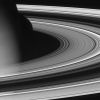
Saturn-PIA06532_modest.jpgSaturn from 618.000 Km59 visiteCaption NASA originale:"Cassini pierced the ring plane and rounded Saturn on Oct. 27, 2004, capturing this view of the dark portion of the rings. A portion of the planet's atmosphere is visible here, as is its shadow on the surface of the rings.
The image was taken with the Cassini spacecraft wide angle camera on Oct. 27, 2004, at a distance of about 618.000 Km from Saturn through a filter sensitive to wavelengths of infrared light centered at 1001 nanometers. The image scale is 33 Km per pixel".Dic 01, 2004
|
|

Enceladus-PIA06531_modest.jpgEnceladus58 visiteCaption NASA originale:"The image shows the trailing hemisphere of Enceladus, which is the side opposite the moon's direction of motion in its orbit. Enceladus is 499 Km across.
The image was taken in visible light with the Cassini spacecraft narrow angle camera on Oct. 27, 2004, at a distance of about 766.000 Km from Enceladus and at a Sun-Enceladus-spacecraft, or phase, angle of 34 degrees. The image scale is 4,6 Km per pixel".Dic 01, 2004
|
|

OPP-SOL297-1F154552343EFF3897P1230R0M1.jpgBurns Cliff on Sol 29756 visiteSiamo proprio giunti - almeno così dicono al Centro Controllo Missione - agli ultimi soles di Opportunity all'interno di Endurance.
Le fotografie ricevute, ultimamente, si sono fatte un pò ripetitive, ma la maggior parte di esse rimane, se non proprio ricca di indizi e misteri, quantomeno bella e suggestiva.
Vi ne offriamo, dunque, solo una: si tratta della veduta frontale - leggermente deformata - della parete interna di Endurance. Dic 01, 2004
|
|

SOL322-2F154950764EFF9400P1110L0M1.jpgAt the base of Columbia Hills - Front View on Sol 32255 visitenessun commentoDic 01, 2004
|
|

OPP-SOL298-1N154625658EDN3897P1582L0M1.jpgUp-Sun... - Sol 29855 visiteUn'immagine che ci mostra degli effetti prismatici particolarmente belli, ottenuti con la tecnica (classica, anche per i fotoamatori con poca esperienza) del "contro-luce" (up-Sun). Dato che, secondo noi, è stato ottenuto un bellissimo risultato (forse neppure cercato o voluto...), ci è sembrata una buona idea pubblicare anche questa immagine nella Galleria.Nov 29, 2004
|
|

Tethys-PIA06140-N-HD.jpgTethys in natural colors (HD)58 visiteCommento NASA originale estratto da "NASA - Picture of the Day" del 29 Novembre 2004:"Tethys is one of the larger and closer moons of Saturn. The Cassini spacecraft now orbiting Saturn passed near the frozen moon at the end of October, capturing the most detailed images since the Voyager spacecrafts in the early 1980s. Tethys is composed almost completely of water ice and shows a large impact crater that nearly circles the planet. Because this crater did not disrupt the moon, Tethys is hypothesized to be at least partly liquid in its past. Two smaller moons, Telesto and Calypso, orbit Saturn just ahead of and behind Tethys. Giovanni Cassini discovered Tethys in 1684. The Cassini spacecraft is scheduled for a close fly-by of Tethys in September 2005". Nov 29, 2004
|
|
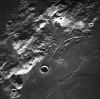
P-APOLLO 17 AS 17-M-R28-1233.jpgAPOLLO 17 AS 17-M-R28-1233 - What a view!137 visiteAnche per questo frame vale il commento svolto per l'immagine precedente. A titolo di curiosità, però, Vi facciamo notare il grande cratere visibile verso il basso della fotografia, poco distante da una montagna di notevoli dimensioni. Notate come il particolare gioco di luce/ombra, che si risolve in una falce illuminata sul bordo superiore del rilievo - segno che il Sole, rispetto all'orizzonte del cratere, è ormai molto basso -, può talvolta trarre in inganno i Ricercatori. Come? L'ingannevolezza della ripresa risiede proprio in quella falce di luce: basta, infatti, sfuocare (solo leggermente) l'immagine in questione, che la effettiva e visivamente percepibile concavità del cratere parzialmente illuminato, si modificherà, dando all'Osservatore un'illusione di convessità (noi lo chiamiamo "effetto bolla"). Ed ecco come un curioso gioco di luci può far apparire ai nostri occhi, al posto di un semplice (ancorchè suggestivo) cratere, un (purtroppo inesistente) "Lunar Dome".Nov 28, 2004
|
|
| 25353 immagini su 2113 pagina(e) |
 |
|
|
|
|
1907 | |
|
|
|
|





