| Ultimi arrivi |
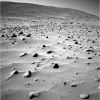
SOL331-2N155752279EFF9900P0665R0M1.jpgSand and stones (2) - possible "too sharp and anomalous" stone57 visiteLo stesso scorcio del frame precedente, ripreso dall'occhio Dx della Camera di Navigazione del Rover.
La pietra appuntita e squadrata che si vede molto chiaramente è "naturale" o "artificiale"? Dic 09, 2004
|
|
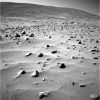
SOL331-2N155752279EFF9900P0665L0M1.jpgSand and stones (1) - possible "too sharp and anomalous" stone56 visiteDal Sol 331 ci arriva qualche nuova (e suggestiva) veduta del panorama Marziano intorno a Spirit. In primo piano troviamo delle dune sinuose e qualche roccia semisepolta che comunque mostra delle forme bizzarre. Per gli amanti delle possibili "anomalie" di superficie Vi suggeriamo di guardare attentamente il margine superiore dell'area sabbiosa; potrete notare, quasi al centro dell'immagine, poco prima che la sabbia ceda il passo ai detriti, una roccia molto appuntita e che sembra presentare una sorta di "lavorazione a sbalzo" sul suo angolo emergente. Illusione ottica? Forse la porzione visibile di una struttura semi-sepolta più grande?
Voi che dite?!?...Dic 09, 2004
|
|

Saturn-PIA06538_modest.jpgSaturn and the shadow of his Rings59 visiteThis majestic view of Saturn captures several phenomena of interest to scientists working on the Cassini mission. The planet's nighttime atmosphere looms ahead - an excellent place to search for storms and lightning. Saturn's shadow stretches across the rings, which will over the next four years receive their most thorough examination since Galileo discovered them in 1610. And barely visible near lower right just inside the F-Ring, is the small shepherd moon Prometheus (102 Km across). Researchers will explore the many moons of Saturn, including special ones like Prometheus that help maintain some of the rings and gaps in this complex and dynamic system.
The image was taken in visible light with the Cassini spacecraft wide angle camera on Oct. 29, 2004, at a distance of about 940.000 Km from Saturn. The image scale is 52 Km per pixel."Dic 09, 2004
|
|

Japetus in the darkness-PIA06146_modest.jpgThe night-side of Japetus (from 1,6 MKMs)59 visiteCaption NASA originale:"Japetus, as it has been already said, is mainly famous for some dramatic contrasts in brightness on its surface: the leading hemisphere is as dark as a freshly-tarred street while the trailing hemisphere and poles are almost as bright as fresh snow. Many impact craters can be seen in the bright terrain and in the transition zone between bright and dark and for the first time in parts of the dark terrain. Also visible is a line of mountains that appear as a string of bright dots (see the color images "Sharp views of Japetus"). These mountains were originally detected in Voyager images and might compete in height with the tallest mountains on Earth, Jupiter's moon Io and possibly even Mars. Further observations will be required to precisely determine their heights. Interestingly, the line of peaks is aligned remarkably close to the equator of Japetus". Dic 09, 2004
|
|

Japetus-PIA06145_modest.jpgSharp views of Japetus61 visiteIn sequenza, alcune delle migliori immagini di Giapeto ottenute da Cassini e superiori, per qualità e dettaglio, a quelle ottenute dalla Sonda Voyager 2 qualche anno fa. Le immagini a colori visibili sulla Sn dell'Osservatore ed al centro sono state ottenute usando (e combinando) i filtri per l'ultravioletto (a 338 Nnmts), il verde (a 568 Nnmts) e l'infrarosso (a 930 Nnmts); l'immagine a Dx è stata ottenuta riprendendo nel cosiddetto "spettro visibile". Le immagini sono state riprese da una distanza oscillante fra gli 1,1 e gli 1,3 MKMs; Giapeto si caratterizza sia per il gigantesco cratere da impatto visibile nell'emisfero sud (400 Km di diametro), sia per alcune notevoli differenze di albedo fra diverse zone della sua superficie (il che ci fa supporre che esistano aree ricoperte, probabilmente, da vasti depositi di polveri - che sono causa di una bassa riflessione della luce ergo di una bassa albedo - ed altre aree che, forse, sono costituite da rocce o addirittura da depositi di ghiaccio).Dic 09, 2004
|
|

ZW-The Moon and Jupiter.jpgMoon and Jupiter129 visiteUn'immagine amatoriale davvero eccellente che ci arriva dalla cittadina di Atmore - Alabama, USA - e pubblicata sul Sito NASA - Picture of the Day del giorno 9 Dicembre 2004.
Ben visibili, accanto a Giove, guardando il versante superiore della Luna (e, per l'esattezza, quella sua parte che ci appare debolmente illuminata a causa del "chiaro di Terra"), riusciamo a vedere due "Satelliti Galileiani": Ganymede (quello più prossimo a Giove) e Callisto.
Complimenti al Sig. Westlake per l'immagine!Dic 09, 2004
|
|

The C-Ring-PIA06537_modest.jpgThe C-Ring in full detail58 visiteCaption NASA originale: "Saturn's inner C-Ring spreads across the field of view, showing the characteristic plateau and wave-like structure for which it is famed.
The center of this image shows an area approximately 75.000 Km from Saturn. The dark gap through the middle of the frame is the Colombo gap which houses the bright, narrow, eccentric Colombo ringlet, in resonance with the moon Titan.
The image was taken with the Cassini spacecraft narrow angle camera on Oct. 29, 2004, at a distance of about 842.000 Km from Saturn. The image scale is 4.7 Km per pixel".Dic 08, 2004
|
|
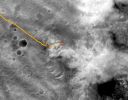
ZM-SOL324_travMOC-A332R1.jpgSpirit's Route in Black and White217 visiteCaption NASA originale:"The Mars Orbital Camera on NASA's Mars Global Surveyor spacecraft took this image of the topography traversed by NASA's Mars Exploration Rover Spirit in months prior to the rover's 318th Sol (Dec. 4, 2004). The yellow line traces the rover's path up to and across the "West Spur" of the Columbia Hills".Dic 08, 2004
|
|

ZL-SOL324_travDEM-A332R1_br2.jpgDigital Elevation Map of Spirit's Trek198 visiteCaption NASA originale: "The blue area represents the basaltic plains on the floor of Gusaev Crater, about 20 meters below the Rover's present location. Spirit crossed those plains for several months after landing to the west, off the left edge of this image. The greenish-blue area is the "West Spur" of the "Columbia Hills," which Spirit reached on sol 156 (June 11, 2004). Since then, Spirit has been gradually ascending the slopes of the "West Spur" in an east-northeasterly direction. Southeast of the Rover's current position is a brighter green area that represents an abrupt increase in slope where the "West Spur" meets the steeper flanks of the "Columbia Hills." The yellow and red areas represent the highest slopes and peaks. A steep valley east of the Rover's location appears, from orbiter images, to have layered outcrops. Scientists are directing the Rover to a ridge overlooking the valley to get a better look at what lies ahead".Dic 08, 2004
|
|
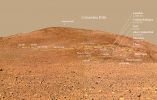
SOL149.jpgColumbia Hills: the Path, the Names, the Final Destination - Sol 149100 visiteThis view from where NASA's Mars Exploration Rover Spirit stood on the rover's 149th Sol (June 3, 2004), shows terrain the Rover has crossed since then. The yellow line traces the path Spirit has taken since arriving at the "Columbia Hills." Labels show the informal names of rocks the rover has studied along the way. Spirit is currently headed east, traversing the flanks of the hills en route to an overlook above a steep valley that is out of view from this perspective. Scientists hope to find more layered rocks that will tell a story of ancient water on Mars.
Spirit has traveled 498 meters and ascended 20 meters above the plains since arriving at the "Columbia Hills" on Sol 156 (June 11, 2004). It covered much of that distance driving on only five of its six wheels. The images used to make this approximately true-color mosaic were taken with Spirit's panoramic camera from about 300 meters away from the base of the hills, using filters centered at wavelengths of 600, 530 and 480 nanometers.Dic 08, 2004
|
|

IC-1805.jpgIC 1805112 visite"...Dopo una tragedia, sia essa dovuta alla Natura o agli Uomini, ho notato che, quanto maggiore è lo strazio che ne deriva, tanto più numerose e rumorose sono le parole di coloro che inneggiano alla Bellezza della Vita, all'importanza che ha il preservarla ed alle - comunque infinite - meraviglie che Essa ci riserva.
Io potrei essere anche d'accordo con costoro, ma non posso non notare che, in primo luogo, queste dichiarazioni - oltre ad essere del tutto banali e fuori luogo - non affievoliscono il dolore, anzi: lo rendono ancora più intenso ed insopportabile.
In secondo luogo io credo che coloro che blaterano della Bellezza della Vita e di tutte le Sue qualità in queste infauste circostanze, si riferiscano alla Vita così come "potrebbe e dovrebbe essere"; certo non a come la Vita - effettivamente - "è".
In ogni caso questa laida ipocrisia non aiuta gli Uomini: in realtà essa si limita a renderli più soli..."
P.C. Floegers - "Conversations" Dic 08, 2004
|
|

NGC-2736-1.jpgNGC 2736 - The "Pencil Nebula"70 visite"...Etiam capillus unus, umbram suam habet..."
(P. Siro)
"...Anche un singolo capello proietta la propria ombra..."Dic 07, 2004
|
|
| 25353 immagini su 2113 pagina(e) |
 |
|
|
|
|
1904 | |
|
|
|
|





