| |
| Ultimi arrivi |

A - Uranus.jpgUranus from Voyager 289 visiteUranus Data and Statistics
Discovered by William Herschel
Date of discovery = AD 1781
Mass (kg) = 8.686e+25
Mass (Earth = 1) = 1,4535e+01
Equatorial radius = 25.559 Km
Equatorial radius (Earth = 1) = 4,0074
Mean density (gm/cm^3) = 1,29
Mean distance from the Sun = 2.870.990.000 Km
Mean distance from the Sun (Earth = 1) = 19,1914
Rotational period (hours) = - 17,9
Orbital period (years) = 84,01
Mean orbital velocity = 6,81 Km per second
Tilt of axis = 97,86°
Orbital inclination = 0,774°
Equatorial surface gravity (m/sec^2) = 7,77
Equatorial escape velocity = 21,30 Km per second
Magnitude (Vo) = 5,52
Mean cloud temperature = - 193°C
Atmospheric pressure (bars) = 1,2
Atmospheric composition: Hydrogen 83%; Helium 15%; Methane 2% Dic 15, 2004
|
|

A - Saturn-a.jpgSaturn, Tethys and Dione in almost true colors193 visiteSaturn Data and Statistics
Mass (kg) = 5.688e+26
Mass (Earth = 1) = 9,5181e+01
Equatorial radius = 60.268 Km
Equatorial radius (Earth = 1) = 9,4494e+00
Mean density (gm/cm^3) = 0,69
Mean distance from the Sun = 1.429.400.000 Km
Mean distance from the Sun (Earth = 1) = 9,5388
Rotational period (hours) = 10,233
Orbital period (years) = 29,458
Mean orbital velocity = 9,67 Km per second
Tilt of axis = 25,33°
Orbital inclination = 2,488°
Equatorial surface gravity (m/sec^2) = 9,05
Equatorial escape velocity = 35,49 Km per second
Magnitude (Vo) = 0,67
Mean cloud temperature = - 125°C
Atmospheric pressure (bars) = 1,4
Atmospheric composition: Hydrogen 97% and Helium 3% Dic 15, 2004
|
|
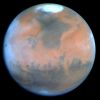
000-Mars.jpgMars: the Red Planet with "Blue Limbs"...256 visiteMars Data and Statistics
Mass (kg) = 6.421e+23
Mass (Earth = 1) = 1.0745e-01
Equatorial radius = 3.397,2 Km
Equatorial radius (Earth = 1) = 5.3264e-01
Mean density (gm/cm^3) = 3,94
Mean distance from the Sun = 227.940.000 Km
Mean distance from the Sun (Earth = 1) = 1,5237
Rotational period (hours) = 24,6229
Rotational period (days) = 1,025957
Orbital period (days) = 686,98
Mean orbital velocity = 24,13 Km per second
Tilt of axis = 25,19°
Orbital inclination = 1,850°
Equatorial surface gravity (m/sec^2) = 3,72
Equatorial escape velocity = 5,02 Km per second
Magnitude (Vo) = - 2.01
Minimum surface temperature = - 140°C
Mean surface temperature = - 63°C
Maximum surface temperature = + 35°C
Atmospheric pressure (bars) = 0,007
Atmospheric composition: Carbon Dioxide (C02) 95,2%; Nitrogen 2,7%; Argon 1,6%; Oxygen 0,13%; Carbon Monoxide 0,07%; Water 0,03%; Neon 0,00025%; Krypton 0,00003%Dic 15, 2004
|
|

0-Venus.jpgVenus from Mariner 10177 visiteVenus Data and Statistics
Mass (kg) = 4.869e+24
Mass (Earth = 1) = 81476
Equatorial radius = 6.051,8 Km
Equatorial radius (Earth = 1) = 0,94886
Mean density (gm/cm^3) = 5,25
Mean distance from the Sun = 108.200.000 Km
Mean distance from the Sun (Earth = 1) = 0,7233
Rotational period (days) = 243,0187
Orbital period (days) = 224,701
Mean orbital velocity = 35,02 Km per second
Tilt of axis = 177,36°
Orbital inclination = 3,394°
Equatorial surface gravity (m/sec^2) = 8,87
Equatorial escape velocity = 10,36 Km per second
Magnitude (Vo) = - 4,4
Mean surface temperature = + 482°C
Atmospheric pressure (bars) = 92
Atmospheric composition: Carbon dioxide 96%, Nitrogen 3% and trace amounts of: Sulfur dioxide, water vapor, carbon monoxide, argon, helium, neon, hydrogen chloride and hydrogen fluoride.Dic 15, 2004
|
|

A-Mercury-Antoniadi Ridge.jpgThe Antoniadi Ridge of Mercury66 visiteMercury Data and Statistics:
Mass (kg) = 3.303e+23
Mass (Earth = 1) = 5,5271e-02
Equatorial radius = 2.439,7 Km
Equatorial radius (Earth = 1) = 3,8252e-01
Mean density (gm/cm^3) = 5,42
Mean distance from the Sun = 57.910.000 Km
Mean distance from the Sun (Earth = 1) = 0,3871
Rotational period (days) = 58,6462
Orbital period (days) = 87,969
Mean orbital velocity = 47,88 Km per second
Tilt of axis = 0,00°
Orbital inclination = 7,004°
Equatorial surface gravity (m/sec^2) = 2,78
Equatorial escape velocity = 4,25 Km per second
Magnitude (Vo) = - 1.9
Mean surface temperature = 179°C
Maximum surface temperature = 427°C
Minimum surface temperature = - 173°C
Atmospheric composition: Helium 42%, Sodium 42%, Oxygen 15%, Other 1%Dic 15, 2004
|
|

Comets-Comet_Ikeya_Zhang_3.jpgComet Ikeya-Zhang - the "ion tail"75 visiteThis composite color image from March 3rd, 2002, captured with a wide-field telescope, shows this active comet's bright, condensed coma and a delightful array of subtle structures in its developing tail. The bluish tail stretches for 5 degrees or so against a background of stars in the constellation Pisces. Cataloged as comet C/2002 C1, improved orbit determinations now make it seem very likely that Comet Ikeya-Zhang has been around here before. Refined calculations indicate this comet's last trip through the inner Solar System was 344 years ago, in 1661, when it was recorded as a bright comet. Dic 15, 2004
|
|

Comets-Comet_Ikeya_Zhang_2.jpgComet Ikeya-Zhang (from Colorado)66 visiteThis lovely early evening view of the comet in Rocky Mountain skies looks northwest over ridges and low clouds. The time exposure was recorded on March 31st from an 8.000 foot elevation near Yampa, Colorado, USA. Sporting a sweeping yellowish dust tail and blue ion tail eight to ten degrees long, Ikeya-Zhang is nestled near the horizon in the northern constellation of Andromeda. To the comet's left is the bright star Mirach or Beta Andromedae while the stretched celestial fuzzball to the comet's right is M 31 or the Andromeda galaxy, the nearest bright spiral galaxy to our own Milky Way. As the days pass, Comet Ikeya-Zhang's apparent motion through the sky is towards the right in this image. Tonight, comet-watchers blessed with clear skies should find Ikeya-Zhang posing perfectly for binoculars and cameras just above M 31, less than two degrees from the center of the bright galaxy.Dic 15, 2004
|
|

Comets-Comet_Ikeya_Zhang_4.jpgComet Ikeya-Zhang - the "ion tail"70 visiteAs Comet Ikeya-Zhang approached the Sun, it developed a complex blue "ion tail". The "ion tail" is composed of ions that boiled off the nucleus and were pushed away from the Sun by the out-flowing fast-moving particles of the solar wind. Complexity in the tail is created by comet nucleus rotation, variability in the comet surface evaporation rate and variability of the Sun's magnetic field and solar wind. Dic 15, 2004
|
|
SOL337-2N156291307EFFA000P0665R0M1.jpgA lonely boulder and deep tracks (4)58 visitenessun commentoDic 15, 2004
|
|
SOL337-2N156291256EFFA000P0665L0M1.jpgA lonely boulder and deep tracks (3)57 visitenessun commentoDic 15, 2004
|
|
SOL337-2N156291153EFFA000P0665L0M1.jpgA lonely boulder and deep tracks (2)94 visiteprosieguo della panoramica iniziata con il frame precedenteDic 15, 2004
|
|
SOL336-2N156199649EFF9946P1579L0M1.jpgUp-Sun...58 visitenessun commentoDic 15, 2004
|
|
| 25353 immagini su 2113 pagina(e) |
 |
|
|
|
|
1899 | |
|
|
|
|
|
|





