| Ultimi arrivi |

Titan-Atmosphere-PIA06160_modest.jpgThe many layers of Titan's Atmosphere59 visiteCaption NASA originale:"Cassini has found Titan's upper atmosphere to consist of a surprising number of layers of haze, as shown in this ultraviolet image of Titan's night side limb, colorized to look like true color. The many fine haze layers extend several hundred kilometers above the surface. Although this is a night side view, with only a thin crescent receiving direct sunlight, the haze layers are bright from light scattered through the atmosphere. The image was taken with the Cassini spacecraft narrow angle camera. About 12 distinct haze layers can be seen in this image, with a scale of 0.7 Km (0.43 miles) per pixel. The limb shown here is at about 10° south latitude, in the equatorial region".Dic 17, 2004
|
|

Titan-PIA06996_modest.jpgDoes Titan have a so-called "weather-pattern"?61 visiteIn the first image (left), obtained on the 1st Titan flyby, from a distance of 200.000 Km, Titan's skies are cloud-free, except for a patch of clouds observed over the South Pole near the bottom of the image. In contrast, the image on the right shows a recent view of this same area of Titan obtained 7 weeks later on the 2nd close Titan flyby, from a distance of 225.000 Km. This image clearly shows that several extensive patches of clouds have formed over temperate latitudes. The appearance of these clouds reveals the existence of weather. Tracking these features is currently underway by scientists, who hope to gain a better understanding of global circulation, regional weather patterns and localized meteorology in Titan's skies. The red color images the surface at a wavelength (2.01 micron) where the surface is relatively bright, making the surface appear reddish in these color images. The green color (2.83 micron) images the surface as well, but due to enhanced absorption of sunlight by the surface and lower atmosphere, the surface is relatively dark here compared to the red. The blue color (2.13 micron) is at a wavelength where sunlight cannot reach the surface at all due to strong absorption by the atmospheric gas methane. In contrast to the reddish surface, bright clouds at a relatively high altitude (here, about 30 kilometers (19 miles) above the ground) residing above most of the atmospheric absorption appear whitish in these representations, as they reflect sunlight effectively in all three near-infrared colors.
Dic 17, 2004
|
|

Titan-PIA06997_modest.jpgHaze Silhouettes Against Titan's Glow59 visite"A high-altitude haze layer residing some 400 Km above the surface of Titan is seen here traced along the limb of Titan as silhouetted against the glow of Titan's atmosphere produced by the fluorescence of methane gas. This detached haze layer can be seen as a dark lane imbedded within the gold-colored fluorescent layers of Titan. This image of Titan's limb and surface was obtained on Dec. 13, 2004 from a vantage point some 158.000 Km above the night side of Titan, at a phase angle of 161°. Beneath the fluorescence, Titan's surface at the extreme limb can be seen in blue color, illuminated by 5-micron wavelength sunlight that penetrates the thick atmosphere and hazes to reflect off the limb of Titan. The darkness of the silhouetted haze layer comprised of relatively small particles suggests that the particles themselves absorb strongly at the fluorescent wavelength and thus are possibly comprised of relatively complex hydrocarbon aerosols generated by photochemical processes in Titan's upper atmosphere".Dic 17, 2004
|
|

Titan-Clouds-PIA06159.jpgTitanian Clouds (December 2004 fly-by)59 visiteCaption NASA originale:"Cutting through the middle of the image is a sharp boundary between the bright region known as Xanadu Regio on the right and dark terrain to the left. This mosaic includes some areas seen at regional scales in October 2004 (see PIA 06124), as well as additional areas to the north and east not seen during that flyby. Among the new features seen in this mosaic is a strangely shaped bright feature near the center of the image as well as clouds near the bottom of the image (see also PIA 06110). The northern portion of the bright/dark boundary appears to be more complex than the arching and sharp boundary seen farther to the south. Cassini scientists continue to examine images such as this to determine the cause of this terrain. The images in this mosaic have been processed to enhance surface features and sharpen brightness variations".Dic 17, 2004
|
|

Titan-Clouds-PIA06158.jpgTitanian Clouds (October 2004 fly-by)60 visiteCaption NASA originale:"Cutting through the middle of the image is a sharp boundary between the bright region known as Xanadu Regio on the right and dark terrain to the left. Several smaller bright features, between 30 and 200 Km across are seen within the dark terrain. These intriguing features are a focus of further research and observations for Cassini scientists. One clue to their origin and history is the presence of bright "trails" within the dark material on the eastern sides of the bright spots. A mottled texture is seen within Xanadu, including dark, crisscrossing lines, suggestive of tectonic activity. No definitive craters have been found in these images, though several bright rings or circular features are seen in the dark terrain. However, without topographic shading, their identification as impact structures can not be confirmed. The images in this mosaic have been processed to enhance surface features and sharpen boundaries".Dic 17, 2004
|
|

Titan-Clouds-PIA06157.jpgTitan: Mid-Latitude Clouds60 visiteCaption NASA originale:"The Clouds seen here are at about 38° South Latitude on Titan. The Clouds across the middle of the frame extend about 250 Km (approx. 155 miles). The image scale is about 0,6 Km (approx. 0,4 miles) per pixel". Dic 17, 2004
|
|

Dione-PIA06164-detail mgnf.jpgThe anomalous "straight tectonic fracture" on Dione - detail mgnf104 visiteLa vedete la "frattura" anomala ora? Guardatela e studiatela con molta attenzione: si tratta di una configurazione della superficie di Dione davvero molto strana e, se si tratta davvero di una tectonic fracture, allora occorre dire che essa è molto differente, da tantissimi punti di vista, da tutte le altre che possiamo vedere nelle immagini HR di Dione.Dic 17, 2004
|
|

Dione-PIA06163.jpgDione: close-up (2) - HR58 visiteCaption NASA originale:"This very detailed image taken during the Cassini spacecraft's closest approach to Saturn's moon Dione on Dec. 14, 2004 is centered on the wispy terrain of the moon. To the surprise of Cassini imaging scientists, the wispy terrain does not consist of thick ice deposits, but rather the bright ice cliffs created by tectonic fractures". Una nostra piccola annotazione: tutta la superficie di Dione è, a ben vedere, un mosaico di quelle che alla NASA chiamano "tectonic fractures"; ma guardate bene che cosa si diparte, circa al centro dell'immagine, dalla linea del terminatore: una "frattura tettonica anomala", perfettamente dritta, curiosamente molto luminosa (ci ricorda una pista di atterraggio/decollo di aeromobili oppure un'autostrada...) che attraversa altre fratture (decisamente più "naturali"...) e che costeggia il bordo di almeno 5 crateri, uno dei quali ci sembra abbastanza grande. Se non la vedete, guardate il detail mgnf che abbiamo preparato per Voi nel frame successivo.Dic 17, 2004
|
|

Dione-PIA06156_modest.jpgDione: close-up (1) - HR67 visiteCaption NASA originale:"This incredible, HR view of Saturn's moon Dione was taken during Cassini's first close approach to the icy moon on Dec. 14, 2004. The view shows linear, curving features within the region of the bright wispy terrain Dione is known for.
The image was obtained in visible light with the Cassini spacecraft narrow angle camera at a distance of approximately 156.000 Km (97.000 miles) from Dione. The Sun-Dione-spacecraft, or phase, angle is 34°. The image scale is about 1 Km (0.6 miles) per pixel".Dic 17, 2004
|
|

Dione-PIA06155-1.jpgDione and Saturn in natural colors85 visiteCaption NASA originale:"Cassini captured Dione against the globe of Saturn as it approached the icy moon for its close rendezvous on Dec. 14, 2004. This natural color view shows the moon has strong variations in brightness across its surface, but a remarkable lack of color, compared to the warm hues of Saturn's atmosphere. Several oval-shaped storms are present in the planet's atmosphere, along with ripples and waves in the cloud bands.
The images used to create this view were obtained with the Cassini spacecraft wide-angle camera at a distance of approximately 603.000 Km from Dione through a filter sensitive to wavelengths of ultraviolet light centered at 338 nanometers. The Sun-Dione-spacecraft, or phase, angle is 34°. The image scale is about 32 Km per pixel".Dic 17, 2004
|
|

APOLLO 14 AS 14-74-10219-HD Detail Mgnf.jpgAS 14-74-10219 - Undocking and blue reflections (8) - ORIGINAL - HD (Detail Mgnf)158 visiteEccoVi un "frammento" del frame originale in cui vengono ripresi questi suggestivi riflessi azzurri. Onestamente, non siamo in grado di dirVi se si tratta effettivamente di riflessi oppure se c'è qualcosa all'esterno della Navicella Americana. Dopo aver visto ed esaminato il frame originale uncompressed, la nostra sensazione è che si tratti effettivamente di semplici riflessi.
Non vogliamo essere fraintesi e quindi precisiamo che stiamo parlando di "sensazione" nel senso più ampio e proprio del termine, ossìa di qualcosa che non ha nulla a che vedere con dati oggettivi e/o valutazioni scientifiche. Noi possiamo solo invitarVi a guardare questo frame, valutarlo e studiarlo, così cercando di maturare una convinzione (od anche una semplice opinione) la quale sia, comunque, più accurata della nostra "sensazione".
Buon lavoro!...Dic 16, 2004
|
|
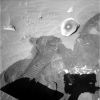
VA-SOL337-2N156285226EFF9952P1811R0M1.jpgCoated stone: natural or artificial? (2)359 visitevedi commento al frame che precedeDic 16, 2004
|
|
| 25353 immagini su 2113 pagina(e) |
 |
|
|
|
|
1897 | |
|
|
|
|





