| Ultimi arrivi |

OPP-SOL324-1P156949170EFF4075P2357L2M1.jpgThe Heat-Shield107 visitenessun commentoDic 23, 2004
|
|

OPP-SOL324-1P156949002EFF4075P2357R1M1.jpgThe Heat-Shield146 visitevedi commento al frame precedenteDic 23, 2004
|
|

OPP-SOL324-1N156948428EFF4075P0705L0M1.jpgThe Heat-Shield92 visiteSiamo davvero a pochi metri dallo Scudo Termico che tanto ci ha fatto pensare e penare nei mesi passati. Esso ha una forma davvero suggestiva, forse diversa da quello che sembrava in lontananza o che ci aspettavamo. Ora attendiamo il "contatto ravvicinatissimo" fra Opportunity ed il suo (ex) Scudo Termico. L'ultima domanda che rimane attiene, dunque, alle fattezze dello Scudo in questione: esso, infatti, ci pare molto diverso da quello fotografato da Spirit sul bordo del Cratere Bonneville. Sono le deformazioni del corpo metallico subìte durante la caduta ed a seguito dell'impatto a renderli così diversi o forse si tratta effettivamente di due oggetti diversi?
Si tratta di una discussione meramente accademica, come ovvio: la risposta ad un tale quesito, molto probabilmente, non l'avremo mai...Dic 23, 2004
|
|

OPP-SOL322-Opp_mono_pcam_heat_shield2-B325R1.jpgThe Heat-Shield205 visiteCaption NASA originale:"NASA's Mars Exploration Rover Opportunity took this image with its panoramic camera when the rover was about 130 meters (427 feet) from its heat shield, during the rover's 322nd sol (Dec. 19, 2004). The protective device shielded the rover from intense frictional heat as it entered the martian atmosphere. The heat shield was shed during the descent and landing sequence, just before the rover (within its folded lander) was lowered on a bridle. Scientists and engineers are interested in seeing what effects the descent had on the heat shield and are directing Opportunity to examine it".Dic 23, 2004
|
|
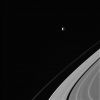
Mimas-N00025980.jpgMimas and Saturn57 visiteLe immagini che ci capita quotidianamente di esaminare sono, a nostro avviso, sempre bellissime. E non ci riferiamo soltanto alla loro "qualità intrinseca", ovviamente (a volte, anzi, è proprio essa a mancare, vuoi perchè l'immagine è sfuocata, vuoi perchè è sotto o sovra-esposta etc.): ci riferiamo alla "qualità del loro contenuto". Pensateci bene: molti pensano che, dopo aver visto 100, o 1000 o anche 10000 frames provenienti dallo Spazio, anche gli Anelli di Saturno possono venire a noia o sembrare banali: in fondo si tratta SEMPRE dello stesso soggetto, ripreso migliaia di volte... Ebbene, la bellezza ed il fascino del nostro lavoro sta proprio in questo: secondo noi, infatti, non esistono neppure due foto provenienti dallo Spazio (Marte, Giove, Urano oppure Saturno e le sue tante Lune) che siano davvero identiche. Molte immagini possono sembrarlo; tante immagini sono simili, ma due immagini uguali non le troverete mai. E' per questo che il viaggio che abbiamo intrapreso è meraviglioso...Dic 23, 2004
|
|

Pulsar 3c58.jpg3C58 Pulsar69 visite"There are no such things as facts: only interpretations"
Friedrich NietzscheDic 23, 2004
|
|

M-096-1.jpgM 96 - Spiral Galaxy66 visite"...Arrendersi, se ci pensi attentamente, è quanto di più difficile possa chiedersi ad un Uomo..."
P.C. Floegers - "Conversations"Dic 22, 2004
|
|

EROS-PIA02493_modest.jpgSunset on Eros61 visiteEros' irregular shape gives rise to some stunning vistas at the time of sunrise or sunset. On March 6, 2000, the imager on the NEAR Shoemaker spacecraft caught this view of a stunning sunset. In the pitch black foreground the Sun has already set, but just over the horizon another part of the asteroid remains lit. Eros' rotation period is just 5 hours, 16 minutes, so in the course one 24-hour Earth day an observer on Eros would be treated to four full cycles of sunrises and sunsets.Dic 22, 2004
|
|

EROS-PIA02901_modest.jpgCraters on the limb of Eros60 visiteIn this image, taken April 17, 2000, from a height of 101 Km (63 miles), the shadows highlight small-scale surface features. The surface is pockmarked with craters ranging in size up to the 2,8 Km (1,74 mile) diameter crater in the center of the image. The smallest craters which can be resolved are about 20 meters (65 feet) across. In lower right corner of the image, 20-meter boulders can be seen that were not evident in images from higher altitudes.Dic 22, 2004
|
|

EROS-PIA02906_modest.jpgHorizon view62 visiteThis image of Eros, taken from the NEAR Shoemaker spacecraft on May 2, 2000, from an orbital altitude of 52 kilometers (32 miles), shows a view toward Eros' horizon. The section shown is about 1.8 kilometers (1.1 miles) across. This particular view provides a snapshot of three of the most common types of features seen on the asteroid: craters whose rims have been rounded by erosion due to smaller impacts and blanketing by the impact debris, or regolith (impact debris); variations in the brightness of material on the walls of the craters; and a scattering of boulders ranging in size from nearly 100 meters (328 feet) down to about 8 meters (26 feet).Dic 22, 2004
|
|

EROS-PIA02907_modest.jpgA strange drawing made by lights and shadows...64 visiteEros' irregular shape creates interesting and beautiful scenes where the Sun shines obliquely on the surface. In the absence of an atmosphere, and hence no secondary illumination reflecting from atmospheric molecules, shade appears nearly as black as space. This image, taken from the NEAR Shoemaker spacecraft on May 2, 2000, from an orbital altitude of 50 kilometers (31 miles), shows one of the more telling and yet comical combinations of light and shadow. The entire scene is about 1.8 kilometers (1.1 miles) across. High spots near the edges of shadows, like the 35-meter (115-foot) diameter boulder just below the center of the frame, seem almost to "float" above the surface. With a little imagination, the shadow dominating the right side of the frame could be seen as a small, long-eared terrier bending over to sniff his dinner!Dic 22, 2004
|
|

Timeline-PIA07142_modest.jpgThe "Timeline" of the Universe...129 visiteThis artist's conception illustrates the decline in our universe's birth-rate over time. When the universe was young, massive galaxies were forming regularly, like baby bees in a bustling hive. In time, the universe bore fewer and fewer "offspring," and newborn galaxies (white circles) matured into older ones more like our own Milky Way (spirals). Previously, astronomers thought that the universe had ceased to give rise to massive, young galaxies, but findings from NASA's Galaxy Evolution Explorer suggest that may not be the case. Surveying thousands of nearby galaxies with its highly sensitive ultraviolet eyes, the telescope spotted three dozen that greatly resemble youthful galaxies from billions of years ago. In this illustration, those galaxies are represented as white circles on the right, or "today" side of the timeline.Dic 22, 2004
|
|
| 25353 immagini su 2113 pagina(e) |
 |
|
|
|
|
1894 | |
|
|
|
|





