| Ultimi arrivi |
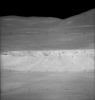
APOLLO 16 AS 16 112-18247.jpgAS 16-112-18247 - South Ray Crater109 visiteFrame from Charlie Duke's 500-mm mini-pan of South Ray Crater. Gen 05, 2005
|
|

APOLLO 16 AS 16 109-17792.jpgAS 16-109-17792 (HD) - Lunar Rover near Plum Crater (5)113 visiteFrame from Charlie Duke's 1st Station 1 pan. Rightward of 17791. Shows slope down into Plum Crater at the right.Gen 05, 2005
|
|

APOLLO 16 AS 16 109-17791.jpgAS 16-109-17791 (HD) - Lunar Rover near Plum Crater (4)118 visiteFrame from Charlie Duke's 1st Station 1 pan. Rightward of 17790. In the distance, we can see the raised rim of South Ray Crater. Note that the rim crest to rim crest distance is about one fiducial spacing. South Ray Crater is about 700 meters in diameter and is about 5.5 Km south of their present location at Flag Crater. On the far rim of Plum Crater, note the partially buried boulder, which John and Charlie will sample after they finish their work near the Rover.
This is the boulder that Charlie Duke mentions at 123:27:36 MCT.Gen 05, 2005
|
|

APOLLO 16 AS 16 109-17790~0.jpgAS 16-109-17790 (HD) - Lunar Rover near Plum Crater (3)136 visiteThis frame from Charlie Duke's first Station 1 pan shows the east wall of Plum Crater and, in the distance, the white ejecta of South Ray Crater. At high-resolution, the images shows details of the South Ray rim profile. Gen 05, 2005
|
|

APOLLO 16 AS 16 109-17769.jpgAS 16-109-17769 - Craters panorama155 visiteTraverse photo taken on the way to Station 1. An examination of Figure 6-15 in the Apollo 16 Preliminary Science Report indicates that this picture shows an unnamed crater immediately south of Halfway Crater. Note the tell-tale dimple crater in the south rim. Note, also, the footprints at the front of the Rover, a clear indication that they stopped so that one of them could get off and take a look at the crater.Gen 05, 2005
|
|

APOLLO 16 AS 16 107-17442.jpgAS 16-107-17442 - The landing pad (clean, as usual...)158 visiteClose-up of the landing pad (perfectly clean...) and detail of the Cosmic Ray experiment. Gen 05, 2005
|
|
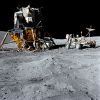
APOLLO 16 AS 16 107-17436.jpgAS 16-107-17436 - The landing area195 visiteThis frame is part of a pan that Charlie Duke took at the start of EVA-2. It shows the LM, MESA, Rover. John is beyond the Rover collecting a rock sample. On the left side of the image, as shown in a detail, we see the empty Quad III Payload Pallet compartment where the UV camera was stowed. The thermal blanket that covered the compartment hangs down from the bottom. As indicated on page 194 of the Final Lunar Surface Procedures document, the LRV Aft Pallet was stowed to the left of the Payload Pallet. Gen 05, 2005
|
|

APOLLO 16 AS 16 106-17403.jpgAS 16-106-17403 - Stone Mountain124 visiteView toward Stone Mountain from Charlie Duke's Station 13 pan.Gen 05, 2005
|
|

Dunes-PIA07152-00.jpgDark Dunes and Yardangs inside Herschel Crater (Original NASA/MGS/MSSS b/w Frame)78 visiteImmagine ripresa dal Mars Global Surveyor (MGS) Mars Orbiter Camera (MOC) che ci mostra Dune di colore scuro, scolpite dal vento, che giacciono sul fondo del Cratere Herschel. La superficie di queste Dune sembra caratterizzarsi per il fatto che ci appaiono - anche da una notevole distanza... - consistenti fessure scavate al loro interno. Questo sta a significare che la sabbia che le forma NON è semplicemente "accatastata" (ma, granuloscopicamente parlando, "libera"), così come accade per la maggior parte delle Dune Terrestri! Questo fenomeno ci dice che la sabbia di queste Dune Marziane è "cementata e compatta", simile a roccia (fragile, ma pur sempre roccia), e l'azione costante dei venti, nel tempo, ha creato, su queste sabbie "indurite", delle particolari "aree erose" che sono conosciute come Yardangs. L'immagine copre un'area di circa 3 Km (1,9 miglia) la quale si trova vicino ai 15,6° di Latitudine Sud ed ai 229,0° di Longitudine Ovest. Il Sole illumina la scena dalla Sn, in alto.Gen 05, 2005
|
|

North_Polar_Features-Chasma_Boreale-PIA07195-00-PCF-LXTT.jpgFeatures of Chasma Boreale (Original NASA/MGS/MSSS b/w Frame) 98 visiteCaption NASA originale:"This Mars Global Surveyor (MGS) Mars Orbiter Camera (MOC) image shows dark Sand Dunes in the North Polar Region of Mars. They are streaming away (toward the left) from a low escarpment at the edge of an outlier of Polar Water Ice (the bright area on the right). The picture covers an area about 3 Km (1.9 mi) wide and is located near 80,7° North Lat. and 80,2° West Long.. Sunlight illuminates the scene from the lower left". Gen 05, 2005
|
|

Comets-Comet_Machholz.jpgComet Machholz76 visiteDa "NASA - Picture of the Day" del 5 Gennaio 2005:"Good views of Comet Machholz are in store for northern hemisphere comet watchers in January. Now making its closest approach to planet Earth, the comet will pass near the lovely Pleiades star cluster on January 7th and the double star cluster in Perseus on January 27th as Machholz moves relatively quickly through the evening sky. Currently just visible to the unaided eye from dark locations, the comet should be an easy target in binoculars or a small telescope. In fact, this telephoto time exposure from January 1, shows Comet Machholz sporting two lovely tails in skies over Colorado, USA. Extending to the left, strands of the comet's ion or gas tail are readily affected by the solar breeze and point away from the Sun. Dust, which tends to trail along the comet's orbit, forms the tail jutting down and to the right".Gen 05, 2005
|
|

OPP-SOL335-1P157922265EFF40B8P2364R1M1.jpgThe Heat-Shield - Sol 33563 visitenessun commentoGen 04, 2005
|
|
| 25353 immagini su 2113 pagina(e) |
 |
|
|
|
|
1886 | |
|
|
|
|





