| Ultimi arrivi |
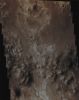
Chaotic_Terrain-Jani_Chaos-2-PIA03200-PCF-LXTT.jpgFeatures of Iani Chaos (Natural Colors; credits for the additional process. and color: Dr Paolo C. Fienga - Lunexit Team)139 visiteImage information: VIS instrument;
Latitude: 2,3° South;
Longitude: 342,3° East;
Resolution: 17 meter/pixel.
MareKromiumSet 18, 2011
|
|

Hills_with_Snow-MGS-PCF-LXTT.jpgWould you like to ski on Mars? (Natural Colors; credits for the additional process. and color.: Dr Paolo C. Fienga - Lunexit Team)194 visiteUna fantastica ripresa effettuata dalla Sonda MGS ci permette di vedere degli abbondanti depositi di neve (o di qualcosa che alla neve assomiglia davvero moltissimo) sui fianchi di alcune colline Marziane. Non c'è nulla di scientifico nel desiderio di dare un'occhiata da vicino a questi pendii innevati: Scienza è anche Curiosità e, come già dicemmo in passato, Bellezza. L'idea di passeggiare (o anche di sciare, perchè no?...) alle pendici di una montagna di Marte che giace, parzialmente ricoperta di neve, in uno spesso ed inviolabile silenzio, la troviamo splendidamente affascinante. Chissà se, un giorno, una simile passeggiata potrà essere davvero possibile e chissà chi sarà il primo Uomo (o la prima Donna) a farla...MareKromiumSet 17, 2011
|
|

Hills-Utopia_Planitia-PCF-LXTT.jpgBouldery Hill in Utopia Planitia (Natural Colors; credits for the additional process. and color: Dr Paolo C. Fienga - Lunexit Team)160 visiteCaption NASA originale:"Boulders are one of the possible keys to determining which processes have eroded, transported and deposited material on Mars (i.e.: Landslides, Mudflows, Flood Debris etc.).
During the first year in orbit, MGS-MOC obtained pictures with resolutions between 2 and 30 mt per pixel. It was found that Boulders are difficult to identify on Mars in images with resolutions worse than about 2-3 meters per pixel. Some rather larger Boulders (larger than about 10 mt in size) have already been seen on Mars by the orbiting camera.
This is a feat similar to that which can be obtained by "spy" satellites on Earth. The MOC image 53104 subframe shown here features a low, rounded Hill in South/Eastern Utopia Planitia. Each of the small, lumpy features on the top of this Hill is a Boulder.
In this picture, Boulders are not seen on the surrounding Plain. These Boulders are interpreted to be the remants of a layer of harder rock that once covered the top of the Hill, but was subsequently eroded and broken up by weathering and wind processes".MareKromiumSet 17, 2011
|
|

North_Polar_Features-North_Polar_Margin-Chasma_Boreale-PIA07052-PCF-LXTT.jpgNorth Polar "Scarp" (Absolute Natural Colors; credits for the additional process. and color.: Dr Paolo C. Fienga - Lunexit Team)247 visiteCaption NASA:"This 1,6 meters (~5 feet) per pixel Mars Global Surveyor (MGS) Mars Orbiter Camera (MOC) image shows a typical North Polar Scarp and associated dark windblown Sand Dunes. Layers of material -- possibly Dust and Ice -- are exposed by the Scarp. The small white patches in the image are remnants of seasonal Frost. When this North Polar image was acquired in late September 2004, most of the Polar Frost had sublimed away. This image is located near 85,1° North Lat. and 210,8°West Longitude. The scene covers an area of approximately 3 Km (about 1,9 mi) across, and is illuminated by sunlight from the lower left.MareKromiumSet 17, 2011
|
|

Craters-Briault_Crater-Dunefield-PIA14775-PCF-LXTT.jpgDunefield inside Briault Crater (Over-Saturated Natural Colors; credits for the additional process. and color.: Dr Paolo C. Fienga - Lunexit Team)191 visiteOrbit Number: 42778;
Latitude: 10,0474° South;
Longitude: 89,6182° East;
Instrument: VIS;
Captured: August, 6th, 2011
Mars Local Time (M.L.T.): 14:24 (Early Afternoon)
MareKromiumSet 17, 2011
|
|
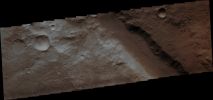
Channels-Ma_adim_Valles-PIA14774-PCF-LXTT.jpgFeatures of Ma'adim Vallis (Absolute Natural Colors; credits for the additional process. and color.: Dr Paolo C. Fienga - Lunexit Team) 188 visiteOrbit Number: 42750;
Latitude: 16,335° South;
Longitude: 176,371° East;
Instrument: VIS;
Captured: August, 4th, 2011
Mars Local Time (M.L.T.): 07:06 (Early Morning Hours)
MareKromiumSet 17, 2011
|
|
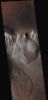
Landslides-Olympus_Mons-PIA07205-PCF-LXTT.jpgLandslide on the Northern Side of Olympus (Absolute Natural Colors; credits for the additional process. and color.: Dr Paolo C. Fienga - Lunexit Team)190 visiteCaption NASA:"The Landslide in this VIS image originated from the steep Escarpment which surrounds the Olympus Mons Volcano on Mars. This landslide is Located on the Northern Side of the Volcano".
Image information: VIS instrument;
Latitude: 23,2° North;
Longitude: 223,9° East (such as 136,1° West);
Resolution: 100 meter/pixel.
MareKromiumSet 17, 2011
|
|
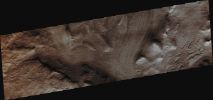
Channels-Reull_Vallis-PIA06957-PCF-LXTT-00.jpgFeatures of Reull Vallis (Absolute Natural Colors; credits for the additional process. and color.: Dr Paolo C. Fienga - Lunexit Team) 187 visiteImage information: VIS instrument;
Latitude 42,5° South;
Longitude: 103,2° East (such as 256,8° West);
Resolution: 19 meter/pixel.
MareKromiumSet 16, 2011
|
|
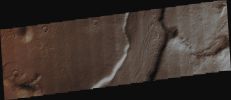
Channels-Reull_Vallis-PIA06951-PCF-LXTT-00.jpgFeatures of Reull Vallis (Absolute Natural Colors; credits for the additional process. and color.: Dr Paolo C. Fienga - Lunexit Team) 186 visiteImage information: VIS instrument;
Latitude 41,8° South;
Longitude: 106,0° East (such as 254,0° West);
resolution: 19 meter/pixel.
MareKromiumSet 16, 2011
|
|

Channels-Reull_Vallis-PIA06948-PCF-LXTT-00.jpgFeatures of Reull Vallis (Absolute Natural Colors; credits for the additional process. and color.: Dr Paolo C. Fienga - Lunexit Team) 191 visiteCaption NASA:"Reull Vallis is located in the Martian Southern Highlands, just East of Hellas Basin. This extensive Channel System records an interesting fluvial and mass wasting geologic history of the area. In many images show interesting patterns of mass wasted material in the bottom of the Channel".
Image information: VIS instrument;
Latitude: 41,1° South:
Longitude 100,3° East (such as 259,7° West);
Resolution: 19 meter/pixel.
MareKromiumSet 16, 2011
|
|

OPP-SOL2709-PIA14752-PCF-LXTT.jpg"Chester Lake" - Sol 2709 (Natural Colors; credits for the additional process. and color.: Dr Paolo C. Fienga - Lunar Explorer Italia)135 visiteCaption NASA:"An Outcrop informally named "Chester Lake" is the second rock on the Rim of Endeavour Crater to be approached by NASA's MER Opportunity for close inspection with instruments on the Rover's R.A. This view of Chester Lake combines images taken during the 2709th Martian Day, or Sol, of Opportunity's work on Mars (such as Sept., 7th, 2011).
Chester Lake is about 3 feet (1 meter) across. It lies on the inboard (South/Eastern) side of a low ridge, "Cape York", which forms a portion of the Western Rim of Endeavour Crater. Rover team scientists chose it for inspection because it is in-place bedrock that appears to be representative of a region of Outcrops on the inboard side of Cape York.
Chester Lake differs from the first rock inspected by Opportunity on the Endeavour Rim, "Tisdale 2", which is a Boulder excavated during an impact event that produced a small crater on the Rim. Both rocks appear to be "Breccia", a type of rock fusing together broken fragments of older rocks.
By Sol 2713 (Sept. 11, 2011), researchers had used Opportunity's Microscopic Imager and Alpha Particle X-Ray Spectrometer to study Chester Lake and were planning to use the Rover's RAT (Rock Abrasion Tool) and, possibly, its Moessbauer Spectrometer on the rock. They will use all the data to reconstruct the chemistry, mineralogy and geologic setting of Chester Lake, including evidence about whether or not the rock has any clay minerals in its composition".MareKromiumSet 16, 2011
|
|

Craters-Unnamed_Crater-PIA07202-PCF-LXTT.jpgUnnamed Crater with Pedestal (Absolute Natural Colors; credits for the additional process. and color.: Dr Paolo C. Fienga - Lunar Explorer Italia)237 visiteThis Mars Global Surveyor (MGS) Mars Orbiter Camera (MOC) image shows an Unnamed Impact Crater, a little over 2 Km (> 1,2 mi) in diameter, located in Noachis Terra near 50,4° South and 14,3° West. The Crater's Bouldery Ejecta Blanket has protected underlying material from being eroded away by wind, leaving the Ejecta up on a low Pedestal. This picture covers an area about 3 Km (approx. 1,9 miles) across, and is illuminated by sunlight from the lower left.MareKromiumSet 16, 2011
|
|
| 25353 immagini su 2113 pagina(e) |
 |
|
|
|
|
179 | |
|
|
|
|





