| Ultimi arrivi |

ESP_023322_1390_RED_abrowse-PCF-LXTT.jpgFeatures of Avire Crater (Absolute Natural Colors; credits for the additional process. and color.: Dr Paolo C. Fienga - Lunexit Team) 240 visiteMars Local Time: 14:15 (Early Afternoon)
Coord. (centered): 40,8° South Lat. and 200,3° East Long.
Spacecraft altitude: 254,5 Km (such as about 159,1 miles)
Original image scale range: 50,9 cm/pixel (with 2 x 2 binning) so objects ~ 1 mt and 53 cm across are resolved
Map projected scale: 50 cm/pixel
Map projection: EQUIRECTANGULAR
Emission Angle: 0,5°
Sun-Mars-Spacecraft (or "Phase") Angle: 41,8°
Solar Incidence Angle: 41° (meaning that the Sun is about 49° above the Local Horizon)
Solar Longitude: 330,2° (Northern Winter)
Credits: NASA/JPL/University of Arizona
Additional process. and coloring: Dr Paolo C. Fienga - Lunar Explorer ItaliaMareKromiumOtt 01, 2011
|
|
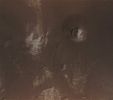
Chaotic_Terrain-Eos_Chaos-01.jpgFeatures of Eos Chaos: Circular Butte (Natural Colors; credits for the additional process. and color.: Dr Paolo C. Fienga - Lunexit Team)227 visiteLocation near: 12,9° South Lat. and 49,5° West Long.
Image width: ~3 Km (~1,9 mi)
Illumination from: lower left
Season: Southern SummerMareKromiumOtt 01, 2011
|
|

Chaotic_Terrain-Eos_Chaos-04.jpgFeatures of Eos Chaos: High Slope (Natural Colors; credits for the additional process. and color.: Dr Paolo C. Fienga - Lunexit Team)212 visiteLocation near: 12,9° South Lat. and 49,5° West Long.
Image width: ~3 Km (~1,9 mi)
Illumination from: lower left
Season: Southern SummerMareKromiumOtt 01, 2011
|
|

ESP_024015_1775_RED_abrowse-01-PCF-LXTT.jpgOpportunity at the Rim of Endeavour's Crater (EDM - Absolute Natural Colors; credits for the additional process. and color.: Dr Paolo C. Fienga - Lunexit Team) 221 visiteMars Local Time: 14:14 (Early Afternoon)
Coord. (centered): 2,3° South Lat. and 354,6° East Long.
Spacecraft altitude: 269,7 Km (such as about 168,5 miles)
Original image scale range: 27,0 cm/pixel (with 1 x 1 binning) so objects ~ 81 cm across are resolved
Map projected scale: 25 cm/pixel
Map projection: EQUIRECTANGULAR
Emission Angle: 5,7°
Sun-Mars-Spacecraft (or "Phase") Angle: 39,3°
Solar Incidence Angle: 34° (meaning that the Sun is about 56° above the Local Horizon)
Solar Longitude: 358,6° (Northern Winter)
Credits: NASA/JPL/University of Arizona
Additional process. and coloring: Dr Paolo C. Fienga - Lunar Explorer ItaliaMareKromiumOtt 01, 2011
|
|

ESP_024015_1775_RED_abrowse-00-PCF-LXTT.jpgOpportunity at the Rim of Endeavour's Crater (CTX Frame - Absolute Natural Colors; credits for the additional process. and color.: Dr Paolo C. Fienga - Lunexit Team) 222 visiteMars Local Time: 14:14 (Early Afternoon)
Coord. (centered): 2,3° South Lat. and 354,6° East Long.
Spacecraft altitude: 269,7 Km (such as about 168,5 miles)
Original image scale range: 27,0 cm/pixel (with 1 x 1 binning) so objects ~ 81 cm across are resolved
Map projected scale: 25 cm/pixel
Map projection: EQUIRECTANGULAR
Emission Angle: 5,7°
Sun-Mars-Spacecraft (or "Phase") Angle: 39,3°
Solar Incidence Angle: 34° (meaning that the Sun is about 56° above the Local Horizon)
Solar Longitude: 358,6° (Northern Winter)
Credits: NASA/JPL/University of Arizona
Additional process. and coloring: Dr Paolo C. Fienga - Lunar Explorer ItaliaMareKromiumOtt 01, 2011
|
|

Craters-Kunowsky_Crater-2004_06-PCF-LXTT.jpgFrost and Wavy Clouds on Kunowsky Crater (Absolute Natural Colors; credits for the additional process. and color.: Dr Paolo C. Fienga - Lunexit Team)209 visiteCaption NASA originale:"This red wide angle MGS-MOC image, acquired in March 2004, shows Kunowsky Crater ringed by seasonal Frost. Kunowsky Crater is about 67 Km (~42 mi) in diameter. Wavy Clouds form to the East of the Crater in early Spring as winds circulate from West to East. The Crater is located at about 57,1° North Lat. and 9,7° West Long.". MareKromiumSet 30, 2011
|
|

Craters-Benedictus_XVI_Crater-PIA07838-PCF-LXTT.jpgImpact Crater with Frost Deposits (Benedictus XVI Crater - Absolute Natural Colors; credits for the additional process. and color.: Dr Paolo C. Fienga - Lunexit Team) 196 visiteLocation near: 37,5° South Lat. and 222,1° West Long.
Image width: ~3 Km (~1,9 mi)
Illumination from: upper left
Season: Southern WinterMareKromiumSet 30, 2011
|
|
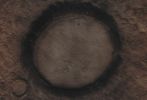
Craters-Unnamed_Impact_Crater-PIA07836-PCF-LXTT.jpgUnnamed Impact Crater wth "Black Rim" in Vastitas Borealis (Absolute Natural Colors; credits for the additional process. and color.: Dr Paolo C. Fienga - Lunexit Team)219 visiteCaption NASA originale:"This MGS-MOC image shows a nearly-filled (and very old) impact crater on the Northern Plains".
Location near: 47,3° North Lat. and 294,0° West Long.
Image width: ~3 Km (~1,9 mi)
Illumination from: lower left
Season: Northern Summer MareKromiumSet 30, 2011
|
|

North_Polar_Features-Dunes-Dark_Dunes-PCF-LXTT.jpgDark Dunes in Vastitas Borealis (Absolute Natural Colors; credits for the additional process. and color.: Dr Paolo C. Fienga - Lunexit Team)184 visiteCaption NASA originale:"This MGS-MOC image shows dark North Polar Dunes overlying other materials in the North Polar Region".
Location near: 79,1° North Lat. and 228,8° West Long.
Image width: ~3 Km (~1,9 mi)
Illumination from: lower left
Season: Northern SummerMareKromiumSet 30, 2011
|
|

Chasmas-Melas_Chasma-08.jpgSample scarp edge in layered unit in Melas Chasma or... Frozen Waterfalls on Mars? (7 - Natural Colors; credits for the additional process. and color.: Dr Paolo C. Fienga - Lunexit Team)226 visitenessun commentoMareKromiumSet 29, 2011
|
|
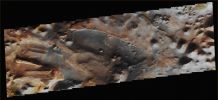
Chaotic_Terrain-Aureum_Chaos-PIA07931-PCF-LXTT-01.jpgFeatures of Aureum Chaos (Extremely Enhanced Natural Colors; credits for the additional process. and color.: Dr Paolo C. Fienga - Lunexit Team)189 visiteNote: the THEMIS VIS camera is capable of capturing color images of the Martian Surface using 5 different color filters. In this mode of operation, the spatial resolution and coverage of the image must be reduced to accommodate the additional data volume produced from using multiple filters. To make a color image, 3 of the 5 filter images (each in grayscale) are selected. Each is contrast enhanced and then converted to a red, green, or blue intensity image.
These 3 images are then combined to produce a full color, single image BUT, since the THEMIS color filters DO NOT span the full range of colors seen by the human eye, a color THEMIS image DOES NOT represent true color. Also, because each single-filter image is contrast enhanced before inclusion in the 3-color image, the apparent color variation of the scene is exaggerated. Nevertheless, the color variation that does appear is representative of some change in color, however subtle, in the actual scene. The long edges of THEMIS color images typically contain color artifacts that do not represent or imply actual Surface Variations.
Image information: VIS instrument;
Latitude 3,6° South;
Longitude 332,9° East (such as 27,1° West);
Resolution: 35 meter/pixel.MareKromiumSet 29, 2011
|
|
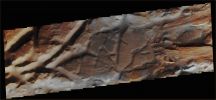
Chaotic_Terrain-Aureum_Chaos-PIA07932-PCF-LXTT.jpgFeatures of Aureum Chaos (Extremely Enhanced Natural Colors; credits for the additional process. and color.: Dr Paolo C. Fienga - Lunexit Team)189 visiteNote: the THEMIS VIS camera is capable of capturing color images of the Martian Surface using 5 different color filters. In this mode of operation, the spatial resolution and coverage of the image must be reduced to accommodate the additional data volume produced from using multiple filters. To make a color image, 3 of the 5 filter images (each in grayscale) are selected. Each is contrast enhanced and then converted to a red, green, or blue intensity image.
These 3 images are then combined to produce a full color, single image BUT, since the THEMIS color filters DO NOT span the full range of colors seen by the human eye, a color THEMIS image DOES NOT represent true color. Also, because each single-filter image is contrast enhanced before inclusion in the 3-color image, the apparent color variation of the scene is exaggerated. Nevertheless, the color variation that does appear is representative of some change in color, however subtle, in the actual scene. The long edges of THEMIS color images typically contain color artifacts that do not represent or imply actual Surface Variations.
Image information: VIS instrument;
Latitude 3,6° South;
Longitude 332,9° East (such as 27,1° West);
Resolution: 35 meter/pixel.MareKromiumSet 29, 2011
|
|
| 25353 immagini su 2113 pagina(e) |
 |
|
|
|
|
174 | |
|
|
|
|





