| Ultimi arrivi |
Dunes-Brashear_Crater-PIA03656-01.jpgDark Dunes on Brashear Crater's Floor (Absolute Natural Colors; credits for the additional process. and color.: Dr Paolo C. Fienga - Lunexit Team)149 visitenessun commentoMareKromiumOtt 14, 2011
|
|
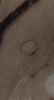
Craters-Unnamed_Crater-Deuteronilus_Mensae-PIA08472-01.jpgAlmost Buried Unnamed Crater in Deuteronilus Mensae (Absolute Natural Colors; credits for the additional process. and color.: Dr Paolo C. Fienga - Lunexit Team)136 visiteCaption NASA originale:"This Unnamed Crater appears to be in the process of being covered over by downslope movement of material. These large slopes of material are common in Deuteronilus Mensae".
Image information: VIS instrument;
Latitude: 41,1° North;
Longitude: 17,8° East;
Resolution: 19 meter/pixel. MareKromiumOtt 14, 2011
|
|

Craters-Becquerel_Crater-Layers-01.jpgBeautiful Layers inside Becquerel Crater: Human Vision (Absolute Natural Colors; credits for the additional process. and color.: Dr Paolo C. Fienga - Lunexit Team)154 visiteOriginal caption:"This MGS-MOC image shows light-toned, layered, Sedimentary Rock Outcrops in Becquerel Crater , located in the Western Arabia Terra Region. The Crater may once have hosted a lake, into which these sediments were deposited. Although the fine, detailed layering in Becquerel was not known until the MGS-MOC first began to image these materials in 1999, the presence of a grossly-layered, light-toned feature was known from Viking orbiter images and was speculated from those data to possibly represent evidence for the presence of a former lake".
Location near: 21,5° North Lat. and 8,2° West Long.
Image width: ~3 Km (~1,9 mi)
Season: Northern Winter MareKromiumOtt 14, 2011
|
|

Craters-Becquerel_Crater-Layers-02.jpgBeautiful Layers inside Becquerel Crater: Camera Vision (Absolute Natural Colors; credits for the additional process. and color.: Dr Paolo C. Fienga - Lunexit Team)157 visiteOriginal caption:"This MGS-MOC image shows light-toned, layered, Sedimentary Rock Outcrops in Becquerel Crater , located in the Western Arabia Terra Region. The Crater may once have hosted a lake, into which these sediments were deposited. Although the fine, detailed layering in Becquerel was not known until the MGS-MOC first began to image these materials in 1999, the presence of a grossly-layered, light-toned feature was known from Viking orbiter images and was speculated from those data to possibly represent evidence for the presence of a former lake".
Location near: 21,5° North Lat. and 8,2° West Long.
Image width: ~3 Km (~1,9 mi)
Season: Northern Winter MareKromiumOtt 14, 2011
|
|

Aeolian_Features-Windstreaks-Chrise_Planitia-MGS-01.jpgWindstreaks in Chryse Planitia (Natural Colors; credits for the additional process. and color.: Dr Paolo C. Fienga - Lunexit Team)190 visiteCaption NASA originale:"This MGS-MOC image shows two Unnamed Impact Craters of nearly equal size, plus their associated Windstreaks. These occur in far Eastern Chryse Planitia. The Wind streaks point toward the South-West, indicating that the responsible Winds blew from the North-East. One of the two craters is shallower than the other and has a suite of large, windblown Ripples on its Floor. The shallower Unnamed Crater with the Ripples is probably older than the other, deeper Unnamed Crater".
Location near: 20,6° North Lat. and 30,1° West Long.
Image width: ~3 Km (~1,9 mi)
Illumination from: lower left
Season: Northern Winter MareKromiumOtt 12, 2011
|
|

Channels-Inverted_Channels_in_Arabia_Terra-PIA03643-01.jpgInverted channels of Arabia Terra (1 - Natural Colors; credits for the additional process. and color.: Dr Paolo C. Fienga - Lunexit Team)155 visiteOriginal caption:"This MGS-MOC image shows a somewhat sinuous, nearly flat-topped Ridge, located in Eastern Arabia Terra. The ridgetop was once the Floor of a Valley, perhaps carved by running water. The Valley Floor, or material that covered the Floor, was more resistant to erosion than the surrounding rock into which the Valley was cut. Thus, over time, the Valley disappeared and its Floor was left standing high as a Ridge. Inverted Valleys are common on Mars, but they also occur on Earth".
Location near: 10,8° North Lat. and 313,2° West Long.
Image width: width: ~3 Km (~1,9 mi)
Illumination from: lower left
Season: Northern WinterMareKromiumOtt 12, 2011
|
|

Channels-Inverted_Channels_in_Arabia_Terra-PIA03643-04.jpgInverted channels of Arabia Terra (2 - Natural Colors; credits for the additional process. and color.: Dr Paolo C. Fienga - Lunexit Team)155 visiteOriginal caption:"This MGS-MOC image shows a somewhat sinuous, nearly flat-topped Ridge, located in Eastern Arabia Terra. The ridgetop was once the Floor of a Valley, perhaps carved by running water. The Valley Floor, or material that covered the Floor, was more resistant to erosion than the surrounding rock into which the Valley was cut. Thus, over time, the Valley disappeared and its Floor was left standing high as a Ridge. Inverted Valleys are common on Mars, but they also occur on Earth".
Location near: 10,8° North Lat. and 313,2° West Long.
Image width: width: ~3 Km (~1,9 mi)
Illumination from: lower left
Season: Northern WinterMareKromiumOtt 12, 2011
|
|

Craters-Unnamed_Craters-Utopia_Planitia-01.jpgOld Buried Unnamed Craters in Northern Utopia Planitia (Natural Colors; credits for the additonal process. and color.: Dr Paolo C. Fienga - Lunexit Team)168 visiteOriginal caption:"This MGS-MOC image shows 2 circular features on the Plains of Northern Utopia. A common sight on the Martian Northern Plains, these rings indicate the locations of Buried Impact Craters".
Location near: 65,1° North Lat. and 261,2° West Long.
Image width: ~2 Km (~1,2 mi)
Illumination from: lower left
Season: Northern SummerMareKromiumOtt 12, 2011
|
|

OPP-SOL2680-PIA14759-PCF-LXTT.jpgApproaching Endeavour - Sol 2680 (Absolute Natural Colors; credits for the additional process. and color.: Dr Paolo C. Fienga - Lunexit Team)192 visitenessun commentoMareKromiumOtt 11, 2011
|
|

Enceladus-PIA14858-PCF-LXTT.jpgFountains of Light (Absolute Natural Colors; credits for the additional process. and color.: Dr Paolo C. Fienga - Lunexit Team) 154 visiteCaption NASA:"NASA's Cassini Spacecraft successfully completed its Oct. 1st Fly-By of Saturn's moon Enceladus and its Jets of Water Vapor and Ice. At its closest approach, the Spacecraft flew approx. 62 miles (about 100 Km) above the moon's Surface. The close approach was designed to give some of Cassini's instruments, including the Ion and Neutral Mass Spectrometer, the chance to "taste" the Jets themselves.
At a higher vantage point during the encounter, Cassini's high-resolution camera captured pictures of the jets emanating from the moon's South Polar Region. The latest raw images of Enceladus are online at:
http://saturn.jpl.nasa.gov/photos/raw/.
The images of the Surface include previously seen Leading-Hemisphere Terrain. However, during this encounter, multi-spectral imaging of these Terrains extended farther into the UV Region of the Spectrum than had previously been achieved at this resolution.
By looking at the Surface at UV wavelengths, scientists can better detect the difference between surface materials and shadows than they can at visible wavelengths, where icy materials are highly reflective and shadows are washed out. With both UV and Visible Light images of the same Terrain available to them, scientists will better understand how the Surface coverage of icy particles coming from the Vents and Plumes changes with Terrain type and age. Cassini's next pass of this fascinating moon will be Oct. 19, 2011, when the Spacecraft shall fly-by at an altitude of approximately 765 miles (such as about 1231 Km)".MareKromiumOtt 11, 2011
|
|
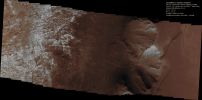
Landslide-Candor_Chasma-20091222a.jpgLandslide in Candor Chasma (Absolute Natural Colors; credits for the additional process. and color.: Dr Paolo C. Fienga - Lunexit Team)158 visitenessun commentoMareKromiumOtt 11, 2011
|
|

Craters-Spallanzani_Crater-MGS-01.jpgLayered "Mesa" inside Spallanzani Crater (Natural Colors; credits for the additional process. and color.: Dr Paolo C. Fienga - Lunexit Team)183 visiteCaption NASA originale:"This MGS-MOC image shows a layered, light-toned Mesa among other Layered Materials exposed in a mound that covers much of the Floor of Spallanzani Crater".
Location near: 58,3° South Lat. and 273,9° West Long.
Image width: ~3 Km (~1,9 mi)
Illumination from: upper left
Season: Southern Summer MareKromiumOtt 11, 2011
|
|
| 25353 immagini su 2113 pagina(e) |
 |
|
|
|
|
168 | |
|
|
|
|





