| Ultimi arrivi |

Dunes-PIA14880.gifDegrading North Polar Barchan-type Dune (a GIF-Movie by NASA/JPL-Caltech/Univ. of Ariz./JHUAPL)197 visitenessun commentoMareKromiumNov 19, 2011
|
|

Dunes-PIA14879.gifMoving Rippled Dune-Front in Hershel Crater (a GIF-Movie by NASA/JPL-Caltech/Univ. of Ariz./JHUAPL)186 visitenessun commentoMareKromiumNov 19, 2011
|
|

Dunes-PIA14877-PCF-LXTT.jpgRippled Dune-Front in Hershel Crater (Enhanced Absolute Natural Colors; credits for the additional process. and color.: Dr Paolo C. Fienga - Lunexit Team)200 visiteThe Eastern Margin of a Rippled Dune located inside Herschel Crater moved an average distance of 3 meters (such as about 3 yards) between March 3rd, 2007 and December 1st, 2010MareKromiumNov 19, 2011
|
|

Dunes-PIA14880-PCF-LXTT-1.jpgDegrading North Polar Barchan-type Dune (Absolute Natural Colors; credits for the additional process. and color.: Dr Paolo C. Fienga - Lunexit Team)190 visiteThis Dune, located in the North Polar Region of Mars, showed significant changes between two images taken on June 25th, 2008 and May 21st, 2010 and revealed Landslides and Sand advancing at the Dune-Front (upper left); changes in the position of the rest of the Dune Boundary relative to the fixed, underlying Terrain and changes in the position of the Ripples located on the Dune Surface.
MareKromiumNov 19, 2011
|
|

Dunes-PIA14876-PCF-LXTT.jpgRippled Patch of Sand in Becquerel Crater (Enhanced Absolute Natural Colors; credits for the additional process. and color.: Dr Paolo C. Fienga - Lunexit Team)184 visiteA Rippled Patch of Sand in Becquerel Crater on Mars moved about 2 meters (such as about 2 yards) between November 24th, 2006 and September 5th, 2010. Becquerel Crater is located just north of the equator in the Arabia Terra region.
MareKromiumNov 19, 2011
|
|

Dunes-PIA14879-PCF-LXTT.jpgMoving Rippled Dune-Front in Hershel Crater (Enhanced Absolute Natural Colors; credits for the additional process. and color.: Dr Paolo C. Fienga - Lunexit Team)191 visiteA Rippled Dune-Front in Herschel Crater on Mars moved an average of about 1 meter (such as about o1 yard) between March 3rd, 2007 and December 1st, 2010. Herschel Crater is located just South of the Equator, in the Cratered Highlands.
This is one of several sites where the MRO has observed shifting Sand Dunes and Ripples. Previously, scientists thought sand on Mars was mostly immobile. It took the mission's High Resolution Imaging Science Experiment (HiRISE) to take sharp enough images to finally see the movement. While Dust is easily blown around the Red Planet, its thin Atmosphere means that strong Winds are required to move Grains of Sand.MareKromiumNov 19, 2011
|
|

Dunes-PIA14878-PCF-LXTT.jpgMoving Rippled Dune-Front in Hershel Crater (Enhanced Absolute Natural Colors; credits for the additional process. and color.: Dr Paolo C. Fienga - Lunexit Team)191 visiteA Rippled Dune-Front in Herschel Crater on Mars moved about 2 meters (such as about 2 yards) between March 3rd, 2007 and December 1st, 2010. Herschel Crater is located just South of the Equator in the Cratered Highlands.
This is one of several sites where the orbiter has observed shifting Sand Dunes and Ripples. Previously, scientists thought sand on Mars was mostly immobile. It took the mission's High Resolution Imaging Science Experiment (HiRISE) to take sharp enough images to finally see the movement. While Dust is easily blown around the Red Planet, its thin Atmosphere means that strong Winds are required to move Grains of Sand.MareKromiumNov 19, 2011
|
|
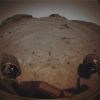
SOL694-2F187979065EFFAKDTP1201L0M1.jpgFront-View (1) - Sol 694 (Enhanced Absolute Natural Colors; credits for the additional process. and color.: Dr Paolo C. Fienga - Lunexit Team) 183 visiteOriginal caption:"Left Front Haz-Cam Non-linearized Full frame EDR acquired on Sol 694 of Spirit's mission to Gusev Crater at app.x 13:00:49 MLT". MareKromiumNov 18, 2011
|
|
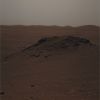
SOL694-2P187972203EFFAKBAP0050L7M1.jpgSpectacular Outcrop! (4) - Sol 694 (Absolute Natural Colors; credits for the additonal process. and color.: Dr Paolo C. Fienga - Lunar Explorer Italia)178 visiteOriginal caption:"Left Pan-Cam Non-linearized Full frame EDR acquired on Sol 694 of Spirit's mission to Gusev Crater at approx. 11:09:30 MLT. Camera commanded to use Filter 7 (432 nm)". MareKromiumNov 18, 2011
|
|
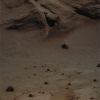
SOL694-2P187980990EFFAKE1P2421L2M1.jpgSpectacular Outcrop! (6) - Sol 694 (Absolute Natural Colors; credits for the additonal process. and color.: Dr Paolo C. Fienga - Lunar Explorer Italia)178 visiteOriginal caption:"Left Pan-Cam Non-linearized Full frame EDR acquired on Sol 694 of Spirit's mission to Gusev Crater at approx. 13:32:03 MLT. Camera commanded to use Filter 2 (753 nm)". MareKromiumNov 18, 2011
|
|
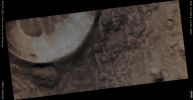
ESP_023814_1970_RED_abrowse.jpgPossible Olivine-Rich Terrain in Isidis Planitia Region (Natural Colors; credits for the additional process. and color.: Dr Paolo C. Fienga - Lunexit Team) 193 visiteMars Local Time: 14:08 (Early Afternoon)
Coord. (centered): 16,7° North Lat. and 80,1° East Long.
Spacecraft altitude: 279,9 Km (such as about 174,9 miles)
Original image scale range: 56,0 cm/pixel (with 2 x 2 binning) so objects ~ 1 mt and 68 cm across are resolved
Map projected scale: 50 cm/pixel
Map projection: EQUIRECTANGULAR
Emission Angle: 0,2°
Sun-Mars-Spacecraft (or "Phase") Angle: 38,0°
Solar Incidence Angle: 38° (meaning that the Sun is about 52° above the Local Horizon)
Solar Longitude: 350,6° (Northern Winter)
Credits: NASA/JPL/University of Arizona
Additional process. and coloring: Dr Paolo C. Fienga - Lunar Explorer ItaliaMareKromiumNov 18, 2011
|
|
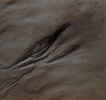
ESP_024241_1400_RED_abrowse.jpgGullies on Massif (Enhanced Absolute Natural Colors; credits for the additional process. and color.: Dr Paolo C. Fienga - Lunexit Team) 183 visiteMars Local Time: 14:31 (Early Afternoon)
Coord. (centered): 39,6° South Lat. and 310,7° East Long.
Spacecraft altitude: 252,2 Km (such as about 157,6 miles)
Original image scale range: 25,2 cm/pixel (with 1 x 1 binning) so objects ~ 76 cm across are resolved
Map projected scale: 25 cm/pixel
Map projection: EQUIRECTANGULAR
Emission Angle: 3,9°
Sun-Mars-Spacecraft (or "Phase") Angle: 52,7°
Solar Incidence Angle: 55° (meaning that the Sun is about 35° above the Local Horizon)
Solar Longitude: 7,3° (Northern Spring)
Credits: NASA/JPL/University of Arizona
Additional process. and coloring: Drr Gianluigi Barca and Paolo C. Fienga - Lunar Explorer ItaliaMareKromiumNov 18, 2011
|
|
| 25353 immagini su 2113 pagina(e) |
 |
|
|
|
|
148 | |
|
|
|
|





